VerbaFlo Is Building What Real Estate Always Lacked
By Smruthi Nadig ·
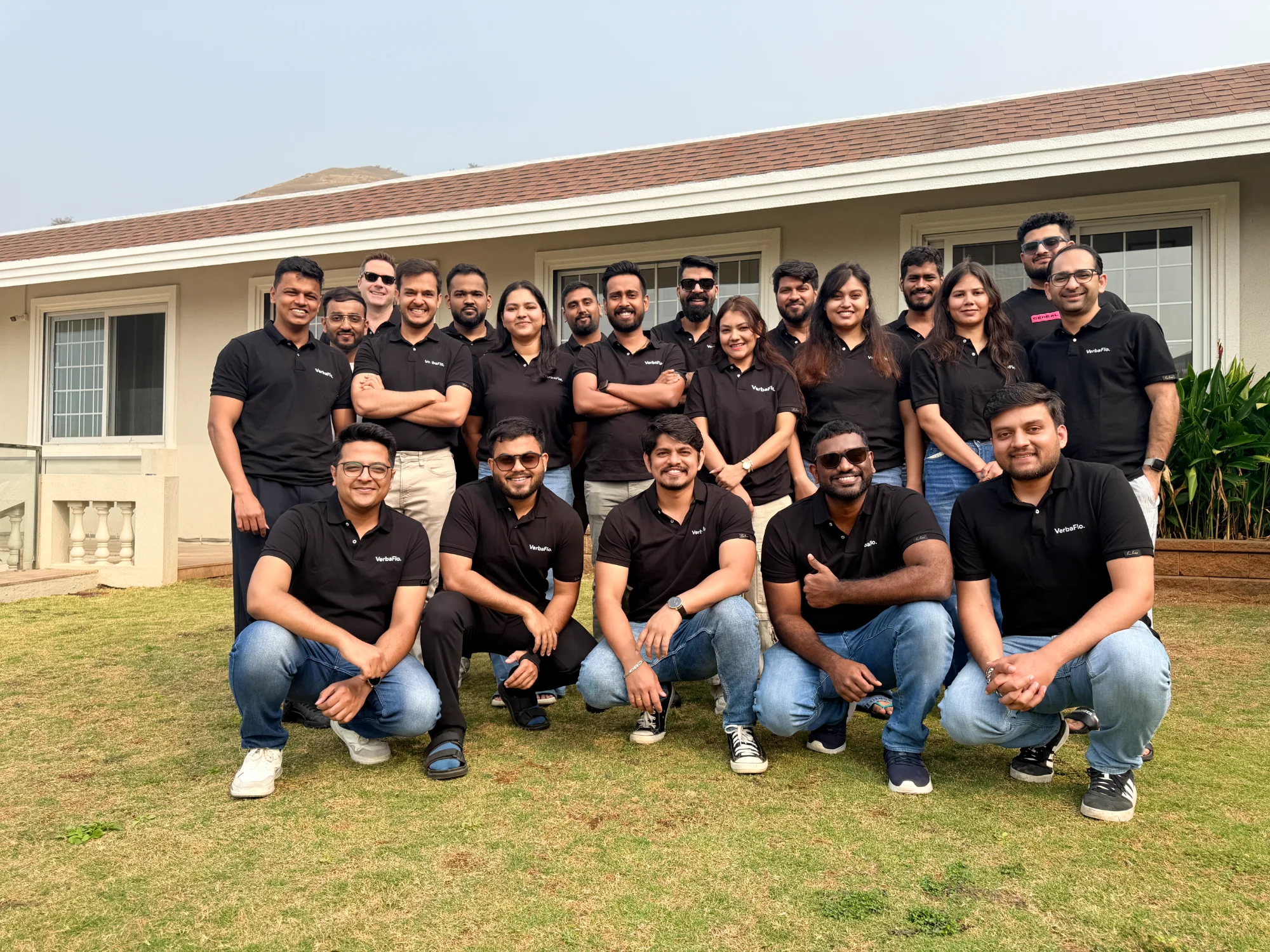
VerbaFlo, a conversational AI startup providing customer engagement for real estate businesses, has raised $7 million in a seed funding round led by Pi Labs, as it looks to expand its global footprint and deepen its product capabilities.
The round also saw participation across geographies from Haatch, Navigate Ventures, Old College Capital, the University of Edinburgh’s venture arm, and several global family offices, taking the company’s total funding to approximately $9 million.
Founded in October 2024 by Sayantan Biswas, Abhishek Garg, VP Singh and Dan Smith, VerbaFlo is building what it describes as a vertical AI communications platform for real estate, designed to automate leasing, operations and resident engagement across fragmented communication channels.
At its core, the platform consolidates interactions across email, WhatsApp, web chat and voice into a single AI-driven layer that can handle everything from lead qualification and booking to maintenance requests and post-move-in engagement. The company says it currently supports over 40 use cases across the resident lifecycle.
Building a Vertical AI Layer for Real Estate
VerbaFlo is already operating at scale. It powers communication across more than 2,00,000 residential units globally and is adding roughly 30,000 units every month. Its platform supports conversations in over 200 languages and is deployed across the UK, Europe and the United States, with expansion underway in markets including the Middle East, Australia and South Africa.
In conversation with AIM, Founder and CEO Sayantan Biswas says the idea for VerbaFlo emerged from his earlier venture, UniAcco, where he encountered inefficiencies in managing high-volume tenant communication across geographies. “There were a lot of redundant conversations where meaningful engagement could be handled by AI, allowing teams to focus on closing bookings,” he says.
Biswas explains that VerbaFlo is not built as a generic chatbot layer but as a deeply integrated system tailored for real estate workflows. “All communication touchpoints, whether it’s WhatsApp, email, or calls, are converted into structured leads and taken to a logical end, whether that’s signing a lease or managing post-move-in operations,” he says.
A key differentiator, according to the company, lies in its hybrid AI architecture. While it leverages leading foundation models, VerbaFlo has also developed proprietary systems trained on what Biswas describes as “golden datasets” built from millions of simulated tenant and operator interactions. “Operators don’t care which model is being used; they care about accuracy and outcomes,” he says.
The startup primarily serves large real estate operators, typically those managing portfolios of at least 500 beds, with some clients operating at up to 65,000 beds. These include institutional asset owners backed by firms such as Goldman Sachs, Blackstone, Brookfield and large student housing operators across Europe.
VerbaFlo’s traction has also been driven by a low-risk adoption strategy. The company offers pilot deployments to clients, all of which, Biswas claims, have converted into long-term contracts, resulting in zero churn so far.
The platform operates on a per-bed subscription model, with pricing ranging from $0.93 to $2.27 per bed depending on usage, making it a scalable solution for large portfolios.
Cracking a Fragmented, High-Stakes Market
Beyond company-specific traction, VerbaFlo is riding a broader shift in the global real estate industry. Despite being one of the world’s largest asset classes, real estate has historically lagged in adopting modern enterprise software, relying instead on fragmented tools and manual workflows.
With the rise of generative AI and agentic systems, vertical SaaS platforms are now emerging as an intelligence layer on top of legacy systems, enabling automation, real-time decision-making and always-on customer engagement. Investors increasingly see this as the next major value creation opportunity in proptech.
However, building in this space has not been without challenges. Biswas notes that while product-market fit has been strong, enterprise adoption cycles have been slow. “The challenge has never been the product; it’s the time it takes for operators to make decisions,” he says, noting that the average customer value in these portfolios can be as high as about $93,000, making operators cautious about experimentation.
Nonetheless, Faisal Butt, Founder and Managing Partner at Pi Labs, said in a statement, “The impact is immediate: faster leasing, lower operational friction and a better resident experience. VerbaFlo is exactly the type of vertical AI company we are backing at Pi Labs, platforms that deliver measurable operational impact for global real estate owners.”
Additionally, Bay Downing, Joint CEO, Downing, also said, “The impact Verbaflo is having on the residential sector is remarkable. By automating lead generation and significantly lowering the cost of acquisition for operators, they are solving one of the most persistent challenges in the industry. The traction they have built across the UK and Europe has been exciting to witness.”
He also highlights structural cost pressures within the industry. With central sales and operations teams in Western markets often costing between approximately $36,000-$60,000 (₹30-50 lakh) annually per employee, scaling traditionally requires proportional hiring. “With AI, they can scale operations without increasing team size, but getting them comfortable with that shift takes time,” he adds.
Compliance has been another key hurdle, particularly in Europe and the UK. VerbaFlo has had to build extensive data protection layers, including GDPR, ISO and SOC 2 compliance, along with customizable data hosting and masking capabilities tailored to each enterprise client.
Expansion Plans and Competitive Landscape
In an exclusive update, Biswas reveals that the company is expanding beyond residential real estate into adjacent sectors. “We are entering the hospitality and marketplace segments, think Airbnb or Booking.com-style workflows, within the next two to three months,” he says, adding that the goal is to cover the entire communication stack across real estate.
Geographically, VerbaFlo is scaling rapidly in the US and preparing for expansion into Australia and New Zealand, while earlier plans to enter Dubai and the Middle East have been temporarily delayed due to geopolitical conditions.
The immediate goal is to scale. VerbaFlo aims to grow from around 220,000 units today to over 500,000 units by the end of the year.
The company operates in an increasingly competitive landscape. In India, proptech startups such as Sell.do and CRM platforms like LeadSquared have begun integrating AI into sales and customer engagement workflows for real estate developers.
Meanwhile, global players, including property management software firms and horizontal AI platforms, are also moving into conversational automation, layering AI onto existing CRM and leasing systems. However, VerbaFlo is betting on its vertical focus and deep workflow integration to differentiate itself from both generic chatbot providers and legacy software vendors.
“We want VerbaFlo to be the communication layer for all real estate,” Biswas says, positioning the startup as a rare example of an India-origin company building a global, vertical AI platform for a traditionally fragmented industry.