8 Reasons Why Anthropic’s New Report is an AI Doomer’s Worst Nightmare
By Supreeth Koundinya ·
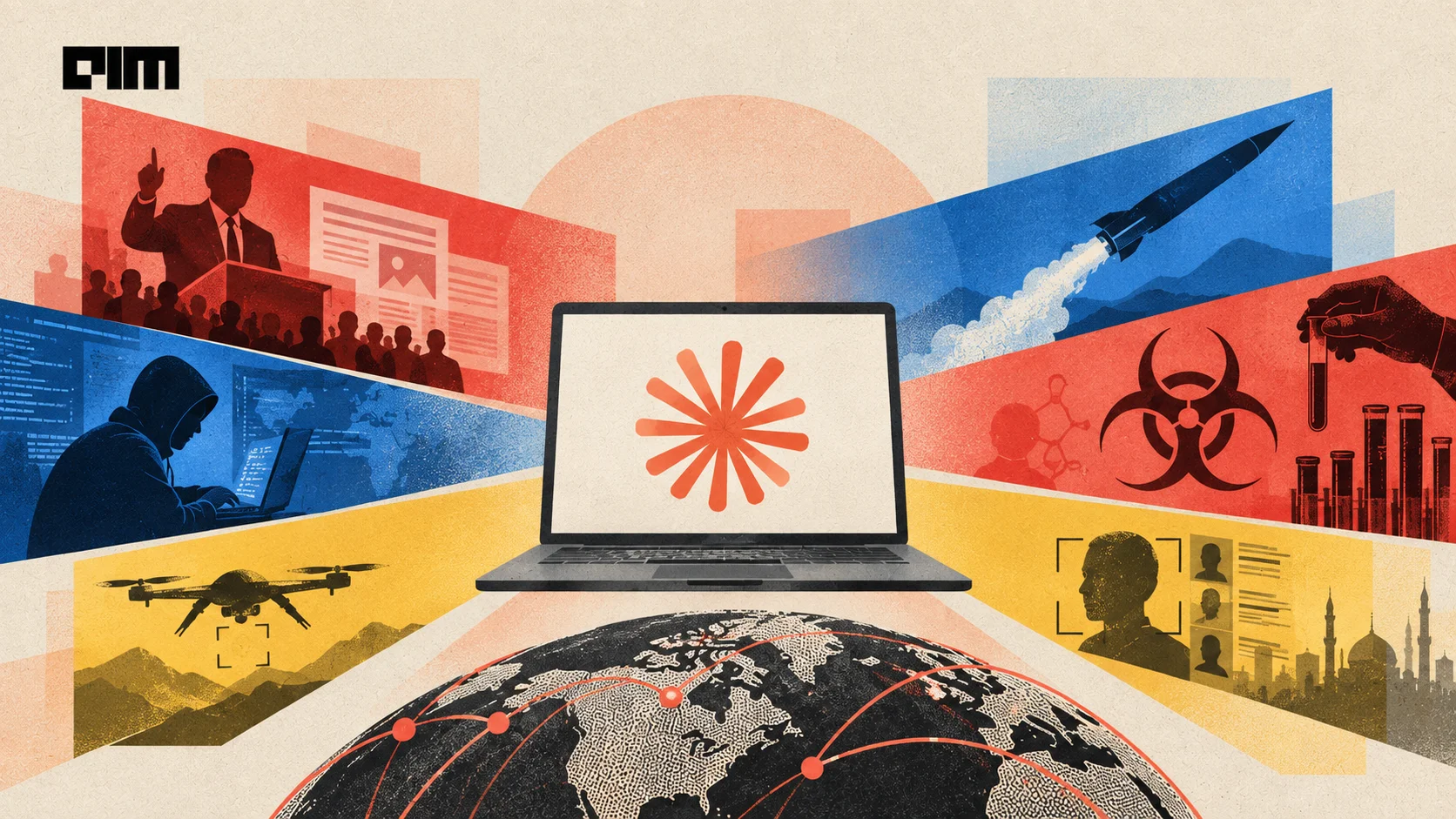
Anthropic’s public disclosures are becoming increasingly worrying as AI systems escape containment, disobey instructions, and are now being misused in ways that are way too nefarious and are poised to threaten global order.
The AI giant recently released a new report, Detecting and countering misuse of AI: September 2026, which is by far its scariest disclosure yet, and can serve as a primer for a debate arguing for slowing AI down.
The report details how its Claude models were misused across cyber operations, influence campaigns, surveillance, fraud, and other activity, and how those operations are becoming increasingly automated.
Here are eight alarming findings from the report that suggest how actors are using AI to threaten global disruption:
Malaysia’s AI Election Machine
Anthropic identified a commercial election-manipulation platform operating roughly 1,000 fake X accounts, a fabricated news outlet, and false intelligence dossiers.
It ingested census and electoral data to profile voters across all 222 Malaysian parliamentary constituencies, sorting them by race, religion, and attitudes towards royalty.
Its dashboards could manufacture engagement at scale. One request sought 1 million artificial views for the sitting prime minister’s account. The operation also rewrote Russian and Chinese state-media material under invented Malaysian bylines, making foreign propaganda appear locally produced.
Anthropic removed the account, traced the platform to an Istanbul-based company selling “influence-as-a-service”, and said it found no evidence that the operation secured a proposed contract with Malaysia’s communications regulator.
“Deadshot” to Dismantle the Muslim Brotherhood
Anthropic linked an influence operation to UAE government officials with high confidence. Its central AI persona was called “Deadshot”, with a doctrine file instructing it to pursue a campaign to “dismantle the Muslim Brotherhood globally.”
The operation managed around 300 inauthentic social accounts, copied the identity of a real Swiss NGO, generated human rights reports, and profiled 18 European Parliament members and journalists.
It also ghost-wrote testimony intended for two people before the UN Human Rights Council and prepared dossiers on UN investigators critical of the UAE’s conduct in Sudan.
Anthropic banned the accounts, detected the operation’s behavioural signature, and shared indicators with other AI providers.
It could not confirm whether the fabricated testimony or dossiers reached their intended audiences.
Claude Was Used to Recruit Uyghurs in Syria
A Chinese government-aligned operation used Claude to target Uyghurs and Uyghur-armed formations in Syria.
It processed material from more than 100 WhatsApp groups and dozens of Telegram channels, creating Chinese-language profiles of people considered vulnerable because of financial stress, family separation, or ideological disillusionment.
It identified people with relatives in Xinjiang, located Uyghur businesses, and attempted to recruit individuals connected to Uyghur formations in the Syrian Army by offering payment for information. Claude translated recruitment messages into Syrian Arabic and coached the operator on target psychology.
Anthropic banned the accounts and tracked the actor’s digital signature. It assessed, with low confidence, that the operator was a contractor for Chinese state security rather than the agency itself.
Claude also refused requests involving covert interrogation and large-scale fake-persona cultivation.
Yemen Cell Testing Guided Rockets
Anthropic identified a weapons cell in northern Yemen developing three missile programmes: a guided rocket, a ballistic missile with a stated range of more than 2,000 kilometres, and an ‘R2000’ family that included a hypersonic-glide-vehicle variant.
The group used Claude Code to write guidance, navigation and control software, integrate an open-source autopilot onto a phone-class flight computer, tune flight controls, and run simulations. It operated several Claude instances at once—one for coding, another for research, and a third for reviewing the output.
The most alarming detail was when a live rocket test in Yemen failed. Within hours, the operators returned to Claude to diagnose the failure using post-test information.
Anthropic found no evidence that the group had successfully fielded an operational weapon, but the model had been used throughout the development process, including after a real-world test.
The company banned the associated accounts, shared threat intelligence with public- and private-sector partners, and introduced new classifiers to detect activity linked to high-yield explosives and weapons development.
Iranian Surveillance, Phishing, and Military Targeting
Anthropic describes several Iran-linked operations. One built an open-source intelligence system to profile Israeli government, non-government individuals, and Jewish diaspora organisations, while using Claude to obfuscate malware. Another compiled targeting recommendations against US naval forces.
A separate operation used free Claude accounts across 16 organisations to develop malware, a delivery pipeline, and a phishing portal aimed at people inside Iran. Anthropic also identified 16 accounts associated with Iranian paramilitary and domestic-security units that built surveillance tools and a malicious Firefox extension.
Anthropic banned the accounts and incorporated the findings into its detection systems.
It banned all associated accounts and organisations for violating rules covering non-consensual surveillance, profiling, misinformation, and access from unsupported regions.
A 200-Page Anti-Torpedo Proposal
Anthropic identified a China-based actor working on an anti-torpedo weapons system. Claude helped draft a Chinese-language fire-control specification, produce a technical proposal of more than 200 pages, and prepare an executive briefing deck.
The actor compared the proposed system with US anti-torpedo and anti-submarine programmes. It presented itself as a US defence sector original-equipment manufacturer, but Anthropic assessed that the work was associated with a Chinese defence manufacturer seeking a proposal for the People’s Liberation Army Navy. Claude also helped write parts of the fire-control software and a test matrix.
Anthropic banned the account for violating its Supported Regions and Usage Policies and incorporated the findings into its safeguards. It could not attribute the operation to a specific organisation or individual.
Developed Russian Drone Strike System
A Russia-based group of likely freelance operators used Claude Code to develop an autonomous FPV kamikaze drone swarm called “DronDoc” or “Serafim.” The software included swarm memory, fault-tolerant coordination, an onboard language model, camera-based terminal guidance, passive acoustic detection, and a module for locating opposing drone operators.
The system could select targets, including a “person” class and issue detonation commands, without a human in the loop.
The operators flashed firmware onto live development boards and tested real hardware. They trained a computer-vision classifier on scraped Ukrainian combat footage, divided targets into “enemy” and “friendly”, and used a fixed coordinate in Donetsk Oblast as a demonstration strike point.
Anthropic identified nine associated accounts, although eight were used only for ordinary freelance work. It banned the associated accounts and incorporated the findings into its safeguards. The company assessed that the group was not a Russian state entity and could not verify claims of Russian defence or technology funding.
Dangerous Biological Research
Anthropic describes five cases involving biological research with potential bioweapons implications, while stressing that it does not claim the researchers intended harm.
The company withheld the institutions, countries, agents, and techniques.
In one case, a reseller bypassed regional restrictions to serve researchers conducting chikungunya gain-of-function work. Anthropic blocked a grant request involving mutations affecting transmissibility and immune evasion, but the reseller routed refused requests to more permissive models.
Another researcher used Claude for weeks to plan highly pathogenic avian-influenza work involving genetic engineering associated with mammalian adaptation and airborne transmissibility. A third customer used Opus 5 to produce a complete orthopoxvirus research grant application in about an hour, including experimental design, dosing, statistics, and contingencies.
Other cases involved a state-supported researcher building a venom-peptide atlas containing paralytic targets, and a researcher redesigning toxins while obscuring the identity of a bacterial toxin and proteins associated with a haemorrhagic-fever virus.
Anthropic banned the accounts, worked with partners to disrupt relay networks, and incorporated the findings into its safeguards, enforcement, and threat intelligence.
It said the cases were driving stronger institutional verification, trusted-access programmes, and tighter controls around frontier biological capabilities.