Why Developers are Abandoning GitHub Again
By Mohit Pandey ·

A few months ago, several developers and projects on GitHub announced they were moving away from the platform. At the time, the biggest concerns centred on instability following leadership changes, including the departure of CEO Thomas Dohmke, alongside broader unease about Microsoft’s complete acquisition.
But now, things are taking a turn. This is no longer about philosophy. What’s unfolding now is more about whether the platform still does its job.
When Mitchell Hashimoto, Creator of Ghostty, published ‘Ghostty is leaving GitHub’, it read like a breakup letter. “I’m GitHub user 1299, joined in February 2008… I’ve visited GitHub almost every single day for over 18 years,” he wrote. “I’m super sad to say this, but it’s time to go.”
Hashimoto is not a fringe voice. He built Vagrant, Terraform, and Vault, tools that helped define modern infrastructure workflows. His career trajectory is tightly interwoven with GitHub’s own rise. So when someone like him walks out, it signals something more extensive than personal preference.
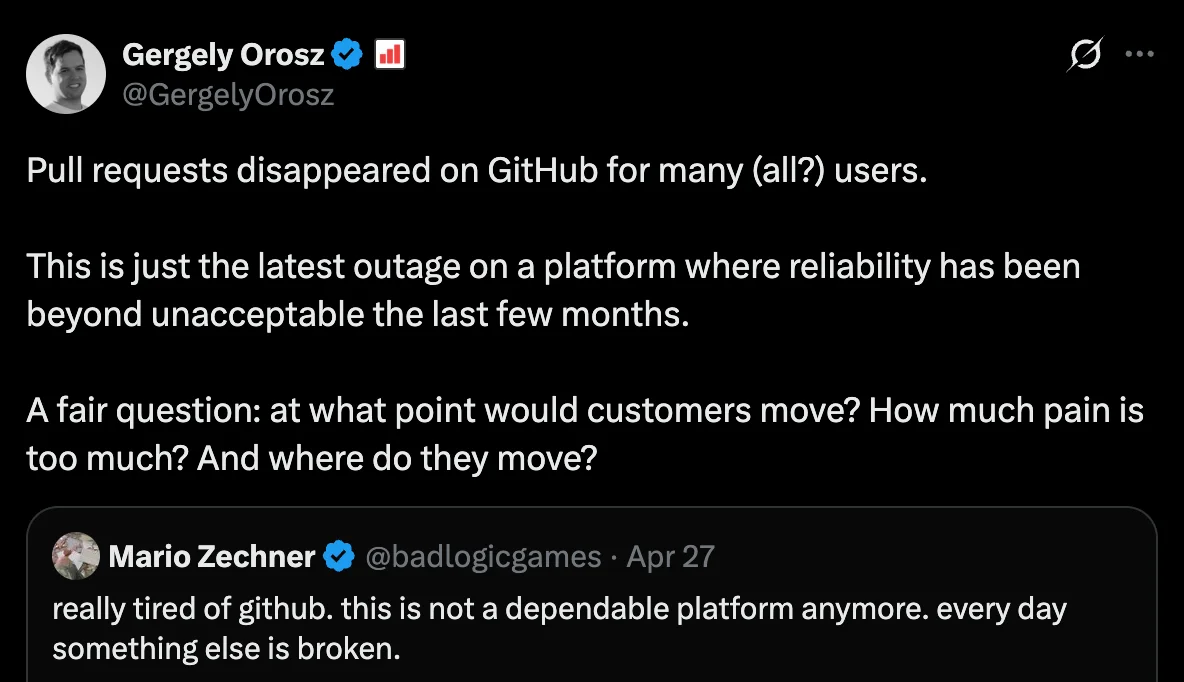
Gergely Orosz, recognised for creating ‘The Pragmatic Engineer’, posted on X, “Pull requests disappeared on GitHub for many (all?) users. This is just the latest outage on a platform where reliability has been beyond unacceptable the last few months. A fair question: at what point would customers move? How much pain is too much? And where do they move?”
GitHub CPO Mario Rodriguez has said that the team is working to fix it, and no pull request data has been lost. “As pull requests are updated, they will be reindexed. We are also working on accelerating a full reindex so these pages return complete results again,” he wrote on X.
A Platform That Gets in the Way
In recent months, developers have increasingly pointed to outages that stretch for hours, sometimes across an entire workday. Earlier this week, Theo Browne, CEO of T3 Chat, also pointed this out: “Github has been down for most of the day. I'm so tired of this. Never been so ready to move on.”
Meanwhile, another developer, Armaan Sidhu, Founder of XPilot by Realize Labs, tracked another such incident. “GitHub Actions has been down for 16 hours and 31 minutes today. That’s an entire dev workday where nothing shipped.”
Hashimoto’s account is more methodical. He maintained a journal. “I put an ‘X’ next to every date where a GitHub outage has negatively impacted my ability to work… Almost every day has an X.”
That is the shift. GitHub is no longer just inconvenient. It is obstructive.
“This is no longer a place for serious work if it just blocks you out for hours per day, every day,” he wrote.
GitHub’s own response has been calculated. Kyle Daigle, COO of GitHub, responded on X, “The team is going to keep working to make GitHub something you can come back to with real proof, not words.”
It is a careful statement, and a telling one. Even GitHub is no longer arguing the premise.
The Deeper Fracture
Outages alone rarely drive developers away at this scale. They have tolerated instability before. What is breaking now is trust.
Two months ago, developers said GitHub was no longer “neutral ground.” That perception is now sharper. The platform is now seen as tied to a single company’s AI strategy rather than the larger open-source ecosystem.
That tension shows up in subtle ways. Projects like Zig cited “an aggressive push towards artificial intelligence tools” as a breaking point. Others describe the interface itself becoming cluttered with AI prompts, nudges, and workflows they did not ask for.
The discomfort is not about the presence of AI. It is the sense of losing control.
Amjad Masad, CEO of Replit, also chimed in on the discussion on X: “It’s honestly impressive that GitHub kept the service up at all, given this kind of growth. I predicted this years ago: Free services will become untenable with the advent of human-level bots.”
When the same infrastructure that hosts your code also shapes how that code is written, reviewed, and even generated, the relationship changes. GitHub starts to look less like a platform and more like a pipeline.
That perception is hard to reverse. There is also a structural problem that GitHub did not anticipate.
GitHub’s core model—pull requests, code reviews, notifications, CI pipelines—was designed for human developers. All of it assumes a pace that fits human cognition: a few commits per day, a handful of pull requests per week.
That assumption is already fading. As one analysis put it, engineers at frontier labs are now relying almost entirely on AI to write code. Sometimes, almost entirely, as one OpenAI researcher revealed. At Anthropic, estimates suggest 70-90% of code is AI-generated.
That changes the load profile completely. While a human team produces dozens of commits per day, an agent system can produce thousands. CI pipelines, issue trackers, and review systems start to strain under that volume.

Any Hopes Coming Back?
“When a thousand engineers spin up a hundred agents each, Git’s merge request model breaks at machine speed,” said Lee Faus, former Global Field CTO at GitLab, on the We Love Open Source podcast.
GitHub is now being pushed into a workload it was never designed to handle. And the cracks are showing.
Maggie Appleton, Staff Research Engineer at GitHubNext pointed out, “They're dealing with unprecedented scale from agents. It’s easy to s*** on GitHub from the outside if you're not in charge of 30X-ing capacity within a few months. Have some grace.”
Despite all of this, there is still hope from GitHub’s end. Some developers point out that maintaining something like GitHub is next to impossible. And there might be some truth to that.
In conversations around Hashimoto’s exit, alternatives like Codeberg, Forgejo, and newer ideas like decentralised forges built on protocols similar to Bluesky are being discussed. Roscoe Rubin-Rottenberg, Co-Founder and CTO of Spark Social, described one such approach where “issues and PRs are decentralised… and the Git forges itself can be self-hosted.”
Yet, none of these are drop-in replacements. The goal is to reduce dependence on a single platform that can fail, change direction, or impose new rules.
But when someone like Hashimoto says, “I want to code. And I can’t code with GitHub anymore,” that lands differently. Even he leaves the door open. “I’d love to come back one day,” he writes. “But this will have to be predicated on real results and improvements, not words and promises.”
That’s where things stand. Not a clean break, but a strained relationship, where developers are waiting to see whether GitHub can prove it still belongs at the centre of modern infrastructure development.