
After months of speculation and delay, OpenAI announced that the image generating system DALL-E is now available as an API. This move will allow developers to build the AI system into their applications, services, and websites. With this, OpenAI looks to see more and more use cases across industries.
The company announced that over three million people will now be able to use the power of DALL-E to produce over four million images per day, after creating an OpenAI API account as part of the public beta.
The Images API would provide three methods for interacting with images. One would be creating images based on a text prompt from scratch, creating edits of an existing image on a new text prompt, and creation of variations using an existing image.
Moreover, the image generation endpoint will allow users to create an original image when given a text prompt. The size of the generated images ranges from 256x256, 512x512, and 1024x1024 pixels. Smaller sizes will be faster to generate, where users can request 1–10 images using the n parameter.

Source: Open AI
The pricing for the DALL-E 2 API will vary by resolution. The 1024×1024 images come with a cost of $0.02 per image; 512×512 images of $0.018 per image; and 256x256 images of $0.016 per image. Volume discounts will be available to organisations that are working with OpenAI’s enterprise team.
Open AI’s product manager Luke Miller said in a recent media interaction, “We encourage developers to disclose that images are AI-generated, but do not require that they include the DALL-E 2 signature.”
Moreover, the API will let users generate new images using text prompts (e.g., “a fluffy bunny hopping through a field of flowers”) or edit existing images.
Companies using DALL.E 2
Recently, Shutterstock also announced that it is using OpenAI’s DALLE.2 to allow its users to create images for prompts that aren’t already a part of its library. With this, the company hopes to bank on the growing popularity of AI art. This also comes after it had claimed to remove AI-generated images from its platform over copyright concerns.
Read: Does DALL.E Pose A Threat to Designer Jobs?
In addition, tech giant Microsoft is leveraging it in its browser Bing and Microsoft Edge with the Image Creator tool, allowing users to create images.

Source: Microsoft
What about biases and risks?
With this, OpenAI became one of the first companies to release an image generation API, besides DeepAI and other open source applications, thereby spearheading the text-to-image generation model. However, the question is the threats and potential risks arising out of the platform.
Recently, OpenAI said that it is closely monitoring the outcome of DALL.E 2 and has put in place various guardrails, preventing generated images from violating their content policy.
Five months ago, OpenAI revealed pre-training mitigation measures, a subset of its guardrails which directly modify the data that its image generation tool learns from.
Read: The Societal Danger of DALL.E 2

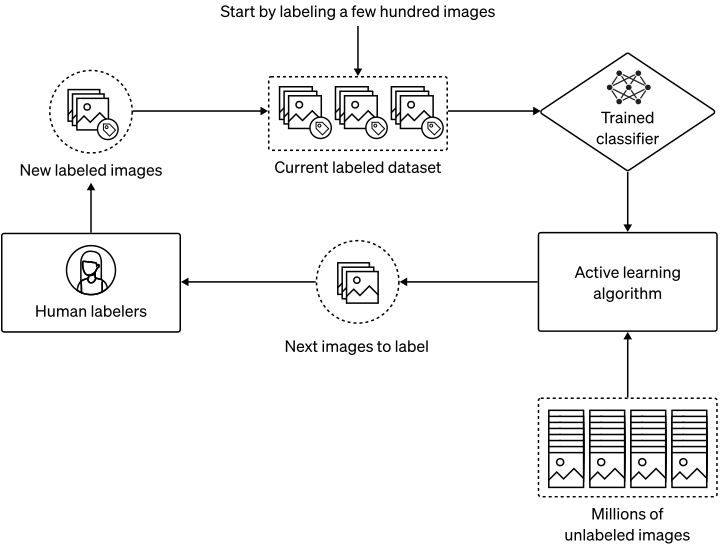
OpenAI’s DALL.E 2 is currently trained on innumerable captioned images from the internet, and some of these images are removed and re-weighed to alter what the model learns. The company has trained these image classifiers in-house and continues to study the effects of dataset filtering on their trained model. It has reused an approach to filter training data for GLIDE to train the image classifiers. For example, OpenAI has filtered out violent and sexual images from its training dataset.
- Telangana Unveils AI-Powered Digital Twin of IT Minister at DevFest 2026
- Musk Says SpaceX Closed $40 Bn GPU Debt Deal, Warns Most Neoclouds Won’t Survive
- Coforge Revenue Rises 54% as AI Engineering and Deal Bookings Gain Momentum
- Tech Mahindra Partners With SpaceXSI to Bring AI Into Software Engineering
- Infosys AI Revenue Rises 29% in Q2, FY27 Growth Guidance Cut
- LTM Launches BlueVerse Industrial AI Lab in Chennai