
5 min
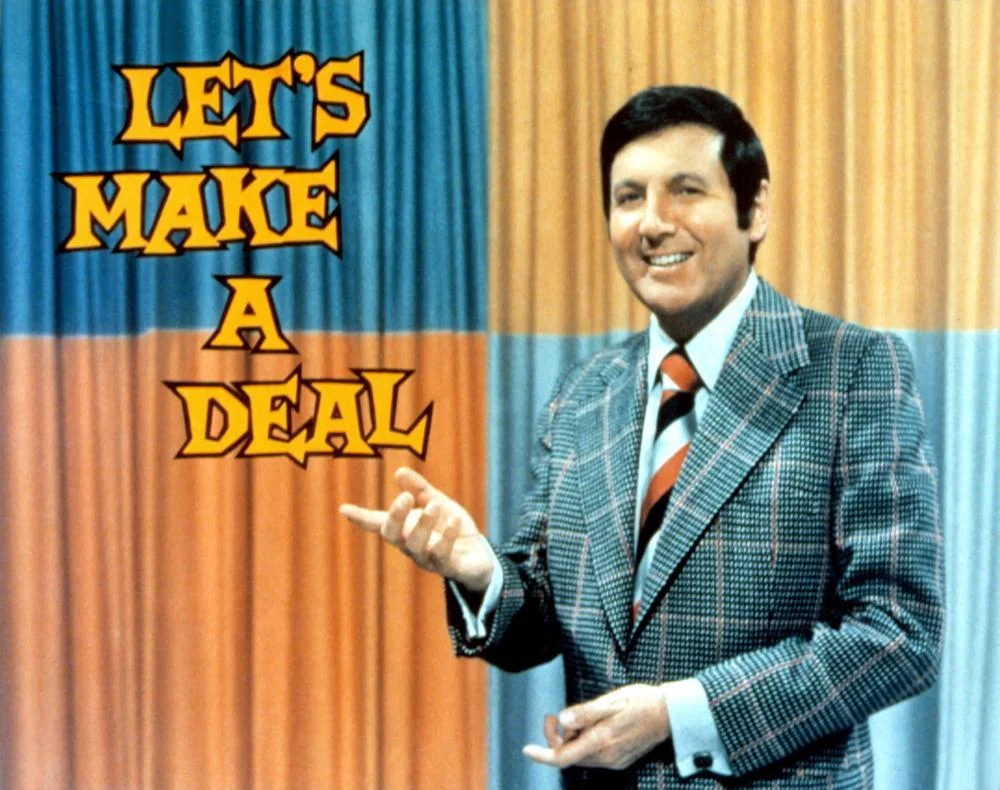
You may remember the old TV show called Let's Make a Deal which ran on American television from 1963 to 1968. The genial host and co-creator of the game show died at his home in Beverly Hills, Calif., on Saturday. He was 96.
Monty Hall offered deals to audience members in the form of choices, dares or other challenges. If the audience member succeeded, they won a nice price like a new car. If not, they got the booby prize--a dirty shoe, an old goat, whatever.
The Monty Hall Problem became famous in 1990 when a reader asked the ‘Ask Marilyn’ column in Parade Magazine the following question:
“Suppose you're on a game show, and you're given the choice of three doors: Behind one door is a car; behind the others, goats. You pick a door, say No. 1, and the host, who knows what's behind the doors, opens another door, say No. 3, which has a goat. He then says to you, ‘Do you want to pick door No. 2?’ Is it to your advantage to switch your choice?”
When a reader submitted that question to Savant's newspaper column Ask Marilyn, she replied: "Yes, you should switch." But her answer caused a firestorm.
The 'Ask Marilyn' column announced the answer as 66.7%, and over one thousand PhDs wrote to tell her that she was wrong.
Some of the mail was even laced with sexist comments like "There is such a thing as female logic." All of this was shocking to Savant and others, mostly because the problem had actually been solved many times before. The first variation of the problem was solved as far back as 1889, by French mathematician Joseph Bertrand.
Regardless, Savant ended up convincing many of her readers that she was right.
Clearly, the Monty Hall problem is a brain bender but has still found resonance in many movies and books. Let us have a look at five cultural references that were made to the Monty Hall problem:
The Curious Incident of the Dog in the Night-Time: The book was written by Mark Haddon, is a 2003 mystery novel where the protagonist, Christopher, a 15-year-old boy who describes himself as "a mathematician with some behavioural difficulties.” Christopher disagrees with the popular belief that every math problem has a straightforward answer and uses the Monty Hall problem as proof.
Sweet Tooth by Ian McEwan: The 2013 Cold War-era romance of multiple deception book has one of the most concise explanations of why he is better to switch that I have seen but then goes on to detail a story written by one of the characters. In the story, a husband follows his wife to a hotel and knows that she is in one of three rooms (401, 402, 403). He picks a room in which to confront her,401, but before he can open the door, a couple comes out of 402. He knows the Monty Hall problem and switches room to 403 and finds his wife.
21: The 2008 movie 21 increased public awareness of the Monty Hall problem. 21 opens with an M.I.T. math professor using the Monty Hall Problem to explain theories to his students. The Monty Hall problem is included in the movie to show the intelligence of the main character because he is immediately able to solve such a notoriously difficult problem.
Brooklyn Nine-Nine: An episode of the show that aired on November 29, 2016, uses the Monty Hall problem as a reference. In the episode, the precinct’s captain, Captain Holt, is in an argument with his husband over the Monty Hall problem, and one of the detectives, Amy Santiago, is trying to figure out a way to explain the correct answer.
Steve Selvin posed the Monty Hall problem in a pair of letters to the American Statistician in 1975. The first letter presented the problem in a version close to its presentation in Parade 15 years later. The second appears to be the first use of the term "Monty Hall problem". The problem is actually an extrapolation from the game show. Monty Hall did open a wrong door to build excitement but offered a known lesser prize – such as $100 cash – rather than a choice to switch doors.

Your reaction
Discussion
What's your take on this story?
No comments yet — be the first to share your view.