
5 min
One of the most interesting trends that are currently emerging is that of Social Media replacing Primary Research in benefits and usage. There are various use cases that can validate this, but lets first dig into the definitions and usage of Primary research.
Primary research involves collecting data about a given subject directly from the real world. Primary research is any type of research where you go out and collect yourself. Examples include surveys, interviews, observations, and focus groups.
A typical and simplistic use case would be that of a car company undertaking a survey to identify the attributes that consumer most prefer/ dislike in its brand of cars.
As an alternative to survey, Social media can get rich public chatter on the same topic that marketers and researchers would kill for. People willingly talk about a brand of car and their preferences and other issues about the same. The car company looking to identify right attributes can seemingly get a deep data that an otherwise costly primary research might reap out after weeks or even months of painstaking execution.
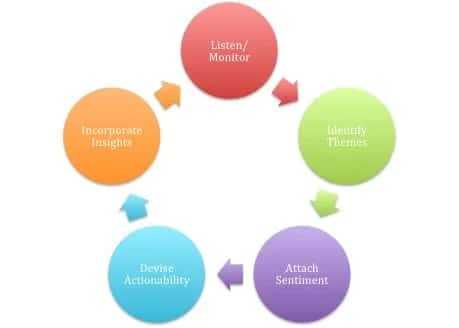
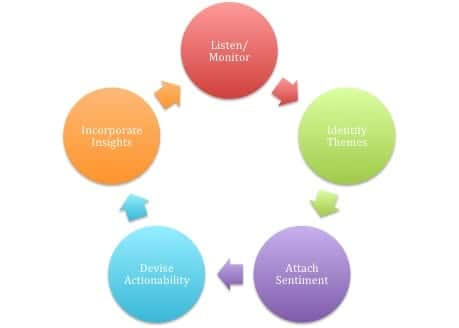
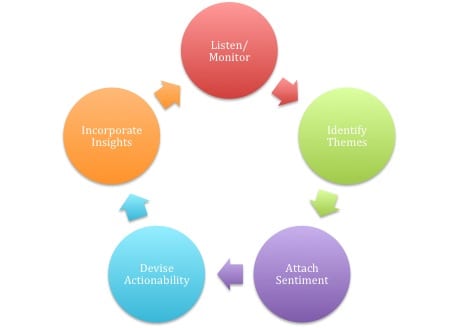
The richness of actionable insights that can be gleaned from Social Media is almost bewildering. People talk about almost everything, sometimes even most private aspects of their lives. Social Media listening is a five step process:
 Some of the benefits of social media over Primary research include:
 Some of the benefits of social media over Primary research include:
- A much larger sample size than primary research
- Lower cost: Primary Research involves significant costs, much higher than gleaning information from Social Media.
- People talk about much more personally on social media than they would in an interview, survey or focus group.
- Unaided insights: Primary research follows the format of questions and answer. There might be hidden insights that are not evident to interviewer that can be captured by social media.
- Speed of execution: Primary research takes weeks, sometimes months to deliver insights. Social media research provides much speedier execution
- Relevant audience: People talking about a theme on social media are the one’s that are most affected by that topic and thus is the most relevant audience for a research. A primary research might not reach out to all relevant audience.
- Concerns over privacy issues means its not easy for anyone to listen to online chatter that many feel is personal. Yet, proponents believe that if something is on social media, it’s for public consumption and for everyone’s benefit.
- Extracting the right insight from social media is a science of its own, which requires deep expertise in linguistic and text analytics, more importantly big data issues of velocity, volume and variety.
- The exact science is yet to evolve before its mainstream and readily available for enterprise consumption.
- Indian IT’s New Workforces Come with a Margin Challenge
- ‘Owning of the IP Itself is Meaningless,’ Says Mphasis’ Ravi Vasantraj
- Infosys’s $5.2 Billion Deal Wins Fail to Lift FY27 Outlook
- Tech Mahindra’s Q2 Revenue Modest, But AI-led Deflation Remains Higher
- Wipro’s Deal Slump Puts Its AI Growth Story to the Test
- The Unintended Winner of US Green Card Pause: India’s Offshore AI Hubs