Key takeaways
- Highlight the critical yet overlooked role of women in AI development and leadership.
- Recognize the significant contributions of underrated women who innovate and promote ethical AI use.
- Address the alarming statistic of only 26.7% of tech jobs held by women.
- Encourage awareness of diverse voices in AI to foster inclusive technological advancements.
- Promote mentorship and support initiatives led by women to inspire future generations in tech.
Recent data shows that women hold approximately 26.7% of technology-related jobs. Despite the critical role technology and artificial intelligence play in shaping our future, the presence of women in these fields, especially in leadership positions, remains abysmally low.
However, despite these challenges, (the few) women in AI are pioneering change, breaking barriers, and paving the way for future generations. Their work not only contributes to technological advancement but also ensures that the development and application of AI is inclusive, equitable, and representative of the diverse society it serves.
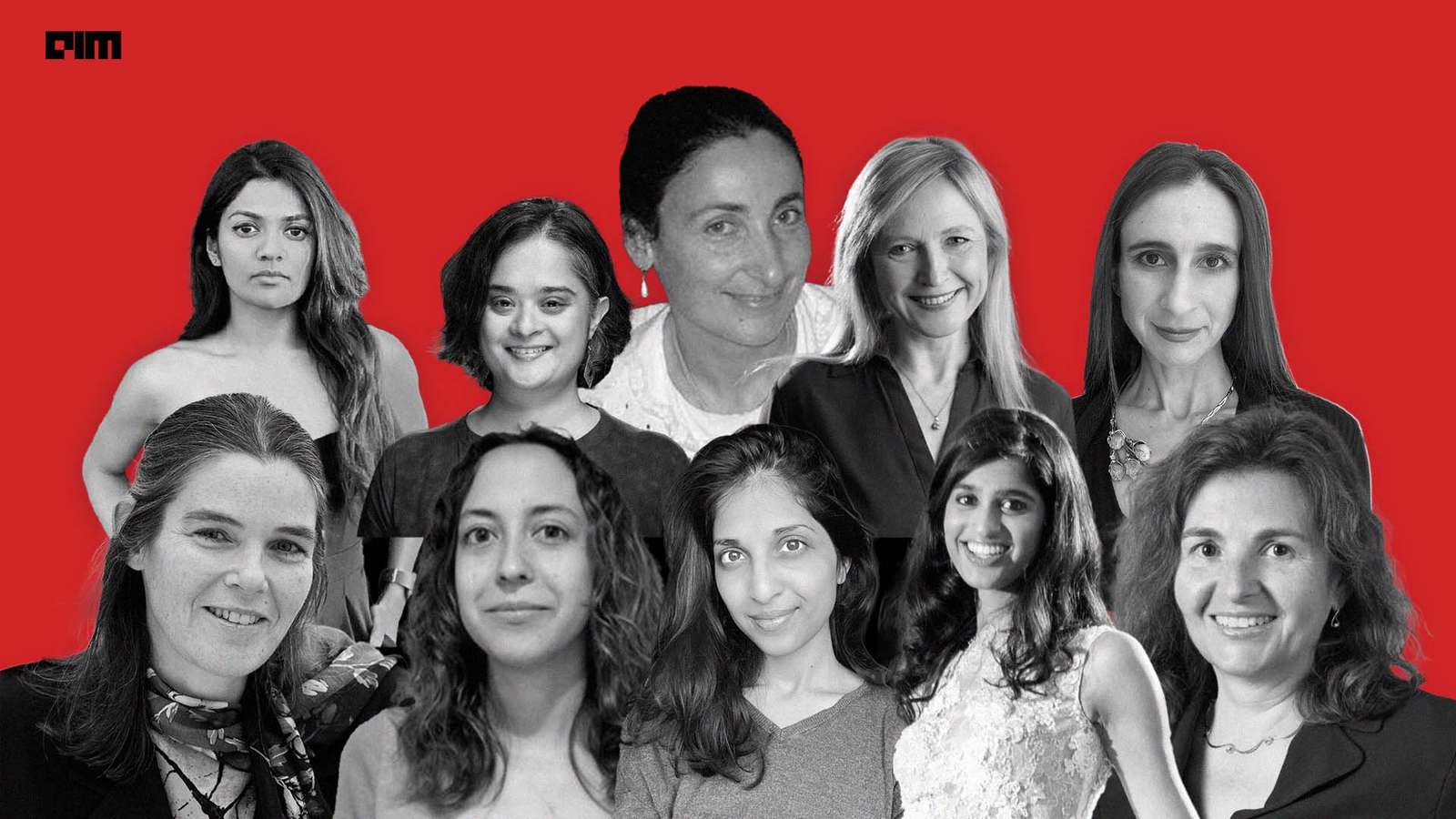
While the media constantly covers the tech elites, here is a list of 10 underrated women whose works range from spreading awareness about AI to building them and ensuring its ethical use.
Aishwarya Srinivasan
Aishwarya Srinivasan currently works as a senior AI advocate within the Microsoft for Startups group at Microsoft, supporting startups in developing machine learning solutions. She recently became an angel investor with Hustle Fund and DynamoFL, after founding Illuminate AI, a nonprofit dedicated to mentoring in AI, in March 2021.
Prior to joining Microsoft, she was a data scientist at Google Cloud and an AI & ML innovation leader at IBM Data & AI.
Aishwarya has a postgraduate degree in data science from Columbia University. She has global work experience having engaged with clients and led projects in London, Dubai, Istanbul, and India. She holds a patent awarded in 2018 for developing a reinforcement learning model for machine trading.
Tulsee Doshi
Tulsee Doshi leads Google's Responsible AI & Human-Centred Technology Organisation. Her work focuses on incorporating ethical considerations into product development and policy, specifically aimed at creating equitable and transparent user experiences. At Google, Doshi manages a team dedicated to improving fairness, safety, and inclusivity across products.
Prior to her current positions, Doshi taught a product leadership course at Product School and led projects at YouTube to enhance inclusive machine learning and creator diversity. She started at Google as an associate product manager, focusing on making Search features more relevant worldwide.
Doshi holds a bachelor's degree in symbolic systems and a master of science in artificial intelligence from Stanford University. At Stanford's HCI Lab, she was involved in research on crowdsourcing and expert collaboration technologies, earning a Best Paper Award at UIST 2014.
Ritu Raman
Ritu Raman is the d’Arbeloff assistant professor of mechanical engineering at MIT, where she leads a lab focused on developing adaptive living materials, with current projects centred on engineering biological actuators. This research aims to enhance machine functionality and restore mobility in humans. Raman's work involves integrating living muscular and neural tissues to create actuators that autonomously adjust to environmental changes.
Her academic background includes a bachelor’s in mechanical engineering with a minor in biomedical engineering from Cornell University, followed by an MS and PhD in mechanical engineering from the University of Illinois at Urbana-Champaign.
Isabelle Guyon
Isabelle Guyon is a director and research scientist at Google, on leave from her role as a professor of artificial intelligence at Université Paris-Saclay (Orsay), specialising in data-centric AI, statistical data analysis, pattern recognition, and machine learning.
Before her current position at Google, Guyon worked as an independent consultant and a researcher at AT&T Bell Laboratories. There, she made significant advancements in neural networks for pen computer interfaces, collaborating with Yann LeCun and Yoshua Bengio. She is the primary inventor of SVM-RFE, a variable selection technique based on SVM, widely cited and used as a benchmark for new feature selection methods.
Guyon holds a PhD degree in physical sciences from the University Pierre and Marie Curie, Paris.
Olga Russakovsky
Olga Russakovsky, Ukrainian-American, completed her PhD in computer vision at Stanford University in 2015, working closely with Fei-Fei Li. Together, they developed ImageNet, a comprehensive image database pivotal for advancements in computer vision. Her research focused on reducing image classification's dependency on human annotators and addressing human bias in algorithm development.
Following her PhD, Russakovsky continued her research as a postdoctoral fellow at Carnegie Mellon University and is now an associate professor at Princeton University. Her work emphasises the importance of algorithmic fairness in visual recognition systems and has proposed computational solutions to mitigate historical and societal biases.
Additionally, her significant contributions to the field include leading the Imagenet Large Scale Visual Recognition Challenge, with the founding paper cited over 13,000 times.
Devi Parikh
Devi Parikh, who is the senior director of generative AI at Meta, worked on developing Make-A-Video 3D in 2023 and Make-A-Video in 2022 that propelled the text-to-video generation. In the same year, she introduced AudioGen, a novel text-to-audio generation tool, and Make-A-Scene, which allows for more creative control in AI-generated images.
These contributions follow her earlier endeavours to humanise AI research, evident in her 2020 projects ‘Humans of AI: Stories, Not Stats’ and ‘AI Paygrades’, aimed at demystifying the AI research community and promoting transparency in AI industry hiring practices, respectively.
Aude Oliva
Aude Oliva serves as the director in the MIT-IBM Watson AI Lab and director of strategic industry engagement in the MIT Schwarzman College of Computing. Her latest research uses deep learning to enable computers to recognize locations within images based on their composite features, such as identifying a bedroom from the presence of a bed, window, and posters, or a kitchen from a stove, tile, and countertop.
Oliva's significant contributions include her work on hybrid images. This work supports applications in information privacy, time-lapses, marketing, and brainteasers. Additionally, she explores the psychological perception of images, focusing on memorability, content, and the human visual system's limitations.
Daphne Koller
Daphne Koller, an Israeli-American computer scientist, co-founded Coursera in 2012. Before Coursera, she worked on probabilistic models with applications in various domains, including computer vision and computational biology. Koller was a Stanford University professor and received the ACM-Infosys Foundation Award in Computing Sciences in 2008, the first recipient of this $150,000 award.
She became a MacArthur Fellow in 2004, recognized for her innovative work in AI. After Stanford, she pursued postdoctoral research at UC Berkeley. Koller has been honoured by being elected to the National Academy of Engineering in 2011, the American Academy of Arts and Sciences in 2014, and the National Academy of Sciences in 2023.
In recent years, Koller left Coursera to focus on new ventures in biotech, founding Insitro in 2018, a drug discovery startup leveraging machine learning and genomics. In 2020, she co-founded Engageli, offering an innovative online learning platform.
Cynthia Rudin
Cynthia Diane Rudin is a professor at Duke University, where she directs the Interpretable Machine Learning Lab. In 2022, she was honoured with the Squirrel AI Award for her contributions to transparent AI systems in critical domains. She also received the Guggenheim Fellowship in the same year and was elected a Fellow of the Association for the Advancement of Artificial Intelligence.
Her research includes developing the Series Finder algorithm for crime series detection and scoring systems for medical diagnosis. Before her tenure at Duke, Rudin was a faculty member at the MIT Sloan School of Management and held research positions at New York University and Columbia University.
She completed her PhD in applied and computational mathematics at Princeton University in 2004 and has been recognised as one of the most impressive professors at MIT by Business Insider in 2015.
Daniela L Rus
Daniela L Rus is the director of the MIT Computer Science and Artificial Intelligence Laboratory (CSAIL) and holds the Andrew and Erna Viterbi Professorship in the Department of Electrical Engineering and Computer Science at MIT.
Rus's contributions address challenges in machine learning such as data quality, bias, and adaptability of systems, alongside innovations in robotics like soft robotics, modular robots, and autonomous vehicle algorithms. She has developed technologies to assist the physically disabled.
Rus was born in Romania and moved to the United States, earning her bachelor's degree at the University of Iowa and her PhD at Cornell University. She started her academic career at Dartmouth College before moving to MIT in 2004.
Spotted an error? Tell our editors. Read our editorial standards and corrections.