
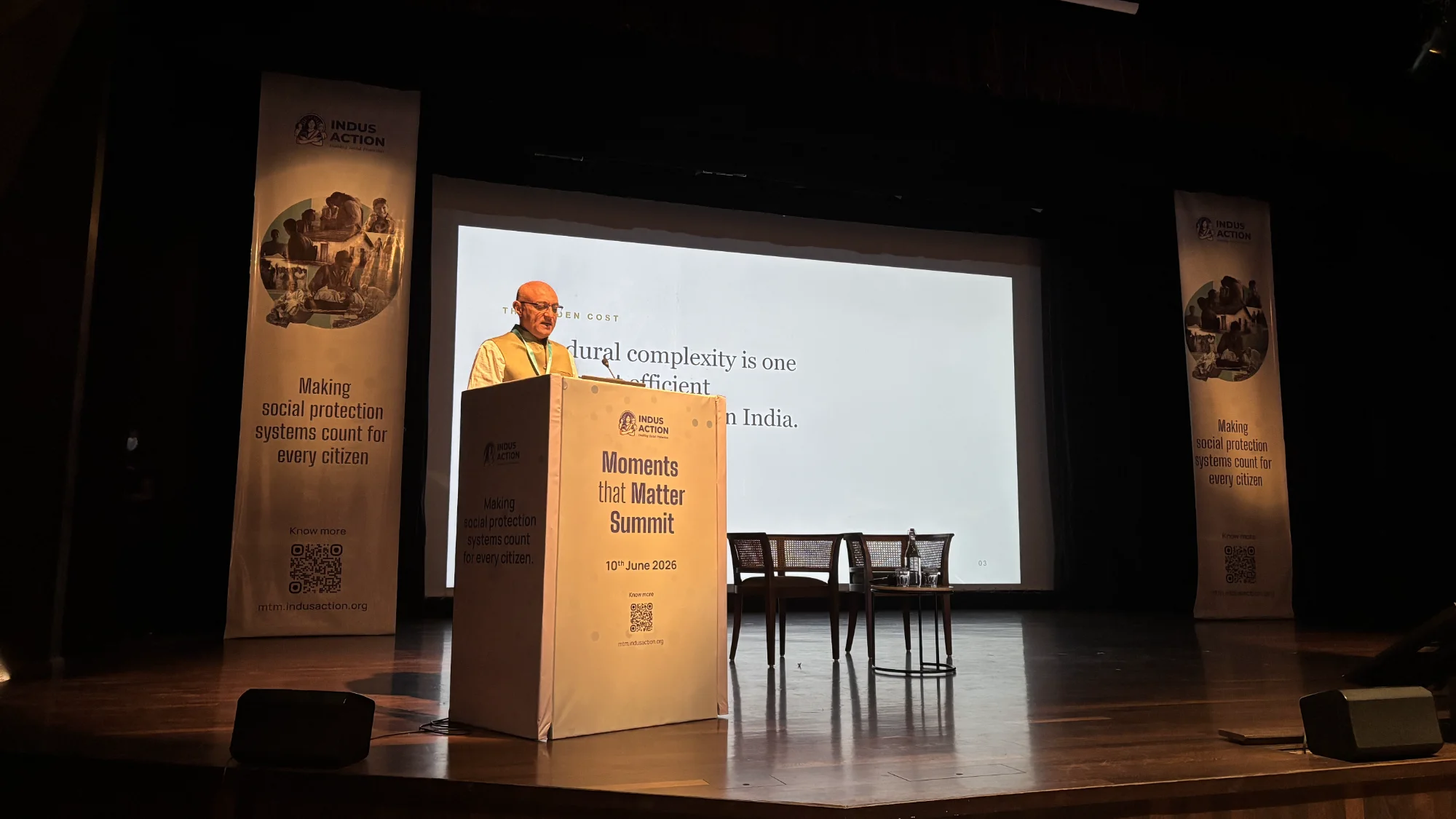
When Srikanth Nadhamuni, Founder CTO Aadhaar and Research Affiliate at MIT, talks about procedural complexity, he does not reach for a policy brief. He reaches for Lakshmi.
Lakshmi, his help from Andhra Pradesh, fed a team of engineers working out of a Bengaluru apartment in 2009, when Nadhamuni and his colleagues were quietly designing what would become Aadhaar. She needed to get a loan but was unable to due to procedural complexities and long wait times.
“Procedural complexity is one of the biggest problems in our country,” Nadhamuni told a session at the annual Indus Action Summit convening in Bengaluru on June 10. “The money exists, the scheme exists, the need exists—everything exists—but the rubber doesn't meet the road.”
Nadhamuni, who also serves as CEO of startup incubator and innovation lab Khosla Labs, was speaking in the context of a question he has been circling for several years: what if an AI agent on Lakshmi’s phone could do what a bank manager, a government officer, and a scheme aggregator all fail to do together?
The DPI Playbook, Applied to AI
The vision he sketched is architecturally precise. A conversational interface in a local language—the “killer app”, as he called it—sits on top of a reasoning layer that navigates regulatory and banking complexity, pulling documents from DigiLocker, completing KYC via face match, and identifying the right loan or government scheme. Underneath it all run the rails India already has: Aadhaar, UPI, the Ayushman Bharat Health Account number.
“Every piece of what I'm describing is eminently doable,” he says. “AI today can come first in the JEE, ace the International Math Olympiad, and pass the USMLE exams. If you want to get Lakshmi a loan, do you think these models can’t help? It’s not the technical complexity stopping us.”
UPI now processes over 22 billion transactions a month. DigiLocker holds 500 million records. The e-KYC cost, which once stood at nearly ₹2,000, has dropped to under ₹50 because of Aadhaar. India, Nadhamuni argued, has already solved the harder problem of deploying digital infrastructure at a population scale with genuine equity built in. The question is whether it can apply the same discipline to AI.
“We have to use this playbook to ensure that AI also gets diffused across the land,” he said. “If we very carefully and deliberately do not do this, it's just going to worsen the divides—not just in India, around the world.”
Sitting at the Table
On the sidelines of the event in conversation with AIM, Tarun Cherukuri, Co-Founder and CEO of Indus Action, which works with state governments to reduce what he calls "administrative burden" in welfare delivery, says the concern is real, but the response cannot be passive.
“The probability of risk is as high as the probability of benefit,” he says. “It may be leaning more towards risk because it's clearly getting out of hand, which is all the more reason to sit at the table.”
Indus Action’s work involves mapping the friction in government-to-citizen programmes, a process that typically runs to 10 or more steps, and then compressing it, building digital infrastructure for states and training frontline officers at centres such as Bangalore One and Andhra’s Grama Sachivalayam and Ward Secretariat (GSWS) outlets.
Cherukuri frames the AI question through the lens of error types. Exclusion errors are the Lakshmis who are eligible but never reached. Inclusion errors are the fraudulent claims that governments, wary of misuse, design elaborate paperwork to prevent.
“Governments over-index on a lot of friction by design,” he says. “And that’s why you have all of this complicated, complex layer and paperwork. As you cut down that burdensome design, it actually opens the door to more inclusion errors. Finding the right balance is not, I guess, inevitable; it has to be a lot of intentional bias.”
That intentional bias, Cherukuri says, has to come from a “thoughtful marriage between the state, civil society actors like us, and the market”. Sovereign AI models developed for public good, frontier models made available to governments at cost, these are not hypotheticals but live policy conversations that Indus Action is trying to shape from within.
The Deepfake Problem Nobody is Ready For
Nadhamuni is not blind to what could go wrong. He is a co-author on research into “personhood credentials”, a technical architecture designed to preserve trust in online systems as deepfakes become harder to detect. The threat he describes is already arriving: voice cloning, fraudulent KYC calls, and AI-assisted impersonation targeting elderly account holders.
“Every technology is a double-edged sword,” he said. “The attacks will certainly increase because AI can impersonate people very well. We have to be vigilant, and we have to regulate.”
Asked whether the existential risk arguments from Frontier Labs give him pause, he was candid. “I’d be foolish to say I don't think that will happen. We are in completely uncharted territory, and frankly, I have no idea how this is going to play out, except that we've got to keep our eyes wide open.”
Who Gets Left Behind
The equity question is not purely about smartphones. Nadhamuni pointed out that even with 900 million smartphones in India, a meaningful portion of the population cannot reliably use them for the kinds of transactions he is describing.
The DPI lesson here is that equity must be designed in, not assumed. Aadhaar worked partly because it built offline fallbacks: business correspondents arriving in villages, biometric authentication conducted in the field, NGO officers serving as introducers for those with no documents at all.
Cherukuri says the same logic applies to AI literacy. Indus Action already trains frontline officials when new digital workflows are introduced. Extending that to AI tools is a natural next step, but it requires governments to move with the same intentionality that made UPI ubiquitous rather than merely available.
“We’d rather be at the table,” he says, “and swing the models towards more public good.”

Your reaction
Discussion
What's your take on this story?
No comments yet — be the first to share your view.