
Key takeaways
- India has emerged as a leader in the analytics domain, particularly in banking and e-commerce.
- Bangalore, Hyderabad, and Pune are prominent hubs for Big Data job opportunities.
- Many multinational corporations have established in-house analytics centres, enhancing service offerings.
- The retail sector shows significant potential for analytics adoption, especially in marketing and sales.
- The healthcare sector is only beginning to explore the benefits of analytics.
 Over the decade, India has certainly evolved as a market leader in the Analytics domain. A lot of top and mid-sized banks have analytics as a separate operating division. Retail has a lot of untapped potential which is yet to adopt on the sales and marketing front; although on the inventory side, we have observed some growth. E-commerce is blooming in this domain. Manufacturing has also adopted analytics on the inventory side, whereas healthcare sector has just seems to have been introduced to it. Here are a couple of trends in the analytics segment you can leverage upon –
LEADING CITIES HIRING IN ANALYTICS (2014)
- BANGALORE
- DELHI
- GURGAON
- NOIDA
- MUMBAI
- HYDERABAD
- CHENNAI
- KOLKATA
- The initial success led to a large number of global multinational corporations (MNCs) across the banking, insurance, retail, telecom, automotive and consulting sectors to set up in-house (captive) analytics centers of excellence.
- Some of the captives offer analytics as a service to their customers, leading to the rise of third-party service providers.
- IT services companies and BPO service providers have seen analytics as the next level of value addition and diversified into delivering analytics services for their clients.
- Boutique analytics solution providers have emerged, with specialization in a specific industry vertical or a functional domain, to deploy deep analytics expertise.
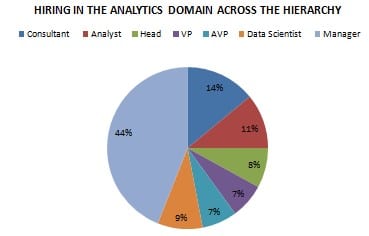 The pie chart here shows the hiring pattern in the analytics domain across the hierarchy, percentage wise.
The list below shows the salary range across hierarchy in the analytics domain -
Fresher's Salary – 2005 - 1,80,000 LPA
Fresher's Salary – 2014 - 6,00,000-12,00,000 LPA
Senior Business Analyst - 12,00,000-15,00,000 LPA
Team Lead - 15,00,000-25,00,000 LPA
Analytics Manager - 25,00,000-40,00,000 LPA
Effect on Analytics Salaries in the next 5 years
- The entry level salaries in analytics are expected to grow at 10 to 20% per annum at least for the next 5 years.
- Professionals in the analytics industry can expect annual pay hikes of about 15% every year.
- Average time for promotion is 18 to 24 months at the lower levels and 2 to 5 years as you move up the hierarchy.
According to a Gartner report in 2014, big data is predicted to create 4.4 million jobs by 2016. As an HR professional, you know there are many decisions dependent on getting incisive information on the talent flow. What are your thoughts on this? Please feel free to write to me on manjushri.shenoy@analyticspeepal.com. You could also call me on +91-9845333518.
Have a great year ahead!
Manjushri Shenoy
manjushri.shenoy@analyticspeepal.com
+91-9845333518
Spotted an error? Tell our editors. Read our editorial standards and corrections.