
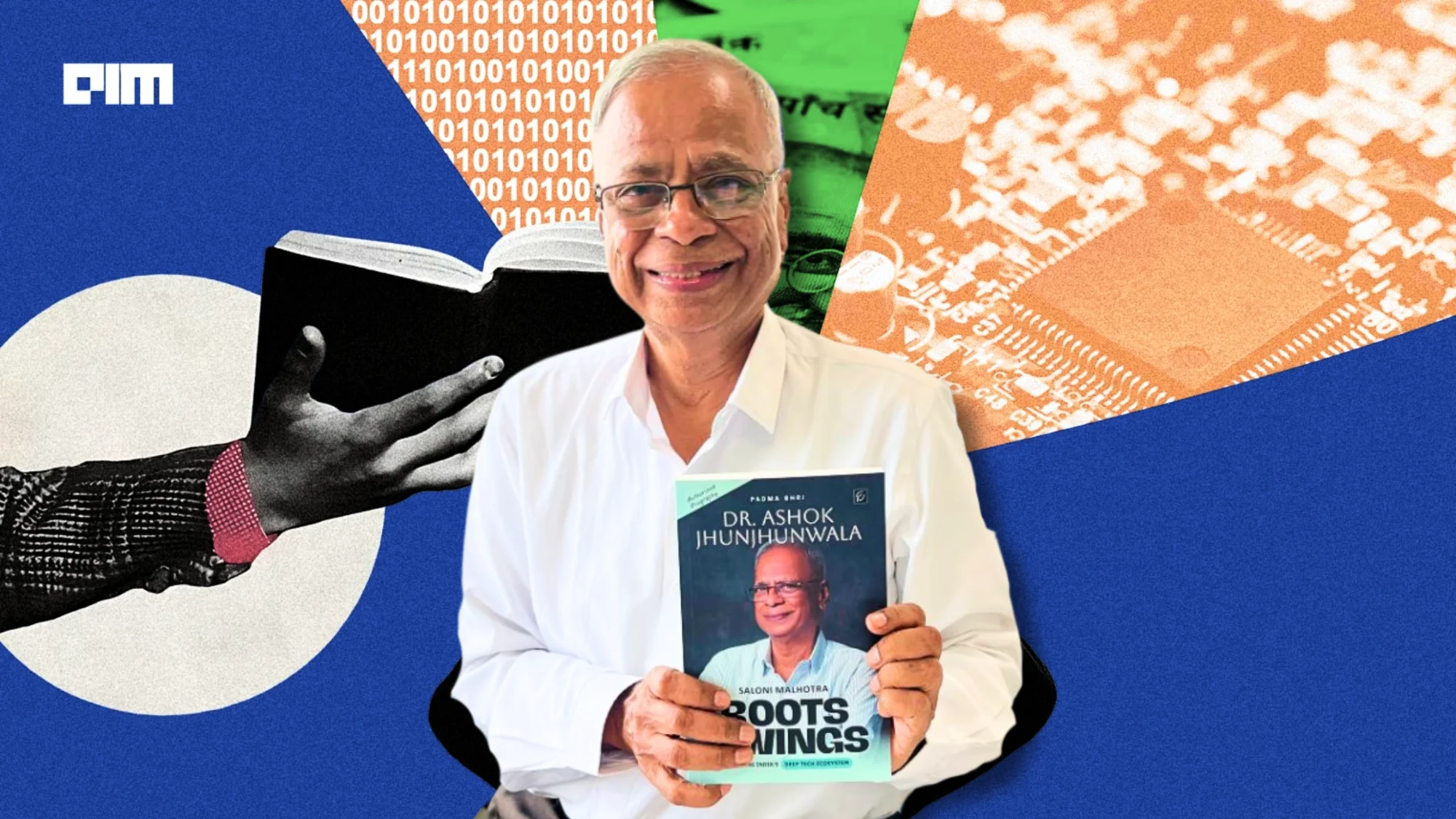
At the Pan IIT Bangalore Summit 2026, the room felt more like a reunion than a book launch. Founders, investors, policymakers, academics—all orbiting one man whose work had quietly shaped each of their journeys. On stage and off, the conversations kept circling back to the same idea: that long before India began talking about deeptech, sovereignty, and self-reliance, Ashok Jhunjhunwala had already started building it.
The occasion was the launch of Roots & Wings: Building India’s Deep Tech Ecosystem, the authorised biography written by Saloni Malhotra. The book attempts to document a career that resists neat summaries: four decades at IIT Madras, establishing the IITM Research Park, and mentoring more than 350 startups.
But the evening itself revealed something else. Jhunjhunwala, who helped India move to low-cost wireless communication in the 1990s, is not interested in looking back for too long.
“Feeling a little bit hurried,” the Padma Shri awardee said, almost apologetically, minutes after the event. Then, almost in the same breath, he shifted focus to what came next. “What we did not talk about is that I have not stopped here. I have taken a new role.”
In an exclusive interaction with AIM, Jhunjhunwala, as the Chairman of Immersive Technology and Entrepreneurship Labs, or ITEL, a Section 8 company, he has one job and one job only: to take on the hardest problems in India, the ones that have no solution yet.
Impossible is the Starting Condition
Jhunjhunwala, who also solved for rooftop solar power and produced innovations in electric vehicle batteries, does not deal in incremental improvements. He frames problems in absolutes.
“You live in Bengaluru. Traffic, anywhere to anywhere, whether 10-12 kilometres or 15 kilometres, takes one-and-a-quarter hours,” he said.
“We want to get you from your home to office, 15 kilometres, in 20 minutes. Period. Impossible.”
The word “impossible” is not rhetorical in his vocabulary. It is the starting condition. The plan is to build national consortia, combining scientists and startups, and “go all out, saying we will find the solution.” Not just find it, but do so in a way that positions India as a global leader. Transport is one problem. Waterlogging is another. Waste, air quality, soil degradation, climate change. The list expands quickly.
This instinct, to anchor technology in India’s hardest problems, runs through both the book and the man. It also shapes his critique of where the country stands today.
“Unfortunately, today in terms of technology, we are pretty much importing everything,” he said. “Very, very few areas are sufficient, and I think this has to change.”
He does not frame this as a policy failure. He frames it as civilisational urgency. “Enough has happened in the last few years in the world to know that if we don’t stand up, we’ll only be beaten,” he said. “From this side to that side, our civilisation cannot allow that.”
The answer, in his view, is not to chase global benchmarks directly but to solve domestic constraints so effectively that leadership becomes a byproduct. “The best way I know to become a leader in technology is if we really solve our problems.”
It is a line that sounds simple, obvious, until placed against the current moment. Jhunjhunwala believes that India’s deeptech ecosystem is flush with capital, policy attention, and ambition. Government-backed funds, venture capital, incubators, and missions are all expanding.
But he draws a sharp distinction between capital and capability. “There is lots of hype, and there is some extremely good strength,” he said. “It is a very unique combination.”
The critique extends to the startup culture. “This whole task is [projected as] a very glamorous task. It is not a glamorous task,” he said. “It is people who starve. They fail and know how to get up.”
Failure, in his telling, is not an exception but the structure of progress. “We will fail when we take on difficult problems,” he said. “But we have to accept failure and say we will dedicate things once again.”
A Philosophy Rooted in His Career
That philosophy is rooted in his own early career. He recounts one of his first industry collaborations, where a partner dramatically cut costs and scaled a technology he himself had not fully completed. “Did I win? Did I lose? I certainly failed,” he admitted. “But he bet on me, and he started talking about me all around his whole industry.”
The lesson was not about success metrics. It was about persistence and trust. “As long as you make a sincere effort, it is okay,” he said. “You need to go on and on till you succeed.”
That same ethos shows up in how he thinks about talent flows. The question of brain drain barely registers as a concern. “We have a large population. Some people can go abroad. There are enough people who continue to live in the country.”
If anything, he sees a reverse pull building over time, driven not by policy incentives but by the nature of the work itself. Even the friction with government, often cited as a structural barrier, is reframed. He acknowledges delays and obstacles, but ultimately sees them as temporary. “If we come up with a really good solution which is technically good and affordable, nobody can stop it,” he said.
Around him, the people he has influenced over decades echo variations of the same sentiment. Vani Kola of Kalari Capital, who was also present at the book launch, described Jhunjhunwala’s ability to push individuals beyond perceived limits. Others speak of his refusal to “hold back,” his willingness to challenge, and his insistence on first principles thinking.
One anecdote captures both the personal and professional dimensions: inviting a visitor home without notice, engaging deeply with an 11-year-old child, and turning even a casual dinner into a lesson in curiosity and simplicity.
There is also a Gandhian thread that runs through his work, often referenced by those who know him closely. Simplicity in living, ambition in problem-solving—a combination that feels increasingly rare in a sector driven by valuation milestones and rapid scaling narratives.
AI, in his framework, is not an end goal. “If I use AI in solving the waterlogging problem and if that is where I win, I win.” It is a quiet rejection of the current framing of technological competition.
“We will invest $10 billion, the US will invest $500 billion. How do you want to win?” he pondered. The implication is clear. Competing head-on in foundational technologies may not be the optimal path. Applying them effectively to uniquely Indian problems might be.
This is where Roots & Wings lands with particular resonance. The book documents a life that consistently chose purpose over prestige, local impact over global optics. It also arrives at a moment when India is trying to define what technological leadership should look like.
Jhunjhunwala, now in his seventies, shows little interest in slowing down. “We are a part of a journey,” he said. “India will succeed. Together.”
Then, almost as a closing note, he returns to the idea that has anchored his career. “We are not worried about failures,” he said. “But we know how to fail, fall, get up, and try again.”

Your reaction
Discussion
What's your take on this story?
No comments yet — be the first to share your view.