
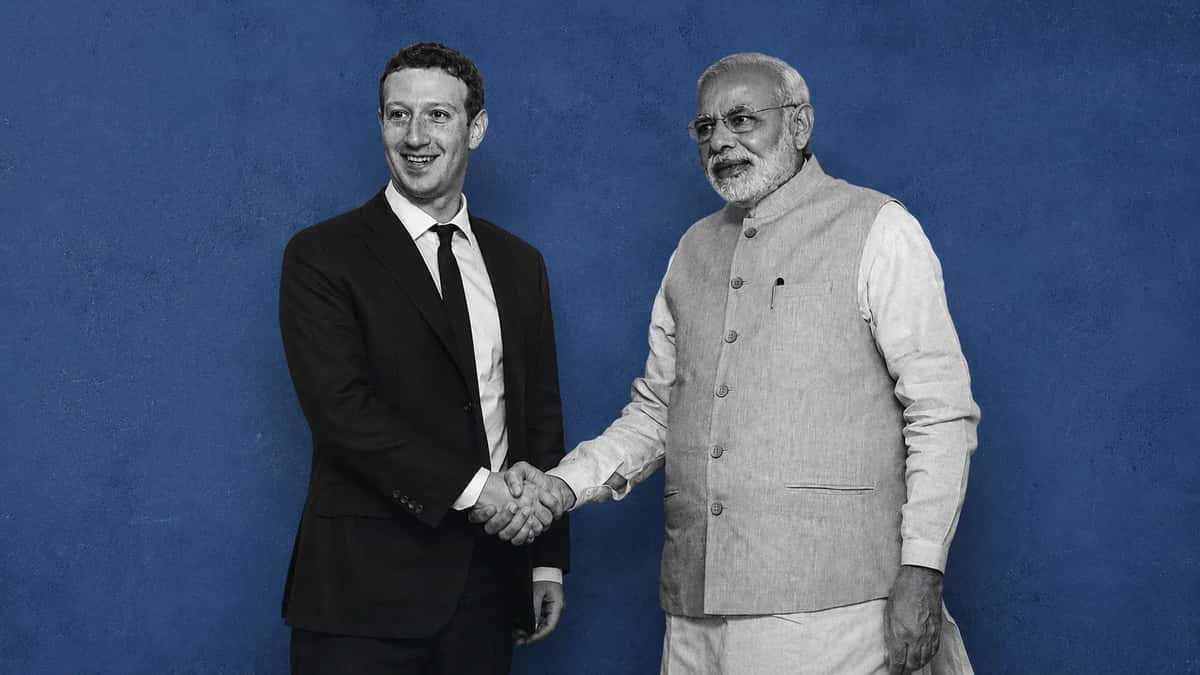

Despite the numerous hugs, pleasantries, and public displays of camaraderie between Prime Minister Narendra Modi and Meta CEO Mark Zuckerberg over the years, Meta's relationship with the Indian government has often been rocky. The latest turbulence was the backlash over Facebook temporarily removing a video posted by PM Modi addressing students at the height of the widespread Cockroach Janata Party protests.
The platform restored the video several hours later, describing it as an operational error. But the Rubicon had been crossed.
Nishikant Dubey, who heads the Parliamentary Standing Committee on Communications and Information Technology, demanded an unconditional apology from Zuckerberg, warning that failure to do so could lead to Meta losing its safe harbour protection under Indian law.
Thus, Meta apologised, with Zuckerberg personally expressing his regret to the Indian government
Joel Kaplan, Meta’s chief global affairs officer, tells AIM in a statement, “I apologised to the minister on behalf of Meta for the error restricting PM Modi’s post.”
For more than two decades, Section 79 of the Information Technology Act, 2000 has provided online intermediaries with “safe harbour” protection, shielding them from legal liability for content posted by users, so long as they comply with prescribed due diligence requirements.
The provision exempts platforms such as Meta, Google, and X from being treated as publishers of what billions of users post on their platforms.
Courts have repeatedly held that intermediaries cannot be held liable simply because unlawful content appears on their platforms. However, they are required to act once they have knowledge of illegal material or copyright violations, or have received a court order or a valid government direction.
Social media platforms have routinely invoked Section 79 in cases involving allegedly defamatory posts, copyright disputes, misinformation, and other user-generated content, arguing that liability rests primarily with the person who creates the content.
If Meta were to lose its safe harbour protection, that legal shield would disappear. The company could potentially be treated as the publisher of content on Facebook, Instagram, and WhatsApp, exposing it to direct civil and criminal liability for user posts.
Overspill
Beyond demanding an apology, the Committee used its August 3 meeting to press the company on a broader set of concerns. Members questioned Meta over child sexual abuse material circulating on its platforms, AI-generated deepfakes, alleged algorithmic bias, verified account safeguards, and the company’s overall content moderation practices.
This was driven by the recent BBC Eye investigation, which found that Instagram had approved and served paid advertisements promoting child sexual abuse material (CSAM). The ads used terms such as “rape video” and “child video” and directed users to Telegram channels where the illegal material was allegedly being sold, raising serious questions about Meta’s ad review and moderation systems.
Media reports quoting officials present at the meeting said the discussions turned unusually combative. According to the reports, government officials accused Meta of prioritising engagement and revenue over user safety, questioning whether the company was “making money from CSAM” by allowing such content to circulate on its platforms.
Officials also reportedly challenged Meta on why its AI systems and moderation tools had failed to detect and remove abusive content despite the company's repeated claims of investing billions of dollars in safety infrastructure.
They further asked why verified accounts, including that of the prime minister, remained vulnerable to operational failures.
According to a report by The Tech Trace, MPs also repeatedly questioned Meta over alleged algorithmic bias, claiming Instagram’s recommendation systems had amplified the Cockroach Janata Party and student protests, with a degree of unfairness. Several members also called for an independent audit of social media algorithms, arguing that platforms increasingly function like publishers rather than neutral intermediaries.
S. Krishnan, the Secretary at the Ministry of Electronics and Information Technology, remarked that the Information Technology Act was written when intermediaries were merely “dumb pipes,” suggesting the existing legal framework no longer reflects the role of modern social media platforms.
Meta was not the only company under the committee’s scanner. Representatives from Google, X, and Snapchat were also called to appear as the Committee examined online safety, user privacy, and the compliance of major social media platforms with India’s intermediary regulations.
What if Safe Harbour was Snatched
The immediate standoff has, for now, ended with Meta’s executives, who travelled to India to attend these meetings and to apologise. But what if the company had stood its ground and did not apologise?
AIM reached out to numerous advocates and legal experts to understand the consequences of the government potentially ending safe harbour protections.
One senior advocate who has worked with Big Tech companies believes the threat is certainly not an empty one.
If Meta had refused to apologise, the government would’ve then had to identify a concrete violation of the intermediary rules rather than simply withdraw its safe harbour protection over the refusal itself.
“They’ll have to figure out what the exact non-compliance under those Rules is that they can use to remove the safe harbour protection,” the advocate says on the condition of anonymity.
Under India’s intermediary framework, platforms continue to enjoy immunity only if they make reasonable efforts to remove unlawful content where required. If a court ultimately finds that an intermediary failed to exercise the level of due diligence expected under the law, it risks losing the protection of Section 79 for the relevant conduct.
According to the advocate, finding such violations would not be difficult if regulators actively went looking for them. He points to the challenge of complying with the IT Rules Amendment 2026, which mandates taking down deepfake content within three hours of receiving an order, compulsory AI labelling, and stricter platform accountability. The timeline for removal of non-consensual intimate or morphed content is even more stringent, with removal mandated within two hours of a valid user complaint.
“In most cases, simply communicating a takedown notice to a platform’s global team takes more than two hours. By then, they’ve already breached the prescribed timeline,” the advocate explains.
Despite that legal possibility, no major intermediary has ever lost its safe harbour protection in India since the framework was introduced. Governments have repeatedly warned platforms over compliance failures, but disputes have generally been resolved through negotiations, meetings, and assurances rather than litigation.
The only recent example was when the Delhi High Court ruled in 2018 that e-commerce marketplaces actively involved in selecting, curating, or facilitating transactions and warranties cannot claim standard intermediary safe harbour under Section 79 if they knowingly host counterfeit goods.
The advocate argues that actually stripping Meta of its intermediary protection would create consequences extending far beyond the immediate controversy.
First, it could trigger a flood of litigation.
Without safe harbour, Meta could potentially face direct civil and criminal claims over large volumes of user-generated content across Facebook, Instagram, and WhatsApp, dramatically increasing the number of cases before Indian courts.
Second, such a move would also carry high political costs. Meta’s platforms remain among the primary digital channels used by political parties, elected representatives, and governments for campaigning, outreach, and advertising. Weakening the legal framework governing those platforms could disrupt an ecosystem that public institutions also depend upon.
For those reasons, the advocate believes that warnings should be viewed primarily as a source of legal leverage rather than an outcome that is likely to be pursued to its conclusion.
“The threat would be possible to execute,” the person notes. “But historically, these situations have usually ended with discussions between the company and the government rather than intermediary protection actually being taken away.”
- AMD’s Server CPU Business Faces a New AI Boom
- How an Engineer Is Using AI to Bridge the Accessible Education Gap
- AI Agents are Making Human Customer Service a Specialist Job
- Why Nandan Nilekani-Backed F2A Believes India's Investment Opportunity Lies in Edge AI
- India Needs to Build the AI 'Brain' for Robotics, Not Just Import Hardware
- Why Enterprise AI Prototypes Break in Production