Key takeaways
- Early black and white films were made with blue-sensitive film, affecting colour registration.
- Digital colourisation began in the 1970s, reviving the lost colours of black and white films.
- The colourisation process is labour-intensive, requiring detailed historical research and technical expertise.
- Advancements in image processing software have simplified colourisation but it remains a time-consuming task.
Overview Of The Model Architecture
In this work, the authors present an end-to-end framework to colourise videos using single references and without losing temporal consistency.
- 4 residual blocks each with 2 convolutional layers.
- The colourisation subnet adopts an auto-encoder structure with skip connections to reuse the low-level features.
- There are 3 convolutional blocks in the contractive encoder and 3 convolutional blocks in the decoder which recovers the resolution; each convolutional block contains 2∼3 convolutional layers.
- It then serves as the last layer to bound the chrominance output within the colour space.
- The video discriminator consists of 7 convolutional layers where the first six layers halve the input resolution progressively.
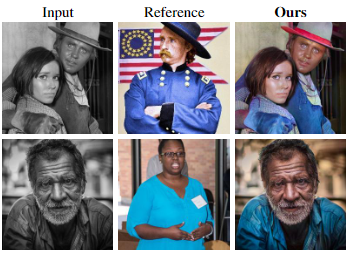 The realistic effects, which this works boast of, has been achieved with the introduction of an adversarial loss. This to constrain the colourisation video frames to remain realistic.
Instead of using image discriminator, a video discriminator is used to evaluate consecutive video frames. The flickering and defective videos had been assumed to be easily distinguishable from real ones, so the colourisation network can learn to generate coherent natural results during the adversarial training.
It is easy for us, humans, to guess the colour of the sky and how the face would illuminate under a street light in comparison to that of a campfire. The effects of colour in an image should be meaningful; have semantic relation to be realistic. And, for a machine to do all this just with one reference is a big ask. But somehow the authors of this paper, claim to have come with a successful solution to arcane problems.
Key Takeaways
- A contextual loss was introduced to encourage colours in the output to be close to those in the reference. The contextual loss is proposed to measure the local feature similarity while considering the context of the entire image, so it is suitable for transferring the colour from the semantically related regions.
- And, a smoothness loss to encourage spatial smoothness. It is assumed that neighbouring pixels should be similar if they have similar chrominance in the ground truth image.
- The authors try to unify the semantic correspondence and colourisation into a single network, training it end-to-end to produces temporal consistent video colourisation with realistic effects.
Spotted an error? Tell our editors. Read our editorial standards and corrections.