Key takeaways
- Prioritize profitability over rapid growth amidst economic uncertainties, as demonstrated by Dukaan's AI integration.
- Recognize that excessive automation may lead to long-term disadvantages, as indicated by a Harvard study.
- Understand the historical parallels between tech revolutions to navigate the current AI wave responsibly.
- Monitor the balance between AI efficiency and human employment to ensure sustainable business practices.
- Evaluate the impact of generative AI on workforce dynamics before making drastic personnel changes.
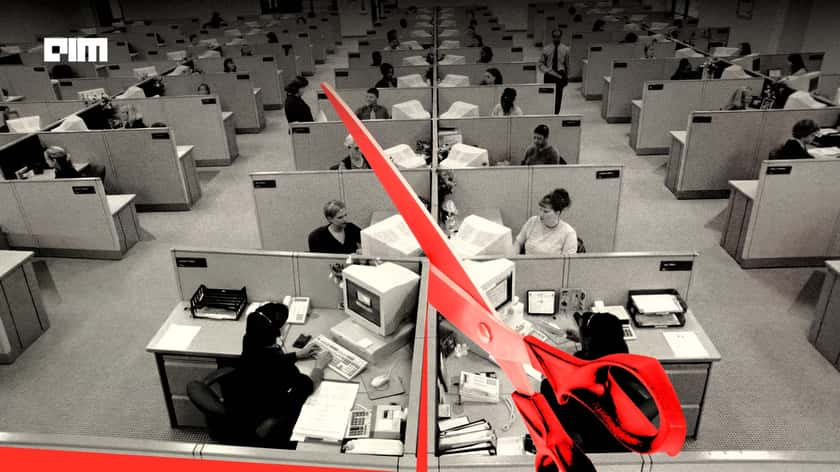
Four months after Bengaluru-based finance start-up Dukaan laid off 90% of its support team because of an AI chatbot, the company’s CEO, Suumit Shah, decided to announce this on Twitter to boast the profitable impact of the company's previous decision.
Referring to the transformation in the company's performance, he highlighted that the time required for the initial response had reduced from 1 minute and 44 seconds to an instant. Further, the resolution time had slashed from an average of 2 hours and 13 minutes to 3 minutes and 12 seconds. “Given the state of the economy, startups are prioritising "profitability" over striving to become ‘unicorns', and so are we,” Shah said.
Dukaan is not the only one to take a huge step amid the ongoing AI revolution due to the dominance of generative AI products and services in the market. Veteran companies like IBM have also taken decisions to let go of human resources gradually and let AI be integrated into the workforce.
Not in favour
The decision to automate several departments is not going to turn out in their favour. The recent Harvard Business Review study ‘Companies That Replace People with AI Will Get Left Behind’, explains so by drawing parallels between the previous tech revolutions at different time periods in history and the ongoing AI wave.
Historically, the study states that industries have never gone through a macro-level unemployment from new technologies, so AI is unlikely to take over people’s jobs in the long term. However, as companies are adopting generative AI remarkably fast, a substantial job displacement in the short term will be visible.
Michael Irwin Jordan, the professor at UC Berkeley and AI visionary Andrew Ng’s mentor told AIM that if tech companies are going to put people out of jobs, "that's maybe okay". But they should not do it so fast that it breaks the economic system. It should be done in a staged way so that people have 10 or 20 years to realise what's happening and make plans around that.
Along similar lines, the HBR study noted AI is different [than the spread of electricity and computing] because companies are integrating it into their operations so quickly that job losses are likely to mount before the gains arrive. White-collar workers might be especially vulnerable in the short-term.
Probable Solutions
Due to the neck to neck competition in the industry, every company is striving to become AI first, probable solutions have been proposed and are being executed by stakeholders in the situation. Several companies like Intuit have begun to think about reskilling programs to retain its workforce with the evolving technology landscape.
In June 2020, the financial software company laid off over 715 employees, while announcing it would add over 700 roles to become an AI-powered company. Since then it has developed programs to upskill employees for technical roles like its signature six-month A.I. course and apprenticeship program.
The AI situation also needs the government to step in either to slow down the commercial adoption of AI (highly unlikely), or to offer special welfare programs to support and retrain the newly unemployed, suggested the HBR study. While conversations are taking place, no concrete approach has been finalised with the help of government intervention.
Globally, several steps of the big tech companies behind these technologies have been criticised heavily amid the continued bloodbath of mass layoffs. Yet no leader has been held accountable for the job losses or unethical restructuring of these organisations.
The recent layoff at Dukaan has caused an outrage and Shah is being called out for being insensitive towards the laid off employees. Whereas IBM’s decision to pause hiring for roles that could be replaced in the coming years looks like a better choice. The bottom line is, it is high time companies and the government harness the power of AI collectively rather than jumping on the bandwagon yet getting left behind.