
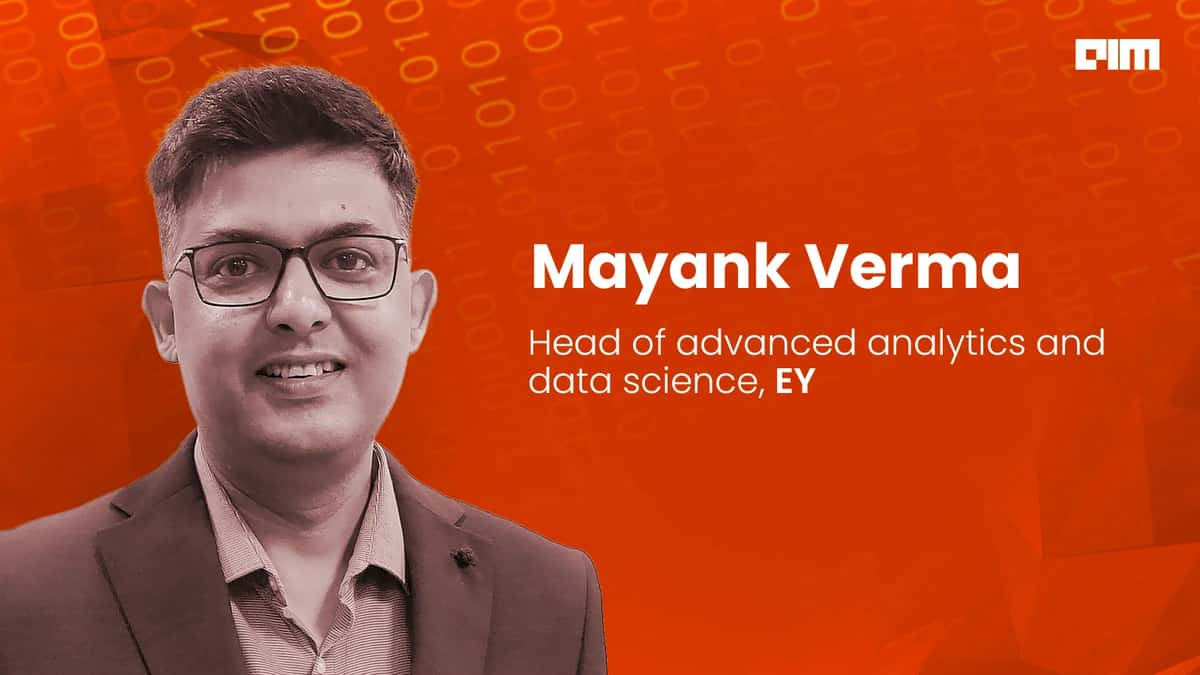
Mayank Verma is the head of advanced analytics and data science at EY India. He graduated in mechanical engineering from NIT Raipur and did his Master's in finance and econometrics at IBS Hyderabad. Mayank also holds an AI product patent and teaches data science at MICA, Ahmedabad.
In an exclusive interaction with Analytics India Magazine, he spoke about his data science journey, patent and interesting challenges he has solved in his storied career.
AIM: What drew you to data science?
Mayank Verma: It all started in the year 2008 when I began working at American Express. Data science wasn’t a well-known field back then. I worked on generating insights from data through econometric models to improve business resilience. I was amazed how economics and mathematics can be applied to data and deeper insights can be fished out to improve business performance. This was the turning point where I decided to devote my career to data science. Fortunately, the field has exploded and become one of the key growth drivers of any enterprise.
AIM: How important is it for data science aspirants to start early?
Mayank Verma: Everyone knows the impact data science has on businesses and communities alike. It is important for aspirants to start early in building their core. Today, topics like AI/ML and data science are being taught in schools. There are many open-source platforms, online hackathons and competitions, where one can learn, collaborate and test their knowledge by doing projects. In the past decade, data science has grown in leaps and bounds. But still, we have just scratched the surface. The knowledge won't come theoretically but with hands-on application.
AIM: Tell us about a challenge/project that stands out in your career.
Mayank Verma: Recently, I worked on developing a forecasting engine for one of our clients that struggled with cash flow management. The cash flow issue arose due to the nature of the business they are in as well as the prevailing high volatility in macro factors. Hence, no standard algorithms were able to predict the cash flow with a greater degree of accuracy.
We worked on this problem and developed a unique adaptive forecasting engine by combining multiple algorithms to capture such variations, both short term and long term. Our solution was able to provide a cash flow forecast with an accuracy of over 94 percent for all markets. The model’s robustness was evident as the client has stress-tested this solution for six months and confirmed the same accuracy over the period. This project stands out amid other niche projects that I was fortunate enough to have contributed to.
AIM: What’s your patent about?
Mayank Verma: The idea came to me during my time at Accenture. My team and I were discussing new ways to identify the financial fraud and AML (anti-money laundering) activities, and how to put a stop to such activities at the source itself. We knew the limitations of current processes, underlying relational databases and standard data science algorithms. The false-positive rate was very high (>20-30%) and had to manage false-negative cases close to 0%. We were quite convinced that we need a solution that can not only mine billions of transactions/information on a real-time basis but also tie the universe of customers together based on their behavioural association with each other. For such a solution, building a multi-agent system data foundation was critical, various AI algorithms have been used to build data foundations on graph databases. Once that was built, we used two kinds of algorithms: To detect the cases which are like previously identified cases, and emerging cases that have a strong probability to become fraud cases in the coming future.
The solution has been validated by a number of experts globally and finally, the patent was granted by both US and EU patent offices.
AIM: How does EY leverage AI/ML?
Mayank Verma: At EY, we thrive to bring maximum business performance improvement to our clients by combining deep sector knowledge with accelerated AI/ML services powered by a trusted data fabric. We don’t look at the problem from a data science lens; we always identify the business problem that can be addressed through data science. We help our clients to embed AI/ML capabilities into core business processes, whether it is driving capital allocation strategies and investment decisions, audits, measuring financial or non-financial performance, improving customer experience, etc.
AIM: What are the key trends in data science?
Mayank Verma: There are six trends that are driving the growth and adoption of AI across sectors and geographies:
- Algorithm’s advancement: The accuracy of prediction models is improving day by day. Apple’s Siri, the virtual assistant, was not as efficient a few months ago, as it is today. This rise in accuracy is the result of a new algorithm being developed that provides a higher accuracy quotient.
- Integration of AI/ML with automation: Process automation is one field that has witnessed the largest integration with AI/ML capabilities. This field has now been rebranded as intelligence automation and is a vital contributor to the great demand for data science.
- Scaled engineering: Thanks to the emergence of centralised infrastructure, you can carry out the DevOps remotely and scale it to interact with large datasets simultaneously.
- New data sources: The more data you have, the better your model performs.
- Cloud-based solution: Cloud-based Cloud-based solutions have given all AI/ML-based models the flexibility to perform on a global scale.
- Acceptability of AI/ML by leadership: CEO, CTO and CXOs have put their trust in AI/ML. Without leadership support, you can't use technology in business to get the maximum benefit.
AIM: What’s your long-term vision?
Mayank Verma: My vision is to democratise the data science field so that it can be used by everyone. There are two factors that can make this feasible:
- Bring awareness to the community
- Develop simplified AI/ML applications which are easy to use.
At EY, we are working on these factors diligently. We have been building user-friendly applications by combining the human-first approach with technology superiority. We are also partnering with universities and colleges to skill up the next generation in data science and AI/ML.
AIM: What’s the one piece of advice you have for data science aspirants?
Mayank Verma: Never settle for less and always question the status quo. There are immense opportunities and means available to make the world a better place, and we all can make this happen if we strive to solve complex issues with the use of intelligent technologies.
- India’s GCCs to Add 1.4 Million Jobs, Drive 170 Million Sq. Ft. Office Demand by 2031
- AI Can Be Cyborg or Centaur. But Can Enterprises Monetise It?
- AMD’s Server CPU Business Faces a New AI Boom
- How an Engineer Is Using AI to Bridge the Accessible Education Gap
- AI Agents are Making Human Customer Service a Specialist Job
- Why Nandan Nilekani-Backed F2A Believes India's Investment Opportunity Lies in Edge AI