

While Google has built almost every layer of the modern AI stack, one of its biggest successes has come from a far smaller corner of its portfolio, the Gemma family of open-weight models.
Rather than competing head-on with frontier models such as DeepSeek or GLM, Gemma focuses on delivering capable AI small enough to run locally, a strategy that appears to have resonated with developers. Since launching in 2023, the Gemma family has surpassed 400 million downloads and says it has inspired more than 100,000 community-fine-tuned variants.
The latest iteration, Gemma 4, ranges from a 2-billion-parameter model to a 31-billion-parameter variant, targeting everything from offline, on-device assistants to reasoning and coding tasks.
Google describes Gemma 4 as its ‘byte for byte, the most capable open models’, maximising ‘intelligence per parameter’ through tightly integrated model architecture, quantisation, inference, and deployment tools.
That approach has helped Gemma carve out a distinct niche among developers building local, privacy-preserving AI applications.
The Encoder-Free 12B Variant
“Where Gemma completely shifts the paradigm against strong competitors like Qwen or Mistral is its radical approach to efficiency,” Harshil Shah, Head of Generative AI at US-based IT firm R Systems, tells AIM.
“With Gemma 4, particularly the 12B model, Google moved to a unified, encoder-free multimodal architecture.”
Unlike traditional multimodal models, which rely on separate vision and audio encoders before passing their outputs to the language model, Gemma 4 12B feeds raw image and audio representations directly into its core language network. Eliminating those additional networks reduces memory overhead while allowing the model to reason natively across text, images, and audio.
“If I have to point to one definitive sweet spot for Gemma, it is on-device, multimodal workflows,” says Shah.
Strong Multimodal Performance
By combining native vision, audio, and reasoning in a compact model, Gemma provides a compelling platform for local AI agents.
Unlike Qwen, which keeps vision in a separate Qwen-VL branch, Gemma 4’s model card lists document/PDF parsing, screen and UI understanding, OCR, and variable-resolution image processing as core capabilities in the same family that handles text reasoning and function calling. Since vision, audio, and text share the same decoder, developers can fine-tune the entire multimodal model with a single LoRA (low-rank adaptation) instead of adapting separate encoders.
Those architectural choices are complemented by a series of optimisation techniques that further improve Gemma's reasoning, efficiency, and deployment.
Another major addition in Gemma 4 is a configurable thinking mode, which Google says allows the model to generate an internal reasoning trace before producing its final response. Enabled by a dedicated control token, it improves reasoning on tasks such as mathematics, coding, and multi-step problem-solving while allowing developers to trade off quality against latency.
Quantization-Aware Training (QAT), which teaches the model to handle low-precision arithmetic, enables aggressive compression without significantly degrading Gemma’s text, vision, or audio capabilities, making it practical on modest hardware.
Multi-Token Prediction (MTP), meanwhile, speeds up inference by using a lightweight draft model to predict multiple tokens ahead before the main model verifies them in a single pass.
Google further improves this process by sharing the KV cache between the draft and target models, avoiding redundant computation while improving throughput.
In a recent blog post, Hugging Face also highlights Gemma 4’s hybrid attention architecture as another optimisation aimed at efficient long-context processing. Rather than applying full attention throughout the network, the model alternates between local sliding-window and global attention, reducing compute and memory requirements while preserving long-context reasoning.
Those architectural choices translate directly into real-world deployment, which is why many developers say Gemma stands apart.
Strong On-Device Inference Optimisations
Jesai Tarun, Founder of Sentient OS, says that these engineering decisions were a major reason his company chose Gemma for an application that serves as an on-device intelligence layer for a user’s entire digital life, processing files and screenshots locally.
Tarun emphasises that Google’s dedicated LiteRT-LM framework provides unusually fine-grained hardware control by allowing developers to dynamically load or exclude specific parts of the model to reduce memory usage.
“You can load up the model to only respond to text if you won’t use the image part of it. It’ll then use less RAM,” he explains.
Because Google built both the model and inference engine, developers gain optimisations largely unavailable in framework-agnostic runtimes.
He also highlights that Google’s implementation of MTP (multi-token prediction) is considerably simpler than the higher-latency implementations found in many community frameworks. Unlike speculative decoding approaches that run two largely independent models, “the draft model inside Gemma shares the same computations as the larger model inside of Gemma,” Tarun says, explaining that this significantly speeds up inference.
Moreover, Gemma’s advantage shows up during deployment rather than in the model's overall download size.
Google says its official 4-bit QAT checkpoints reduce the Gemma 4 12B model's memory requirement from 26.7 GB to around 6.7 GB, while the E2B and E4B variants can run in as little as 1.1 GB and 2.5 GB of memory, respectively.
Gemma 4 (specifically its edge-optimized E2B and E4B variants) running fully offline on an iPhone via apps like Locally AI or Google AI Edge Gallery.
Download the ~1.5 GB quantized model, all inference happens on-device using Apple Neural Engine.pic.twitter.com/TnDE5eji1m
— Rohan Paul (@rohanpaul_ai) April 19, 2026
Supports 140+ Languages
Gemma has also emerged as one of the strongest open-weight models for multilingual AI.
Adithya S Kolavi, Founder of CognitiveLabs that has undertaken numerous multilingual and multimodal projects, strongly recommends the Gemma family for multilingual AI applications.
“It has excellent language coverage, a highly efficient tokeniser, and a strong multilingual data distribution, which makes it one of the easier open models to fine-tune for region-specific or multilingual use cases,” he says.
Google says the model supports more than 140 languages and reports that its flagship 31B variant scores 85.2% on the Massive Multitask Multilingual Language Understanding benchmark that measures knowledge and problem-solving skills across 57 diverse subjects.
The models inherit the same 262,000-token vocabulary used in Gemini and are trained on a diverse multilingual corpus spanning text, code, images, and audio.
Community evaluations have also highlighted particularly strong performance across several European languages, placing Gemma 4 among the leading open-weight models for multilingual reasoning and translation.
Google's Gemma 4 26B A4B running on MacBook Pro M5 Max
100% native Swift
Achieving over 100tk/s with Apple MLX framework pic.twitter.com/j5w1foONU3
— Adrien Grondin (@adrgrondin) April 15, 2026
Where Qwen Exceeds
Despite these strengths, developers say Gemma is not the best choice for every workload.
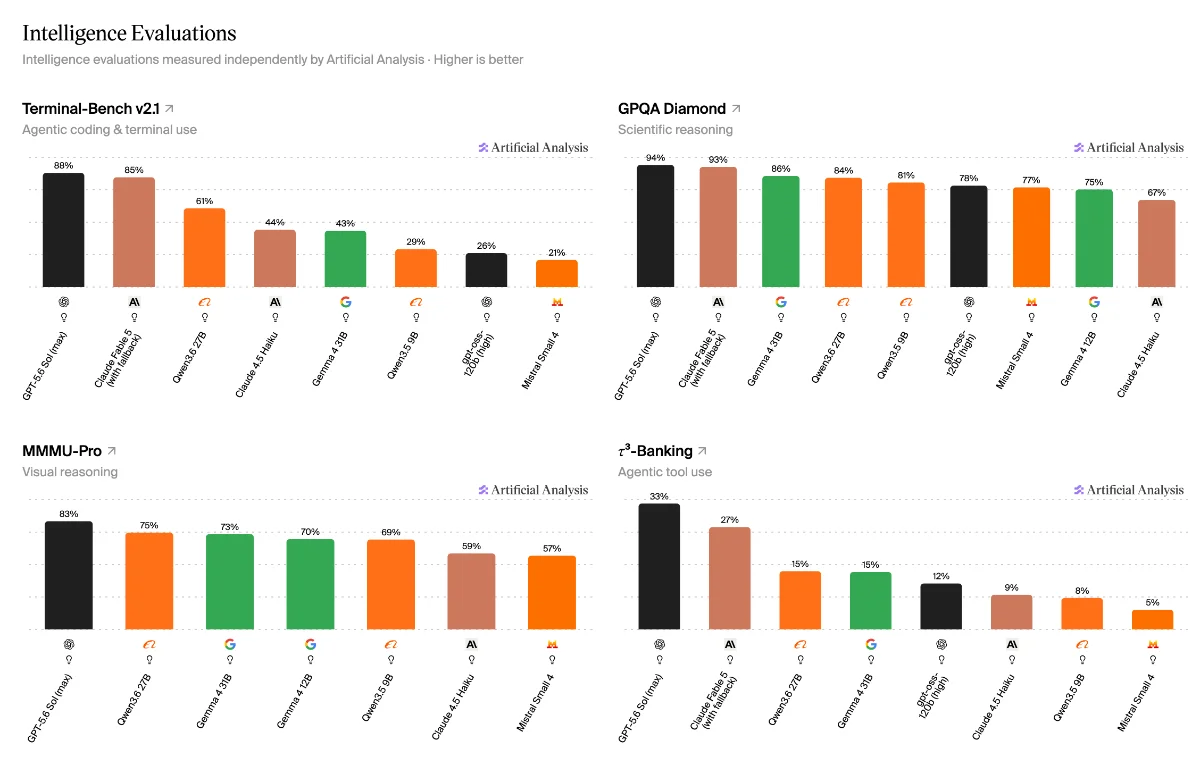
“If you want coding performance, the latest Qwen 3.6 models at the same size as Gemma models are way better, even in agentic terminal use,” says Tarun.
Google’s official benchmarks show the Gemma 4 26B A4B scoring 68.2% on TAU2-Bench, a benchmark that evaluates an AI model’s ability to autonomously plan, use external tools and complete multi-step agentic tasks across realistic scenarios. In comparison, Alibaba’s similarly sized Qwen3.5-35B-A3B scores 81.2%, indicating a sizeable lead in complex tool-use and agentic workflows.
Similarly, Alibaba’s newer Qwen 3.6-27B also pulls ahead across software engineering evaluations.
But Google remains unfazed. Its goal with Gemma is to build the most deployable family of open-weight models, and running locally is where it finds its strength.

Your reaction