Key takeaways
- Hardware plays a crucial role in AI applications, emphasising the importance of computing power and information relay efficiency.
- Researchers at UCLA have developed neural networks for tasks like handwritten digit recognition and imaging lenses.
- Optical techniques are being explored to enhance the performance of deep learning algorithms.
- The integration of optical components in neural networks has historical roots, dating back to studies in 2004.
- Previous attempts at implementing optical systems in deep learning faced challenges, but recent studies show renewed interest.

An Optical Approach
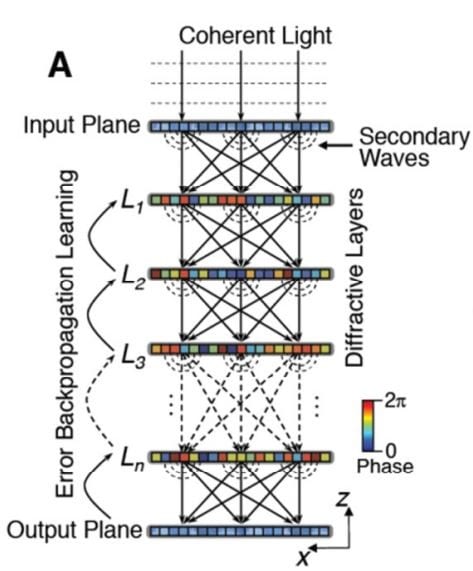
The first record of a scientific study which had optical components for neural networks was in 2004. This study focussed on using a particular tool called matrix gratings for recognition through the Hopfield network. Later, other studies looked at the physical implementations which were conceived as programmable array logic devices or even as analogue computers. However, these did not progress well and stalled for a while in research before one novel study tried exploring deep learning under optical systems. This research paper titled All-Optical Machine Learning Using Diffractive Deep Neural Networks, Xing Lin and team from UCLA construct and implement a physical neural network itself based on optical phenomena such as diffraction and interference. Termed as ‘diffractive deep neural network (D2NN)’, each neuron in the network layer is optically connected to another neuron in the subsequent layer with light waves.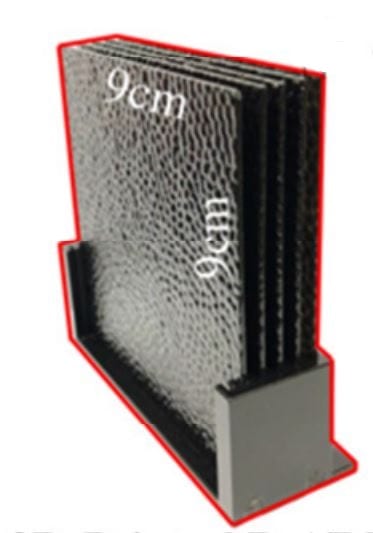
Network Architecture And Implementations
As mentioned earlier, since D2NN works on diffraction, the network architecture consists of transmissive layers placed between the input and output layers. Every point in the transmissive layer is a neuron having a transmission coefficient. In fact, it is these coefficients that are trained to perform learning tasks at the speed of light. An important factor taken here is when the secondary light waves pass through this architecture and undergo diffraction, the amplitude in the transmission coefficient of a neuron is assumed to be constant i.e, only phase term is the focus of study. So, this is achieved through error back-propagation algorithm based on stochastic gradient descent (SGD). A detailed account can be found here.Once the setup is ready and a physical model is obtained through a 3D printer, D2NN is trained and tested as a classifier as well as an imaging lens separately.