Key takeaways
- Explore how Japan's copyright laws allow AI training on protected artworks, sparking ethical debates.
- Investigate the trend of 'Ghiblification' as OpenAI's GPT-4o generates Studio Ghibli-style images.
- Consider Hayao Miyazaki's view on AI art, emphasizing concerns about its impact on creativity.
- Understand the functionality of GPT-4o's image generation, enabling diverse visual content creation.
- Engage with ongoing discussions about copyright implications of AI-generated art and its future.
Grant Slatton, a founding engineer at Row Zero, used OpenAI’s 4o image generation to generate a Studio Ghibli version of a picture, sparking a trend that’s still going strong as of now. Those who have not tried it yet, there’s a good chance they will join in after hearing about it.
Recently, OpenAI, the company behind ChatGPT, introduced native image generation features in GPT-4o. This development enables GPT-4o to produce a wide range of images, including infographics, comic strips, signboards, graphics, menus, memes, street signs, and more.
It is also possible to refine and edit images generated with follow-up prompts. The feature is available for users with Plus, Pro, Team, and Free plans.
However, the trend has raised several crucial questions: how was the model able to replicate Studio Ghibli’s art style so accurately? Aren’t there copyright issues involved? What exactly made this possible in the first place?
Japan’s Law on Training AI Models on Copyrighted Work
To start with, DeepLearning.AI, in a blog post in 2023, highlighted that Japan’s laws enable developers to train models on copyright-protected materials.
Notably, many raised concerns about this law. In 2024, the Japanese government’s Agency for Cultural Affairs published a document titled ‘General Understanding on AI and Copyright in Japan’.
The document explained the concepts of when the copyright laws come into effect, and when the data, irrespective of copyrights, can be used for AI.
It stated that, when discussing AI and copyright, it is crucial to distinguish between the exploitation of copyrighted works during the AI development and training phase and infringement during the generation and utilisation phase.
“Exploitation of a copyrighted work not for enjoyment of the thoughts or sentiments expressed in the copyrighted work...may, in principle, be allowed without the permission of the copyright holder,” it further read.
It explained that “enjoyment” in the above context refers to “the act of obtaining the benefit of having the viewer’s intellectual and emotional needs satisfied through using copyrighted work”.
This means that anyone developing an AI model does not need the consent of the copyright holder if the purpose of the training is not for enjoyment purposes.
The document mentioned that if AI training generates content closely resembling copyrighted works, or if such works are used as input for generative AI to implement retrieval augmented generation (RAG), it would not qualify as being for non-enjoyment purposes.
Notably, the document further stated, “Copyright protection applies to the ‘creative expressions’ of an idea and not to the idea itself. Therefore, an AI-generated material which applies the ‘creator's style’ of a preexisting copyrighted work does not infringe copyright if the style merely encompasses an idea.”
Gergely Orosz, creator of The Pragmatic Engineer Newsletter, highlighted a similar observation on X. “[I] was wondering why OpenAI chose to showcase images in the style of Japanese art studio Studio Ghibli, but not Disney characters, Marvel Comics, etc. I suspect it's because Japan is the only major country that made training on copyrighted works legal.”
Evan Brown, an intellectual property lawyer at Neal & McDevitt law firm, told TechCrunch that products like GPT-4o’s native image generator operate in a legal gray area, considering style is not explicitly protected by copyright.
Studio Ghibli Gets Well-Deserved Visibility
While the internet continues to debate the ethics of AI mimicking the art style of an award-winning Japanese animation studio is right or wrong, the trend has firmly taken hold, with many now labelling the creations as ‘Ghiblified’ images.
Even famous personalities, like Sachin Tendulkar, took to X to and shared ‘Ghiblified’ versions of his favourite memories.
AI-sa kuch trend ho raha hai, maine suna. Toh socha, what if Ghibli made cricket? pic.twitter.com/NdKptwOliM
— Sachin Tendulkar (@sachin_rt) March 27, 2025
Sam Altman, CEO of OpenAI, also shared a team photo when launching the image generation capabilities to ChatGPT and Sora.
this was a real labor of love from @gabeeegoooh. congrats gabe; excellent work!
— Sam Altman (@sama) March 25, 2025
here is what we generated during the livestream: pic.twitter.com/fmHWp4d9AF
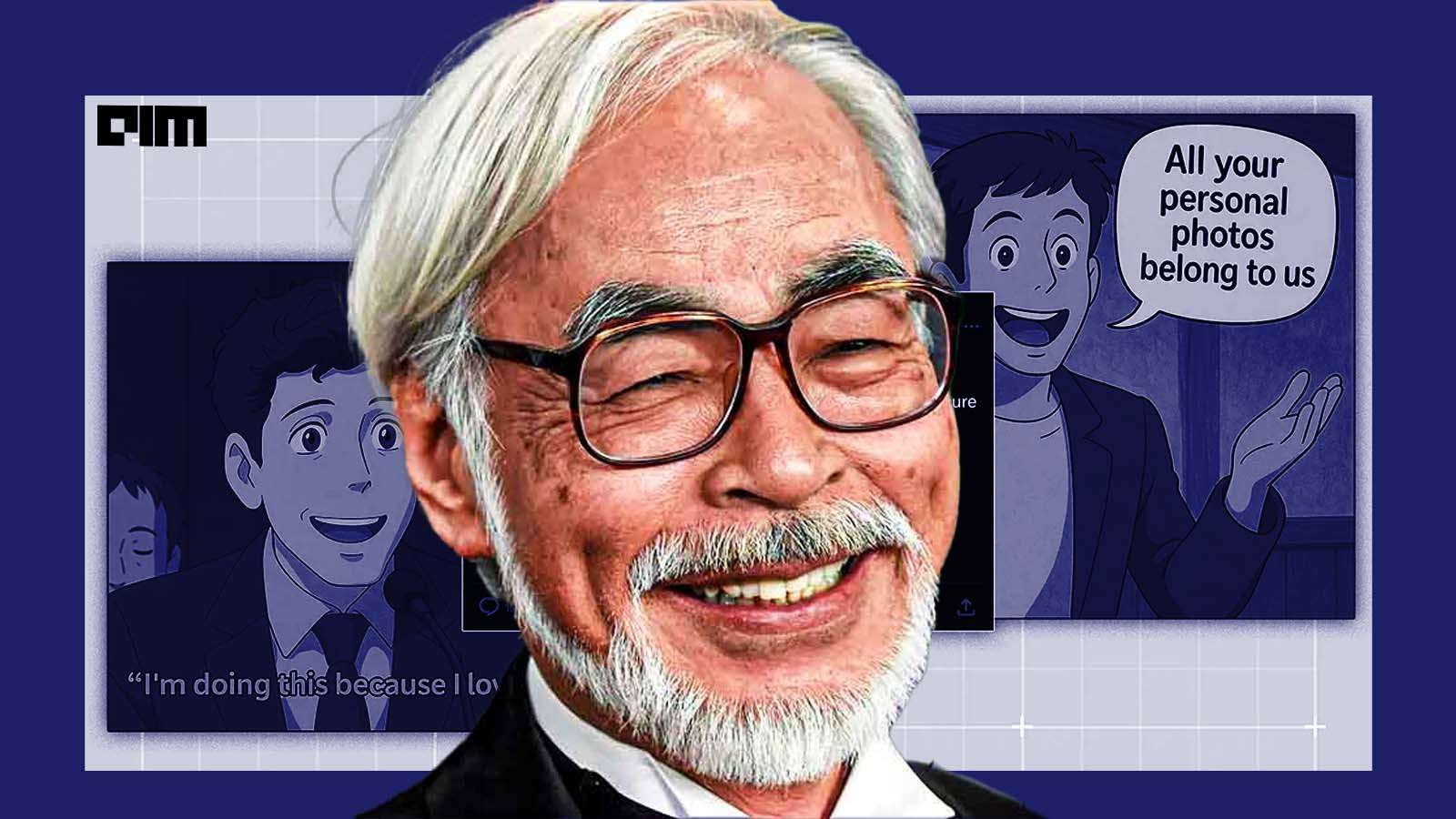
Amidst the trend, an old remark from Hayao Miyazaki, one of the founders of Studio Ghibli, on AI-generated art being an “insult to life itself” has resurfaced.
Despite the copyright concern and the ethical angle of recreating an art style, the legacy of the original art style can never be replaced.