
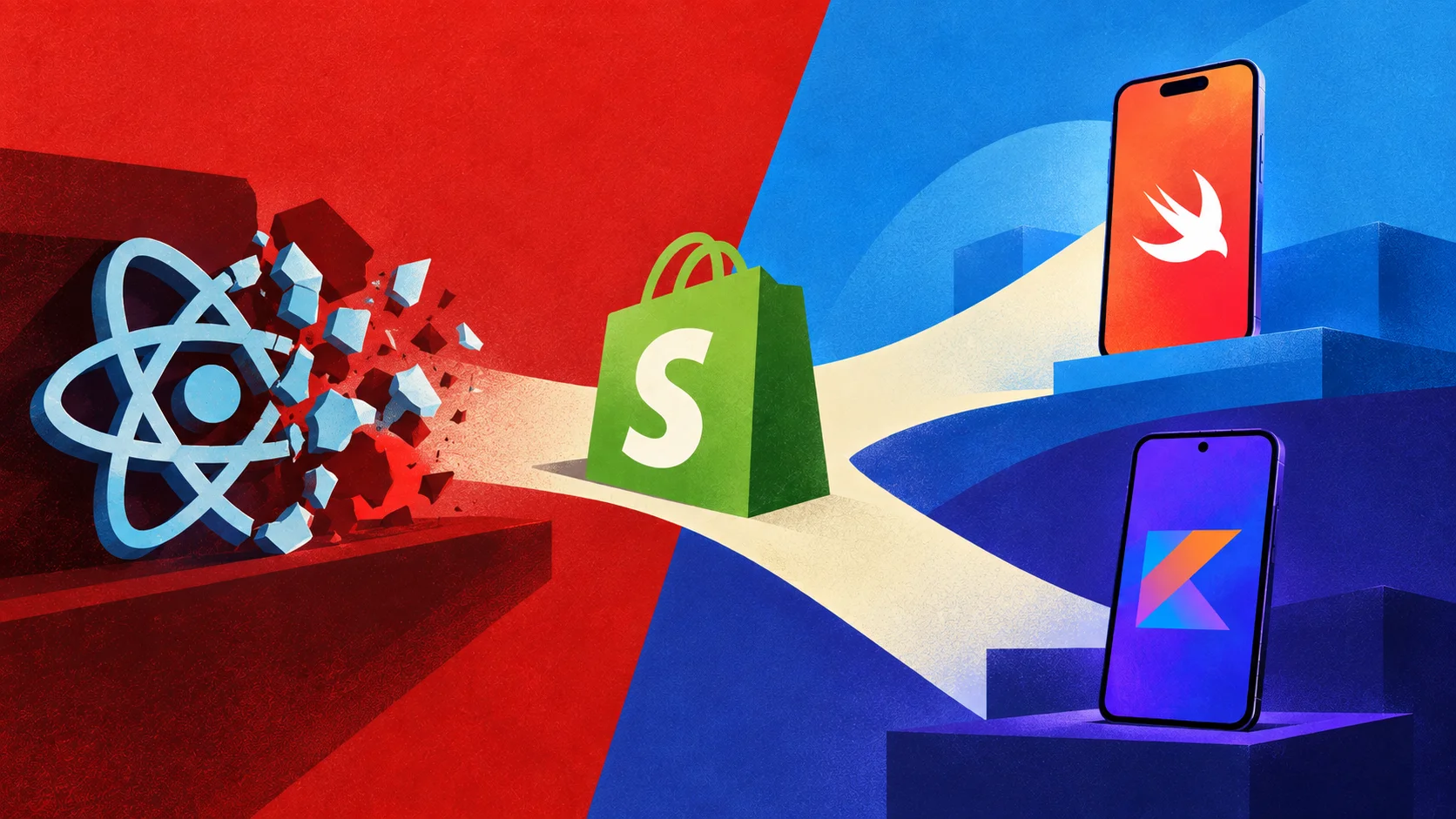
Six years ago, Shopify announced it would move away from separate codebases for iOS and Android and adopt React Native. This reduced duplicated engineering work and provided up to 99% code sharing for some of its products.
But now, the company has reversed its decision. And as with most engineering decisions today, AI was behind it.
The company has now moved back to separate code bases for Android and iOS.
“Coding models have gotten dramatically better, and for our apps and our team, building the same feature in Swift and Kotlin no longer carries the same cost as it used to,” Mustafa Ali, Shopify’s director of engineering, wrote in a blog post.
“LLMs changed one of our core assumptions behind our 2020 decision.”
Ali wrote that coding agents could now reduce the time to implement new features on Android and iOS, which have separate code bases. “Agents have reduced the advantages of sharing implementation, while the advantages of building for each platform remain,” he wrote.
He adds that this ‘Native’ stack keeps Shopify closer to first-party tooling, with fewer framework and dependency layers between the platform and the company’s code.
With this new native architecture, Shopify said startup time for the Shop app dropped by 23% on iOS and 50% on Android. Session stability rose from more than 99.5% to more than 99.95%, which Shopify described as a tenfold reduction in crashing sessions. The Android release build also shrank by 109 MB, or 37.2%.
Engineering decisions, particularly success stories from technical blogs, have often inspired teams both small and big, but the general consensus this time around is that Shopify could afford to do it given the scale at which they operate.
Shopify Could Afford to Pay for the Advantages
The company could simply afford to maintain two separate codebases, thanks to AI. Thus, it doesn’t make sense for everyone to copy the same playbook. This also leads to higher token spend, engineering effort, and time to maintain two codebases.
Alex Mikucki, Principal Software Developer at Software Mansion and former core contributor at Expo, tells AIM, “If you have a lot of tokens and custom tooling, you can build great native apps on two platforms at once.”
Mikucki also explains that the company’s rewrite was unsurprising, arguing that declarative UI frameworks such as SwiftUI and Jetpack Compose are similar enough for agents to migrate between them effectively.
He says that his experience in building Expo Go’s UI in Jetpack Compose has reinforced that view, but also cautions that the harder challenge is maintaining consistent business logic and behaviour across separate native codebases. “I’m sure that the decision they took is reasonably well explored and thought out for their use case.”
However, Mikucki also underscores the advantages of React Native. “The abstraction layer of React Native still has its value: OTA, server-driven UIs, platform quirks already abstracted/handled for you, and more.”
He also explains that the falling cost of writing lower-level code with AI doesn’t automatically make abstractions obsolete, pointing to various community-driven efforts, projects, and frameworks available for free.
React Native is for Everyone
Another engineer said on X that, on paper, for Shopify, “having AI port your iOS app to Android while keeping specs and tests aligned sounds like a dream.”
However, he said that relying on AI to build and maintain an Android app from Swift code on iOS, “especially if you don’t know Android, feels like playing with fire.”
He said that working with native codebases requires a deep understanding of the lifecycle, performance metrics, or architectural patterns of operating systems.
“AI is eventually going to feed you unmaintainable spaghetti code. Shopify can pull this off because they have an army of senior devs reviewing every pull request and custom internal tools to keep the AI in check,” he said. “Most teams simply don't have that kind of safety net.”
He added that for startups and indie app developers, React Native is still a killer choice. “It lets you iterate crazy fast, share logic, and ship products without the overhead of running two completely separate native projects.”
For Shopify, being right next to the ‘bare metal’ of operating systems still wins out. “But AI isn't a magic wand that erases the need for real native expertise; it just speeds up people who already know what they are doing,” he noted.
‘React Native is Native’
Gregg Luskin, Founder and CTO of logistics and freight technology company Mothership, also argued that people are taking the wrong lesson from Shopify’s migration.
“React Native is native. With the new architecture and a competent team, there should be effectively no noticeable difference for the vast majority of product experiences,” he wrote on X.
He pointed to the framework’s ability to share not just UI code, but TypeScript, API clients, validation, and business logic across platforms, alongside faster development cycles and OTA updates.
“For most companies, I’d still take one extremely good React Native app over two extremely good native apps, especially if the rest of the company already speaks TypeScript,” he said.
Shopify’s migration caused a stir among the React Native community, with users coming out in strong defence of the framework.
Mikucki argued that the community should focus less on accepting the framework’s limitations in the name of flexibility and more on building tools that make the path easier for both developers and coding agents.
“I think we need to do a better job as a community of pushing developers down a pit of success—a set of high-quality tools built with a lot of effort that just work for agents and users alike,” he said.
“The current fragmentation is both a strength and a curse of React Native, but we shouldn’t accept obvious limitations for the sake of choice and total customisation.”

Your reaction