
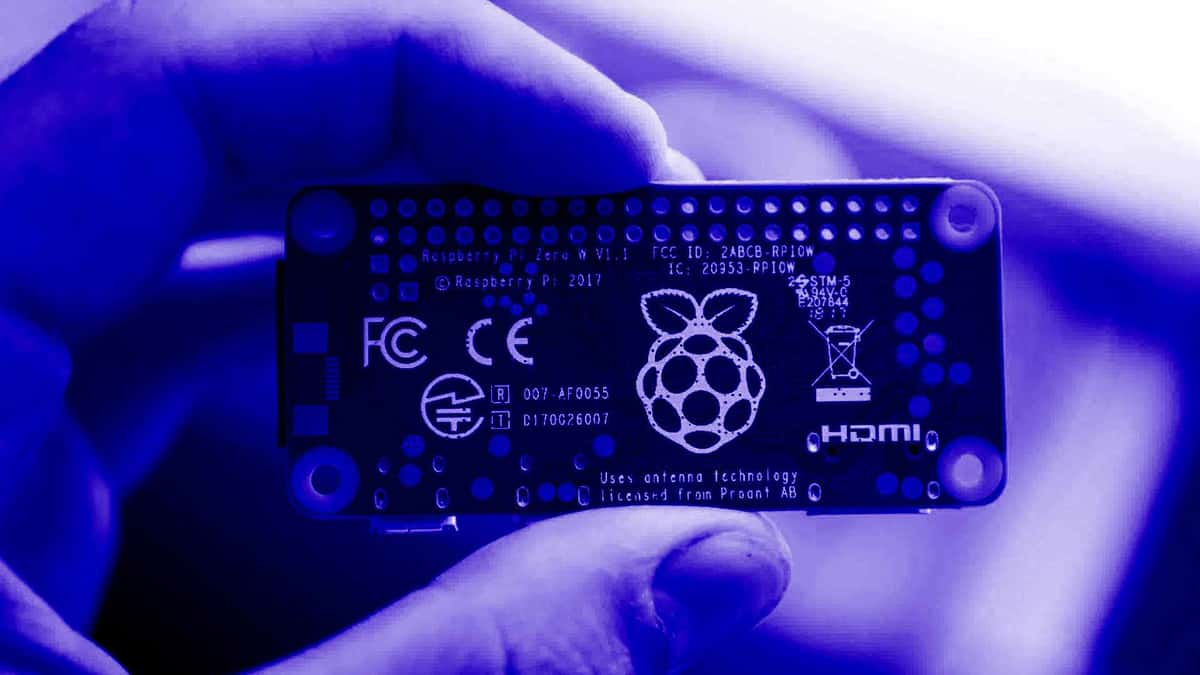
The tiny pocket-sized computer Raspberry Pi recently completed ten years of its existence, and it has now become more than just a computer. It has been widely used among students, teachers and enthusiasts to push their boundaries of technology, and engineers and IT managers use it for their professional work.
On completion of ten years, Eben Upton, the founder of Raspberry Pi, said, "Ten years ago, when Raspberry Pi computers began their sale, about 1,00,000 orders were already placed, and we had out-trended Lady Gaga very briefly. Raspberry Pi was on the road to become a little larger than we had planned."
Raspberry Pi computers are largely used in weather monitoring, desktop PCs, wireless print servers, media usage, game servers, retro gaming machines, robot controllers, stop motion cameras, time-lapse cameras, FM Radio stations and web servers. They are now used prominently in robots, AI-driven cameras, and smart-home devices.
The Raspberry Pi Foundation was founded in 2009 to promote basic computer science in schools. A team from Cambridge University's Computer Laboratory saw a declining interest in computer science and created an easy, low-cost access to a computer.
Timelines of the launch of various Raspberry Pi computers
Raspberry Pi 1 Model B
April 2012
Raspberry Pi 1 Model B, the first model, was launched in 2012 and used a Broadcom BCM2835 SoC, which included a 700 MHz ARM1176JZF-S processor, VideoCore IV graphics processing unit (GPU) and had 512Mb. A lower-cost Model A was also launched; it had less memory and fewer USB ports.
Raspberry Pi 2 Model B
February 2015
The RPi2 increased computing power significantly using a Broadcom BCM2836 SoC, utilising a quad-core Cortex-A7 900 MHz processor. The computer had also doubled its memory to 1 GB with a shared GPU. The CPU was at least 4-6 times more powerful than the previous computer.
Raspberry Pi Zero
November 2015
This computer set a new benchmark in low-cost computing, which was priced at just around $5/£5. The size of the computer was around 65mm x 30mm x 5mm, which could be embedded in robotics and other applications. The CPU of RPi Zero was 40 per cent faster than RPi 1.
Raspberry Pi 3 Model B
February 2016
The RPi3 used a 64-bit compatible SoC and bumped up the processing power to 4×Cortex-A53 1.2 GHz. It offered 802.11n wireless and Bluetooth 4.1, giving it an even greater appeal to consumers. These computers could be mounted in remote locations and still access data that the computer could record.
Raspberry Pi 1 Model B+
March 2018
The upgraded B+ increased the ethernet speed up to 300 Mbit/s, introduced 802.11ac dual-band 2.4/5 GHz wireless and Bluetooth 4.2 LS BLE, and a small bump in the CPU speed to 1.4 GHz.
Raspberry Pi 4 Model B
June 2019
This model has a 1.5 GHz 64-bit quad-core ARM Cortex-A72 processor, on-board 802.11ac Wi-Fi, Bluetooth 5, full gigabit ethernet, two USB 2.0 ports, two USB 3.0 ports, 1–8 GB of RAM, and a dual-monitor, which was supported via a pair of micro HDMI (HDMI Type D) ports for up to 4K resolution. When used with an appropriate PSU, the Pi 4 can also be powered via a USB-C port, enabling additional power to downstream peripherals. This Pi could be operated only with 5 volts and not 9 or 12 volts like other minicomputers of this class.
Raspberry Pi 400 Kit
November 2020
This model featured a custom board derived from the existing Raspberry Pi 4, and it was remodelled with a keyboard attached. A robust cooling solution, the broad metal plate and an upgraded switched-mode power supply allowed the Raspberry Pi 400's Broadcom BCM2711C0 processor to be clocked at 1.8 GHz. The keyboard-computer features in this model had 4 GB of LPDDR4 RAM.
Raspberry Pi Zero
Raspberry Pi Zero was launched in November 2015 with a smaller size and reduced input/output and general-purpose input/output capabilities.
Raspberry Pi Zero W was launched in February 2017; it was a version of Zero with Wi-Fi and Bluetooth capabilities.
Raspberry Pi Zero WH was launched in January 2018; it was a version of Zero W with pre-soldered GPIO headers.
Raspberry Pi Zero 2 W was launched in October 2021; it was a version of Zero W with SiP designed by Raspberry Pi and based on Raspberry Pi 3. Pi 2W has 64-bit capabilities.
Raspberry Pi Pico
January 2021
The Pico has 264 KB of RAM and 2 MB of flash memory. This model is programmable in MicroPython, CircuitPython, C and Rust. The Pico partnered with Vilros, Adafruit, Pimoroni, Arduino and SparkFun to develop accessories for Raspberry Pi Pico and boards using RP2040 Silicon Platform. Pico was mainly designed for physical computing.
Raspberry Pi models are affordable and flexible. The uncountable projects that one can do using these tiny computers, make them relevant even today.
- India’s GCCs to Add 1.4 Million Jobs, Drive 170 Million Sq. Ft. Office Demand by 2031
- AI Can Be Cyborg or Centaur. But Can Enterprises Monetise It?
- AMD’s Server CPU Business Faces a New AI Boom
- How an Engineer Is Using AI to Bridge the Accessible Education Gap
- AI Agents are Making Human Customer Service a Specialist Job
- Why Nandan Nilekani-Backed F2A Believes India's Investment Opportunity Lies in Edge AI