
Key takeaways
- Artificial intelligence significantly enhances both cybersecurity and the potential for cyber breaches.
- Cyber attacks have led to substantial financial losses, with projections suggesting a rise to six trillion dollars by the decade's end.
- Distributed denial of service (DDoS) attacks are prevalent, aiming to overwhelm websites or servers with excessive requests.
- Adversarial attacks pose a significant challenge, with few systems capable of defending against them.
- The IDSGAN framework developed by researchers can effectively produce adversarial attacks that deceive intrusion detection systems.
 Cyber Security is one of the best applications of artificial intelligence. It has been used not only to build more secure systems, but also to breach secure systems. There is an estimate that more than 3 trillion dollars were lost due to cyber attacks or other internet fraud. This already astounding number is speculated to go up to 6 trillion dollars by end of this decade.
One of the most common attacks is the distributed denial of service (DDoS) attack. The DDoS attack is an attempt to traffic on a target website or server by flooding it by many requests.
There is a special family of cyber attacks known as adversarial attacks. There are almost no systems that are able to face these. Researchers from the Shanghai Jiao Tong University in China have developed a framework of the generative adversarial networks called IDSGAN. This framework is proposed to produce adversarial attacks, which can fool and evade the intrusion detection algorithm or system.
Idea Behind IDSGAN
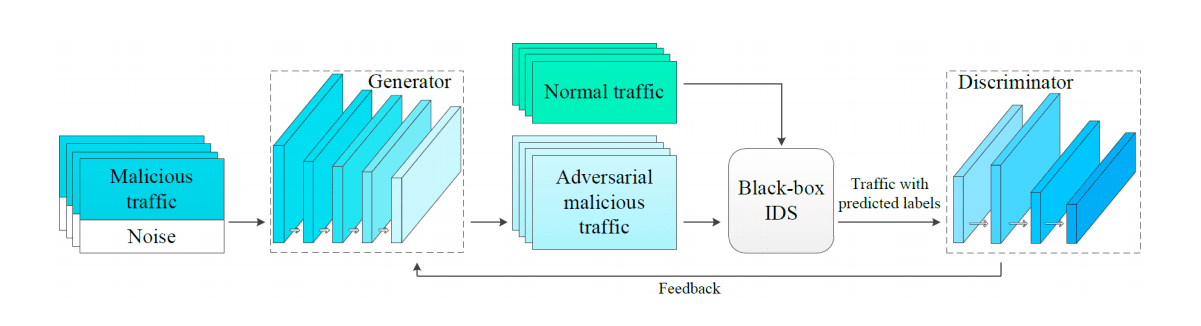
In a recent paper, researchers have developed a system to deceive systems assuming nothing is known to attackers about the system. IDSGAN works on the concept of a generator to change original bad traffic data. The concept of discriminator classifies traffic data and simulates a completely black box detection system. Their experiments are based on the dataset known as NSL-KDD, the researchers attack many systems and showcase very good results. In some of the last decades there has been amazing work done in the field of generative training. Goodfellow introduced the GAN (generative adversarial networks) a very popular framework. His main idea is that two neural networks, generator and discriminator play a game to find an optimal solution. The researchers say that there is not much research done in security domains by applying GANs. The Main Contribution Of The Researchers Are:- The improvement to IDSGAN is the main contribution which is an improved framework upon the GAN against a cyber defence system. It produces malicious and bad traffic to attack the intrusion detection system (IDS).
- To build and mimic attacks and IDS in the real world.
- Adversarial attacks go on to perform black box attacks.
- IDSGAN shows impressive performance in experiments. The detection rates to the artificially produced have also reached 0 which is very impressive.
- The researchers also test and discuss the influence on IDSGAN various conditions. The changes in condition also demonstrate the robustness of the system.
Structure Of IDSGAN And Dataset
The dataset of NSL-KDD is used as a benchmark dataset to check the performance of any intrusion detection system. In NSL-KDD dataset, there are training set known as KDDTrain+ and the testing set known as KDDTest+. There are multiple types of malicious and normal traffic data in the dataset. The malicious categories are Probing (Probe), Denial of Service (DoS), User to Root (U2R) and Root to Local (R2L). The dataset consists of 9 features in discrete values and 32 features in continuous values, making it a total of 41 features. In abstract there are four sets of feature types:- “Intrinsic” features try to reflect the inherent characteristics of a single connection for the general network analysis.
- “Content” features are used to mark the content of connections which indicate whether some behaviours related to the attack exist in the traffic.
- “Time-based traffic” features do the working of examining the connections in the past 2 seconds, which have the same destination host or the same service as the current connection, including the “same host” features and “same service” features.
- “Host-based traffic” features try to monitor the connections in the past 100 connections, which have the same destination host or the same service as the current connection, as the mirror of “time-based traffic” features.
Experiments And Results
The researchers use PyTorch to implement IDSGAN and are run and evaluated on a Linux PC with Intel Core i7-2600. IDSGAN is trained with the 64 batch size for 100 epochs. The learning rates for both the generator and discriminator are 0.0001 and the dimension of the noise vector is 9. The table below shows the performance of IDSGAN in different attacks.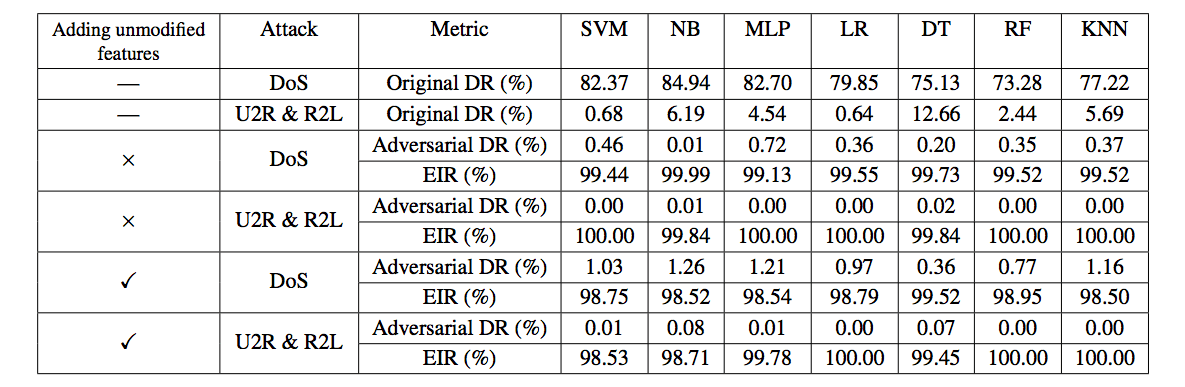
Spotted an error? Tell our editors. Read our editorial standards and corrections.