

IBM has been calling the shots and providing everyone with the capabilities, giving other players a run for their money, when it comes to quantum computing.
According to the recent International Data Corporation (IDC) report, IBM is the leader in MarketSpace on quantum computing systems, followed by Rigetti Computing and Quantinuum in the major players segment.
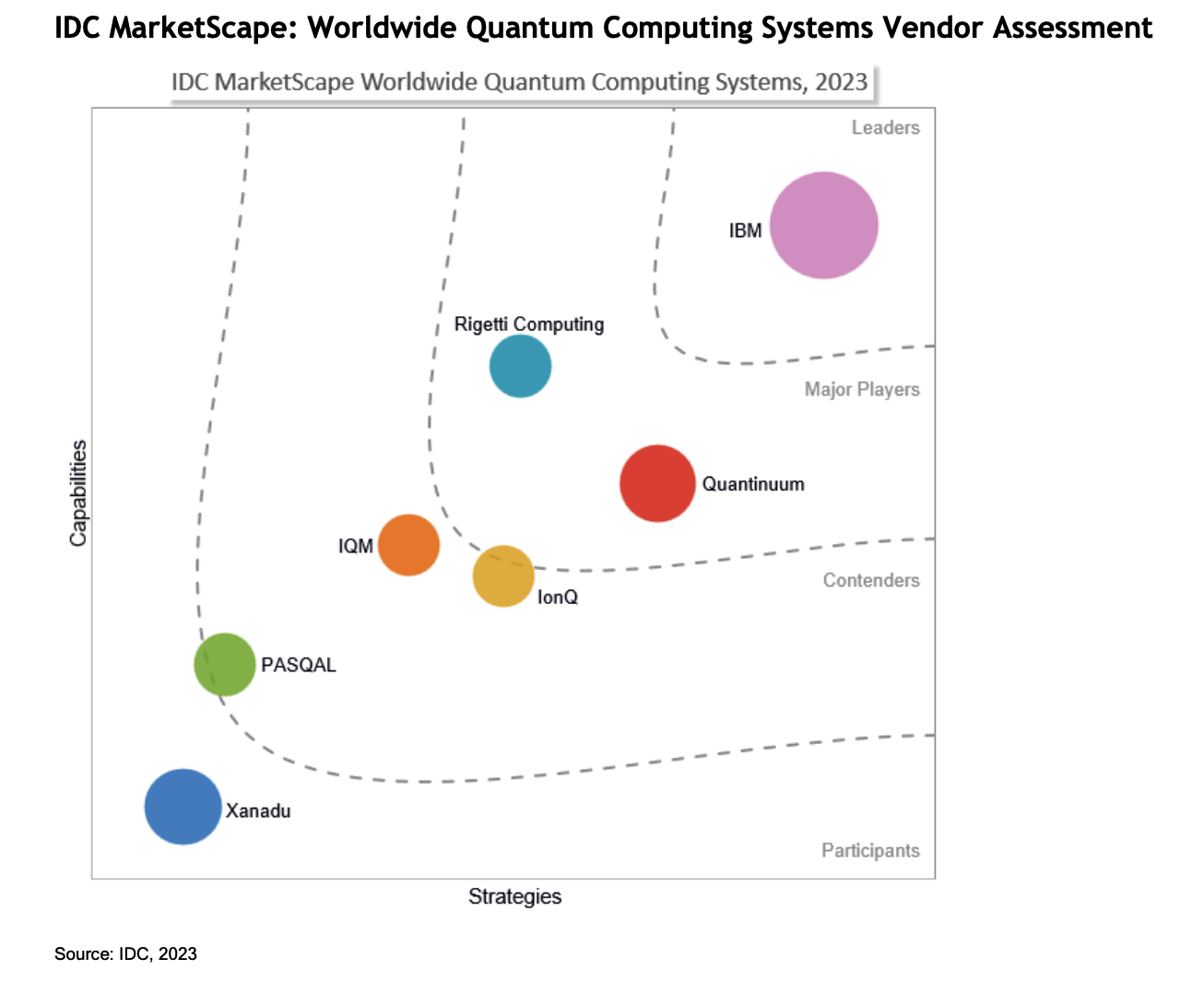
IDC opted to exclude cloud service providers that provide access to quantum computing systems developed by other quantum hardware vendors, but do not develop and offer access to their own quantum computing systems since this evaluation focused on quantum hardware vendors specifically. For the same reason, companies such Google are also not included in the report.
How to be the IBM of quantum
IBM has been following a collaborative approach for the last five decades and has been making big claims when it comes to quantum computing. But the claims are slowly taking shape for the company. IBM says that Boeing, Samsung, Sony, Vodafone, Capgemini, JP Morgan Chase & Co, MIT are members of the IBM Quantum real applications.
In 2022, Arvind Krishna, CEO of IBM said that organisations would be able to deploy quantum computers “in the 2023 to 2025 time frame” and a 4,000 qubit system would be available by 2025. This was possibly a hint at the company’s plan to combine 3 Kookaburra processors, totalling into 4,158 qubits, according to the roadmap.

What is IBM doing right?
IBM started its quantum computing journey in 1970 and over the last five decades, the company has continuously invested in quantum research, focusing on the research and design of a full-stack superconducting quantum computer. However, according to IBM’s review on the quantum computing report, the company’s focus is not just on being the best, but also enabling an entire ecosystem of quantum and craft a path to quantum advantage.
It is clearly visible in IBM’s approach towards quantum computing. In 2016, the company took the first step in advancing the quantum computing industry by releasing its 5-qubit system to the IBM Cloud. This was the first time a quantum computing hardware was made available for research and public experimentation, along with the software release of Qiskit, an open source and hardware-agnostic SDK for running on quantum computers.
Forging ahead, in 2017, IBM decided to release a client-facing IBM Quantum Network for providing quantum computing-as-a-service (QCaaS) for the companies, governments, academic institutions, and startups as well as for full experimentation with the company’s quantum hardware.
IBM leads the way, breaking boundaries making powerful quantum computers – the same way it made the first computer.

Your reaction