
Key takeaways
- Indian IT firms minimize H-1B visa impacts through increased local hiring strategies.
- None of the major IT companies reported H-1B visa challenges in recent earnings calls.
- H-1B visa dependency among Indian IT firms has significantly decreased over the past decade.
- Trump's policies led to a sharp rise in H-1B visa denial rates affecting Indian IT services.
- Companies like Infosys and TCS saw 50% to 80% drop in H-1B approvals from FY2015 to FY2024.
While concerns about H-1B visa scrutiny and enforcement continue to make waves, their actual impact on India’s IT services sector appears increasingly muted. This can be attributed to years of proactive workforce localisation and wage realignment.
In their recent Q4 earnings calls, Accenture, TCS, Wipro, Infosys and HCL Tech, none of them highlighted any challenges pertaining to H-1B visa rejection or acceptance rates.
However, the companies did mention that Trump’s tariffs created uncertain business situations.
During Trump’s first term, the administration pursued a restrictive stance on legal immigration, particularly targeting work visas. Through Executive Order 13788, titled ‘Buy American and Hire American’, the administration significantly tightened the eligibility criteria for H-1B and L-1 visas.
As a result, denial rates for these visa categories rose sharply, disproportionately affecting IT services companies, which were heavily reliant on foreign skilled workers.
H1B Visa Dependency Declining for Indian IT?
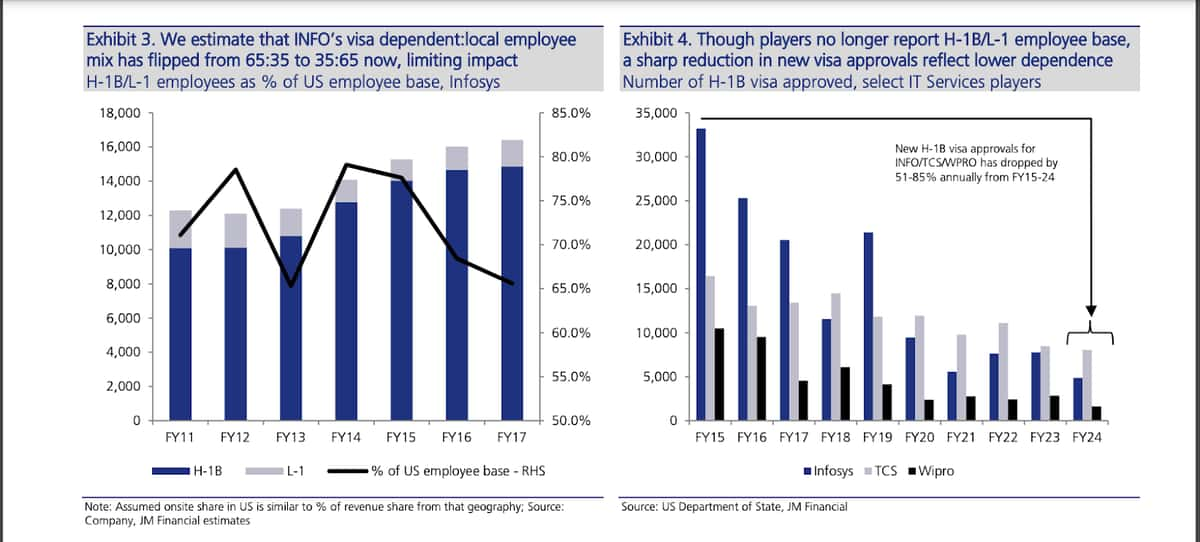
According to a report by JM Financial, in FY2017, approximately two-thirds of US employees at major Indian IT services firms were on H-1B or L-1 visas.
However, over the past decade, this dependency has significantly declined, as companies proactively localised their talent base in response to tightening visa norms. This strategic shift is evident in the 50% to 80% drop in H-1B visa approvals for major players like Infosys, TCS, and Wipro between FY2015 and FY2024, according to the report.
This evolving workforce composition now offers Indian IT services firms greater insulation from future disruptions in the H-1B visa programme. Even if the Trump administration were to return with a renewed focus on restricting work visas, the reduced reliance on H-1B holders could soften the impact for these companies.
Rajesh Ranjan, managing partner at Everest Group, believes that Indian IT will remain unaffected as they have already strengthened their presence in the US during the previous Trump administration in response to similar issues earlier.
Meanwhile, a report by NFAP revealed that Cognizant had the second most H-1B petitions in FY 2024 approved for initial employment (2,837), followed by Infosys (2,504), TCS (1,452), IBM (1,348), Microsoft (1,264), HCL America (1,248), Google (1,058), Capgemini (1,041) and Meta Platforms (920) in FY 2024.
Why Indian IT Appears Muted?
The reason is that Indian IT companies have significantly increased their focus on local hiring, particularly in the Americas.
In a LinkedIn post, Prince Chaturvedi, regional business head at IDFC FIRST Bank, mentioned that Infosys, for example, has expanded its workforce in the region from 19,720 employees in 2014 to 36,118.
Similarly, Cognizant has grown its US workforce from 40,500 in 2014 to 65,000 by 2023. Alongside this hiring surge, these firms are also making substantial investments in talent development.
“Increased local hiring and higher offshoring since Trump’s first term has reduced IT companies’ dependence on visa-based talent, thereby safeguarding their interest against immigration related policy uncertainties,” Abhishek Kumar, equity research analyst, JM Financial Ltd, told AIM.
Collectively, as per reports, the Indian technology companies have contributed over $1.1 billion and developed partnerships with nearly 180 universities, colleges, community colleges, and others to strengthen and diversify the STEM pipeline in the US.
Sid Tipnis, leader, technology, media and telecommunications (TMT) consulting at Deloitte, told AIM that “IT/ITeS organisations have relied in the past on temporary/permanent immigration arrangements to enable workforce to be onshore and maintain high touch with clients focused across the lifecycle of sales, delivery and customer success.”
He further added, “These organisations are increasingly augmenting talent onshore through local sovereign engagements. Furthermore, as clients welcome virtual and collaborative ways of working on the delivery lifecycle, we see a limited impact of potential immigration restrictions.”
Link Between H-1B Workers and AI Innovation in the US
As per the report, since 2000, foreign-born workers have accounted for 55% of job growth in AI-related fields, highlighting their essential role in advancing the sector. The shortage of qualified AI professionals in the US has created a significant talent gap, and H-1B visa holders are critical in filling it.
Their presence contributes to both short-term productivity and long-term innovation. Notably, H-1B visa applications are strongly linked to higher rates of patent filings and citations, suggesting these workers play a direct role in technological advancements.
Furthermore, the absence of H-1B workers could lead to a decline in successful AI startups, as these visa holders often contribute to new business creation and are more likely to secure venture capital funding.
Speaking on the same topic on X, Elon Musk said, “The reason I’m in America, along with so many critical people who built SpaceX, Tesla and hundreds of other companies that made America strong, is because of H1B.”
What About Wage Obligations for H-1B Workers?
Kumar stated in his report that one area that could still be affected is wage obligations for H-1B workers.
In Trump’s previous term, the Department of Labor (DOL) attempted to raise wage levels for foreign workers through an Interim Final Rule (IFR) in late 2020 and early 2021, though this was later struck down in court.
Today, wage data for select software roles suggests that H-1B employees are paid approximately 25% above prevailing wage levels, casting doubt on the argument that they undercut American workers.
Interestingly, he further stated that not all potential Trump policies would be unfavourable for the tech sector. His proposed expansionary fiscal policies include reducing the corporate tax rate from 21% to 15% for domestic production.
This could stimulate demand in IT services by easing client budget constraints, particularly in sectors with heavy IT spending.
Meanwhile, recent developments in US immigration enforcement continue to raise concerns among immigration attorneys, as officials are now issuing Requests for Evidence (RFEs) for H-1B and other employment-based immigrant petitions, asking for home addresses and biometrics—a move previously unseen in such cases.
According to a Forbes report, these requests are linked to the US Citizenship and Immigration Services (USCIS), citing “adverse information” about individuals, though the specifics remain unclear.
Meanwhile, it is still uncertain whether Trump-era officials have included employment-based visa applicants in broader efforts to identify and deport individuals who are lawfully residing in the United States, or if these requests are intended for a different purpose altogether.