
5 min
 Will artificial intelligence take over the world? Or will it be a blessing to humanity? To understand broader issues like these, engineers at the University of Buffalo were awarded a $1 million by the Defense Advanced Research Projects Agency (DARPA) in the US.
The project for which such a huge grant was awarded was to identify ways to combine physics-based models with conventional, data-driven AI methods — which basically means teaching physics to AI systems.
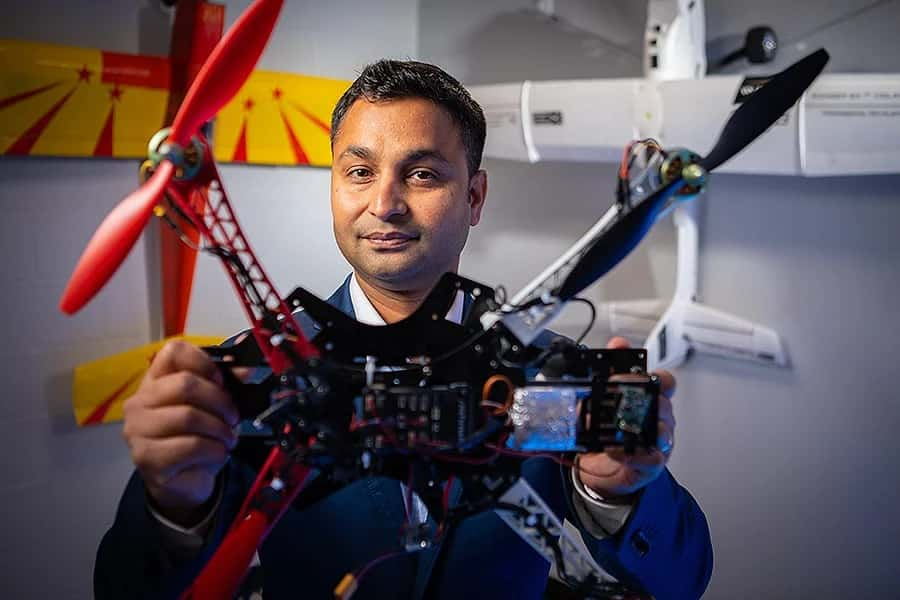
Interestingly, this project of teaching physics to AI systems is being led by an Indian professor and Engineer in UB Artificial Intelligence Institute which focusses on autonomous systems, advances core AI technologies that optimise human-machine partnerships and provides complementary tools and skills to understand the societal impact of these technologies.
What Will Be The Outcome Of This Project?
- The main goal of this project is to provide AI systems, which work within specific frameworks and lack tools to explain the reasoning process, with a broader foundation of knowledge through physics.
- The project, in theory, will allow for more streamlined, efficient and adaptable AI systems which are ideal traits for defence systems, such as unmanned aerial vehicles (UAVs), which operate in uncontrolled environments. These UAVs will get an understanding of the physics of things like how birds fly.
- This information, combined with weather and data that other sensors are processing, will also provide the UAV with better collision-avoidance mechanisms.
- It will also reduce the amount of data that purely data-driven AI systems require.
- And, also will lead to more efficient and less costly systems as these combined models will provide AI systems with a greater understanding of their surroundings.
- To make all these hypotheses viable and practical physics-based models will be integrated.
Outlook
- Intelligent systems need to incorporate a significant amount of understanding of the world in terms of intuitive physics.
- This understanding can be gained from data in multiple ways. Now, a group of researchers from UB Artificial Intelligence Institute are trying to achieve for enhancing the capabilities of UAVs.
- Earlier AI team of INRIA and Facebook developed a simpler evaluation framework which diagnosed how much a given system understands about physics, by testing the system’s computation plausibility of possible physical events versus the computation of plausibility of impossible physical events.
- India’s Frontier AI Race Gets a 240M Model That Beats Liquid AI
- The AI Slowdown Narrative Doesn’t Reflect Enterprise Reality
- India’s Enterprises are Scaling AI. Is the Infrastructure Ready?
- Industry Wants Faster Approvals and Cheaper Power in India’s Data Centre Policy
- Inside Jio Platforms: Its Tech Bets, Loss-Making Subsidiaries and Hidden Risks
- India’s GCCs to Add 1.4 Million Jobs, Drive 170 Million Sq. Ft. Office Demand by 2031