
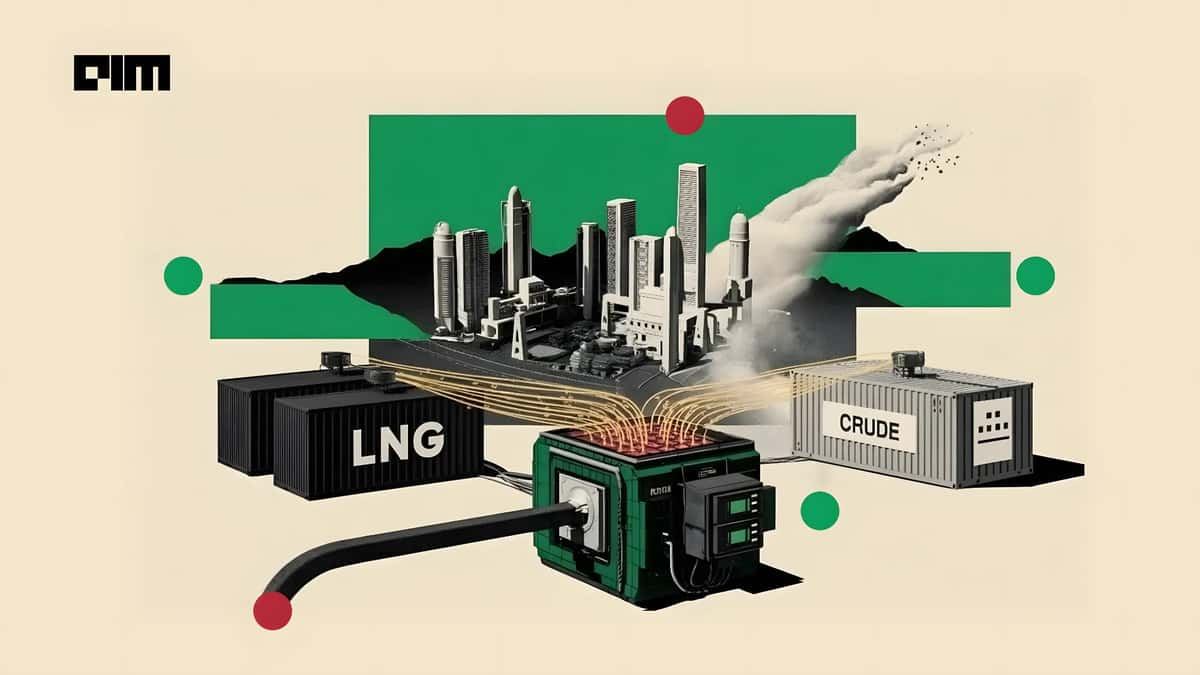

The US-Israeli offensive against Iran threatens to spill over to a wider regional war, not only disrupting Middle Eastern economies and global travel, but also sounding the alarm for the fast-scaling AI ecosystem heavily dependent on a constant flow of oil and gas to power data centres.
The Strait of Hormuz, through which nearly a fifth of global oil trade passes, has emerged as the most critical flashpoint. Iran has reportedly warned shipping against traversing the route. Tanker traffic has effectively paused, with marine insurers withdrawing war risk cover following reports of vessels being attacked.
Meanwhile, both Saudi Arabia and Qatar have scaled back energy production.
On Monday, QatarEnergy, a state-owned petroleum company, halted its liquefied natural gas (LNG) production following Iranian attacks on its Ras Laffan complex. Saudi Arabia’s state oil company Aramco also paused operations at the Ras Tanura refinery—one of the world’s largest oil processing facilities—after a drone struck the facility.
The developments have set oil and gas prices soaring.
Brent crude oil jumped from under $70 a barrel on February 26 to nearly $80 as of March 3. Natural gas prices also climbed 3.17% day-over-day as of noon on March 3.
The energy market’s volatility has direct implications for AI infrastructure, an industry increasingly central to national security, economic competitiveness, and technological leadership.
Market Volatility
Sunanda R Marak, Senior Geopolitical Analyst at think-tank Future Shift Labs, believes markets are reacting in familiar ways. “The current developments in the Middle East are, of course, a matter of concern and may create short-term disruptions in capital deployments,” she tells AIM.
However, Marak argues that most Gulf economies are better cushioned than assumed. “Most Middle Eastern states possess substantial fiscal buffers and sovereign reserves, enabling them to sustain strategic investments even during crises,” she notes.
On March 1, eight members of the Organisation of the Petroleum Exporting Countries Plus’ (OPEC+) decided to boost oil production by more than 200,000 barrels per day.
Yet, with energy prices soaring and uncertainty about the end of the conflict, AI compute costs are also set to match step.
AI Infrastructure Runs on Energy Stability
Several Big Tech companies have accelerated their investments in AI infrastructure in the Middle East over the past two years.
Google Cloud partnered with the Public Investment Fund (PIF), Saudi Arabia's sovereign wealth fund, on a reported $10 billion AI hub in Saudi Arabia, aligning with Vision 2030 ambitions.
Amazon Web Services announced a $5+ billion AI Zone in the kingdom, backed by PIF, including large-scale AI compute infrastructure. The cloud services company was also immediately impacted by the conflict, with one of its data centres in the UAE caught in the crossfire.
Microsoft, too, expanded its regional footprint through a partnership with G42, announcing a 200 MW data centre capacity expansion in the UAE as part of a broader multibillion-dollar AI push. While Meta has not announced a standalone AI hub in the region, it remains active in global AI compute partnerships that indirectly support Middle Eastern cloud expansion, signalling sustained hyperscaler confidence in the growth of Gulf AI infrastructure.
Marak highlights that AI investments in the Middle East are unlikely to slow meaningfully, especially in defence-linked domains, as AI-assisted targeting increasingly enables modern warfare. “As AI-driven industries expand, particularly in defence and intelligence, where energy demand and data capabilities are critical, states are unlikely to divert funding,” she says.
However, for emerging AI hubs such as India, the risk profile is more complex.
India aims to attract over $200 billion in investments for AI infrastructure and applications. Reliance Industries has committed $110 billion over seven years, while the Tata Group partnered with OpenAI to enhance AI-ready data centres. Adani Enterprises also plans to invest $100 billion to build green-energy-powered data centres. Additionally, Google announced $15 billion investments, including new subsea cable routes and an AI hub in Visakhapatnam.
Anwesha Sen, Assistant Programme Manager at The Takshashila Institution, says that energy vulnerability could significantly dampen AI growth. “Persisting vulnerabilities in the near future could significantly hamper the development of new data centres in India,” she cautions.
Sen highlights structural exposure as “about 60% of India's oil comes from the Gulf through the Strait of Hormuz, fueling transport, construction, and diesel backups for data centres. Meanwhile, 75% of electricity generation relies on fossil fuels, making the grid highly sensitive to imported LNG price spikes that inflate power tariffs.”
Disruptions in the supply chain consequently increase pressure on the grid, with rising fuel prices undermining baseload reliability, compelling load-shedding during peak times, and increasing reliance on diesel for continuous power, she highlights. This prolongs the processes of land acquisition, equipment delivery, and commissioning, which can hinder advancements in hyperscale projects.
However, Charith Kond, Energy Specialist, India Mobility and New Energy at the Institute for Energy Economics and Financial Analysis, counters that less than 1% of total electricity output in India is based on imported LNG. Rather, the country significantly depends on imported coal for power generation. “India imports coal largely from Indonesia, South Africa, Russia, Australia, and the US. These imports are unlikely to be impacted due to the present conflict in the Middle East.”
Energy accounts for a substantial share of data centre operating expenditure.
“Electricity, which accounts for 40–60% of data centre opex, passes through inflated grids when energy prices spike, delaying rollouts, favouring sparse or efficient models over large ones, and disproportionately impacting non-US hyperscalers,” Sen notes.
“Globally, energy price hikes can slow down AI scaling and inflate inference and training prices,” she predicts.
Nonetheless, Konda stresses that India aims to power its data centres predominantly with renewable energy by 2030. In the initial years, these facilities may rely on grid electricity, which remains largely coal-based. “Over time, however, the transition will be driven by a mix of solar and wind generation supported by energy storage technologies.”
“Data centres are expected to procure renewable power through mechanisms such as green open access, captive or near-site renewable projects, and participation in emerging green power markets,” he highlights.
And while nuclear power is often cited as a long-term solution, with India passing the SHANTI Act to allow private sector participation in building and operating nuclear power plants, aimed to support data centres, Sen cautions that the latest nuclear energy developments will take at least a decade to mature. The reliance will remain on non-renewables and solar or wind energy with storage systems.
Energy Policy and AI Strategy
Higher energy prices driving compute costs could also raise competition concerns. Rahul Rai, Partner and Co-founder at law firm Axiom5, sees energy volatility potentially reshaping market structure.
“Energy volatility could be a catalyst for consolidation in the foundational infrastructure market. Yet, it is likely to also spur a wave of innovation in energy-efficient AI architecture, which may eventually lower barriers to entry for app developers,” he says.
Beyond immediate market reactions, the absence of a policy approach addressing energy security through an AI infrastructure lens weighs heavily. The central government has also been pushing for data centre investments, giving foreign cloud service providers utilising Indian data centres a tax holiday until 2047.
“While there are no mandatory benchmarks that tie data centre approvals to fuel diversification yet, the AI Impact Summit marked a shift in discourse. There was significant focus on the inextricable relationship between energy and AI infrastructure, perhaps signalling future policy shifts to link the two,” Sen says.
Marak, meanwhile, sees no long-term impact of the war on AI investments. “There may be some hiccups due to market volatility, but otherwise, neither fund-wise in the short run nor logically in the long run, investments in the AI sector don’t seem to be falling, especially keeping in mind the national security,” she asserts.
To attract investment, the Department of Economic Affairs has classified data centres with loads over 5 MW as "infrastructure." Konda notes that, currently, there is no clear policy on energy allocation during supply disruptions, but India’s limited exposure to globally traded commodities such as oil and gas makes a major power supply shock unlikely.
The evolving geopolitical situation in the Middle East has also exposed a structural interdependence of India’s AI ambitions on energy security. While Gulf producers may absorb shocks through fiscal buffers and coordinated supply management, energy-importing AI economies like India face layered risks, higher operating costs, delayed expansions, grid instability, and policy recalibration.
- Smaller Language Models Could Reshape How Enterprises Deploy AI
- Enmovil Plans to Quadruple FDE Team as Enterprise AI Hiring Moves Beyond Coding
- Does the World Need a New GitHub?
- Can India’s AI Boom Reach Bharat?
- AI's Next Agritech Frontier Is India's Fragmented Supply Chain
- India’s Frontier AI Race Gets a 240M Model That Beats Liquid AI