
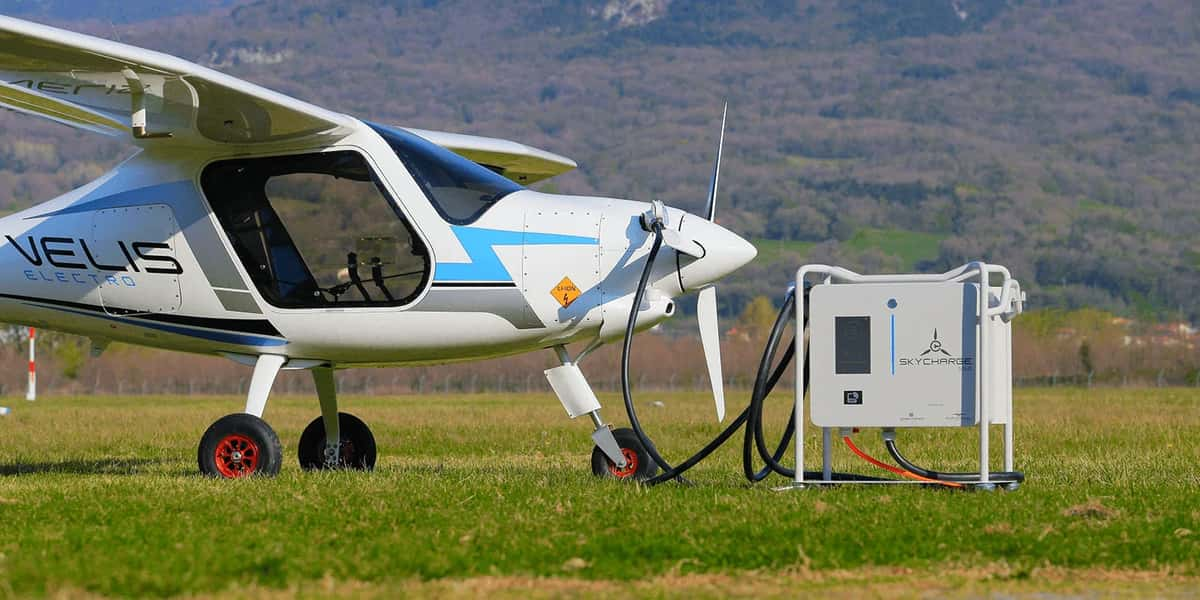
When ‘Alice’, an all-electric aircraft completed its maiden flight on September 28, 2022, it received a lot of media attention. Alice took off from Grant County International Airport at Washington and flew for 8 minutes at an altitude of 3,500 feet. Aircrafts like Alice could possibly boost the use of electric aircraft by the aviation industry and its drive towards sustainability.
The aviation industry is one of the largest contributors to global emissions. The sector produces 900 million tonnes of CO2 per year, according to the International Air Transport Association (IATA). Emissions have also gradually increased over the years and are expected to soar further in the coming years. Hence, electric aircraft could go a long way in helping the aviation industry achieve its sustainability goals.

Emissions level-Aviation industry (Source: Statista)
Who’s making them?
Developed by Washington-based Eviation Aircraft, ‘Alice’—inspired by Lewis Caroll’s classic novel, ‘Alice in Wonderland’—is a passenger plane that would be capable of carrying around 2,500 pounds, which means around nine passengers and two crew members. Currently in its prototype phase, Alice has a maximum air speed of about 287 miles per hour. It’s powered by a pair of MagniX engines and a battery system that’s similar to those in electric cars.

As its development continues, Alice is expected to be available for commercial use only in 2027. However, the company has already received orders from DHL, Cape Air, Global Crossing and GlobalX.
Sweden-based Heart Aerospace is likewise developing an all-electric, 19-passenger aircraft. The ES-19 is planned to have a 400-kilometre range and be able to charge in less than 40 minutes.
The Swedish company has already received orders from United Airlines, one of the largest carriers in the world. Interestingly, United Airlines have also invested an undisclosed amount in Heart Aerospace.
United Airlines will buy 100, 19-seat ES-19 electric planes and will use them for regional, short-haul flights with distances ranging from 250–300 miles.
Canada’s flagship carrier, Air Canada, also placed an order for 30 of these electric aircrafts that Heart Aerospace is developing. However, both United Airlines and Air Canada are expected to start using these aircrafts in 2028.
New York-based Wright Electric is also working on a 100-seat, fully-electric jet called ‘Wright Spirit’. It is an electric-powered version of the BAe 146 jet, which was originally manufactured by BAE Systems, and is expected to take off in 2026. Founded in 2016, Wright Electric is also developing a 186-seat commercial aircraft named ‘Wright 1’, which is expected to be commercially available in 2030.
What are Airbus and Boeing doing?
The concept of an electric aircraft is not new. Over the years, many companies have mushroomed all over the world focused on working to make electric aircraft a reality. But, what about the big two planemakers in the world—Airbus and Boeing?
European-based planemaker Airbus embarked on its electrification journey in 2010. That year, Airbus developed ‘CriCri’, the world’s first fully electric, four-engine, aerobatic aircraft. Five years later, Airbus’ electrically powered ‘E-Fan twinjet’ crossed the English Channel.
Over the years, we have witnessed multiple projects from Airbus when it comes to electric planes, but nothing concrete. For long, European planemaker have projected hydrogen-powered planes as the future of aviation.
But last year, the planemaker announced that it is working on hybrid-electric alternatives.
Similarly, Boeing too is venturing into electric aircraft through different avenues. Earlier this year, Boeing invested USD540 million in ‘Wisk Aero’, a San Francisco-based company that’s building all-electric, autonomous, passenger-carrying aircraft. Previously known as ‘Zee Aero’, Wisk wants to be the first ever US company to receive a certification for its flying taxis. Companies such as ‘Archer Aviation’ and ‘Joby Aviation’ are also operating in the same space.
Sustainability
Today, the global aviation industry contributes to nearly 3% of global emission. Last year, IATA said that it is aiming for net zero carbon emissions by 2050. Hence, electric aircraft could go a long way in making the sector sustainable and achieving IATA’s goal.
“With the collective efforts of the entire value chain and supportive government policies, aviation will achieve net zero emissions by 2050,” Willie Walsh, IATA’s Director General, said.

(Source: IATA)
As per the IATA report, sustainable aviation fuel is expected to be the main contributor in the aviation industry’s quest towards net zero carbon emissions. However, IATA emphasises that newer technology such as electric aircraft will also have a significant role to play.
- India’s GCCs to Add 1.4 Million Jobs, Drive 170 Million Sq. Ft. Office Demand by 2031
- AI Can Be Cyborg or Centaur. But Can Enterprises Monetise It?
- AMD’s Server CPU Business Faces a New AI Boom
- How an Engineer Is Using AI to Bridge the Accessible Education Gap
- AI Agents are Making Human Customer Service a Specialist Job
- Why Nandan Nilekani-Backed F2A Believes India's Investment Opportunity Lies in Edge AI