
5 min
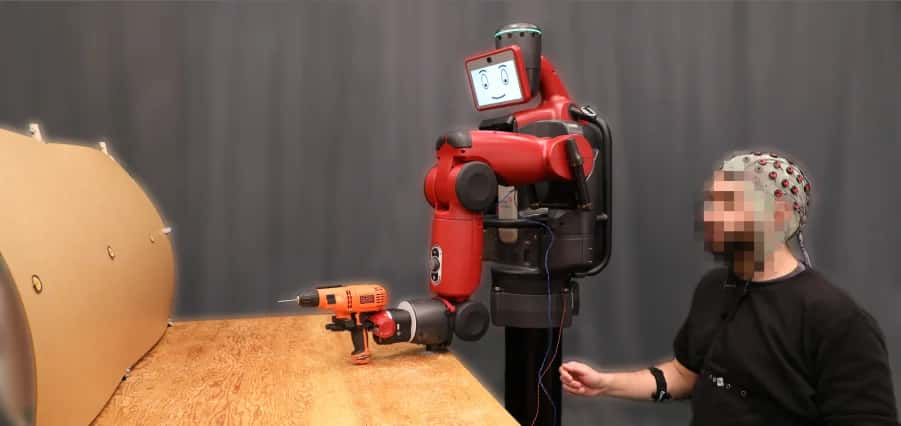
[caption id="attachment_26240" align="aligncenter" width="901"] Image Source: MIT[/caption]
In an age where robots are being controlled by the mind, researchers from MIT’s Computer Science and Artificial Intelligence Laboratory system have designed a plug-and-play supervisory control using muscle and brain signals for real-time gesture and error detection. In a new paper, MIT researchers have presented an end-to-end system that enables classification of gestures which will help correcting the robot on demand. The research combined three streams — human biosignals, brain activity and muscle feedback — by harvesting Electromyography (EMG) and Electroencephalography (EEG) signals to enable human intervention in supervisory tasks. Earlier last year, MIT’s CSAIL department joined hands with Boston University to design a system that corrects errors in real-time. This research has gone further down the path to making the communication between robots and humans more seamless and intuitive by allowing a means to control robots and minimise errors in critical situations.
According to CSAIL director Daniela Rus, this particular work combining EEG and EMG feedback enables natural human-robot interactions for a broader set of applications that we’ve been able to do before using only EEG feedback. She shared,
“...And by including muscle feedback, we can use gestures to command the robot spatially, with much more nuance and specificity.”
To show how the system works, researchers utilised error-related potential (ErrP) or the brain signals that are related to error which surface when people notice errors. When the plug-and-play system detects an ErrP, the robot stops so that a user can correct the action with hand gestures, which are conveyed to the robot through the user’s muscle activity.
Image Source: MIT[/caption]
In an age where robots are being controlled by the mind, researchers from MIT’s Computer Science and Artificial Intelligence Laboratory system have designed a plug-and-play supervisory control using muscle and brain signals for real-time gesture and error detection. In a new paper, MIT researchers have presented an end-to-end system that enables classification of gestures which will help correcting the robot on demand. The research combined three streams — human biosignals, brain activity and muscle feedback — by harvesting Electromyography (EMG) and Electroencephalography (EEG) signals to enable human intervention in supervisory tasks. Earlier last year, MIT’s CSAIL department joined hands with Boston University to design a system that corrects errors in real-time. This research has gone further down the path to making the communication between robots and humans more seamless and intuitive by allowing a means to control robots and minimise errors in critical situations.
According to CSAIL director Daniela Rus, this particular work combining EEG and EMG feedback enables natural human-robot interactions for a broader set of applications that we’ve been able to do before using only EEG feedback. She shared,
“...And by including muscle feedback, we can use gestures to command the robot spatially, with much more nuance and specificity.”
To show how the system works, researchers utilised error-related potential (ErrP) or the brain signals that are related to error which surface when people notice errors. When the plug-and-play system detects an ErrP, the robot stops so that a user can correct the action with hand gestures, which are conveyed to the robot through the user’s muscle activity.
Some Of The Highlights Of The Paper Are:
- A framework for combining error detection through EEG with gesture detection via EMG allows supervisory control of autonomous robots
- Since a new user doesn’t need to provide additional training data for EEG or EMG classifiers, training is done on a corpus of data which increases the applicability and makes the interface plug-and-play
Need For Brain-Controlled Robots And How Humans Can Correct It
According to Kurzweil AI, the plug-and-play supervisory control systems is not without its shortcomings. While EEG signals cannot be detected reliably, EMG signals can be tricky to map the motion. But when are the two combined, it enables better bio-sensing, making it possible for the system to work on new users without training. As the world gears for more intuitive and natural systems, a safe robot supervision architecture can pave the way for human safety as well. However, in cases where a human supervisor is crucial and a human element has to close the loop, this plug-and-play system can play an important role. If robots and humans have to exist as co-workers, have to exist and robots require supervision, then robots and human should work on tasks in coordination in real time.Areas Where Plug-And-Play System Can Play A Central Role:
- With the rise of industrial robotics, labour-starved national economies are dependent on an automated workforce and are using industrial robots more extensively in the manufacturing and service-oriented sector. In fact, industrial robots were introduced in the manufacturing industry a decade ago with Japan being the leading maker and supplier of industrial robots. Automotive industry and emerging markets in China, North America and South-East Asia are also investing heavily in the robotics sector.
- While the widespread use of robotics has sparked talks about labour displacement, a research paper claims that around four million workers are directly interacting with robots in their day-to-day tasks. This underscores the need for a supervisory system with a human element closing the loop.
- While robots do perform pre-programmed tasks in a highly-structured environment such as the automotive and manufacturing industries, the involvement of humans through the plug-and-play system can minimise the scope of error.
- Major robot manufacturers such as FANUC have provided a system for safe cooperation with robots with physical and information support in place, to support human work.
- Close attention to correcting errors and ensuring a safe human-robot interaction with plug-and-play systems
- And lastly, MIT’s work is truly groundbreaking because the plug-and-play system can be easily deployed in large manufacturing settings and other sectors with humans managing a team of robots.
- India’s Frontier AI Race Gets a 240M Model That Beats Liquid AI
- The AI Slowdown Narrative Doesn’t Reflect Enterprise Reality
- India’s Enterprises are Scaling AI. Is the Infrastructure Ready?
- Industry Wants Faster Approvals and Cheaper Power in India’s Data Centre Policy
- Inside Jio Platforms: Its Tech Bets, Loss-Making Subsidiaries and Hidden Risks
- India’s GCCs to Add 1.4 Million Jobs, Drive 170 Million Sq. Ft. Office Demand by 2031