
Retailers and quick commerce companies have spent the past year embedding AI into almost every part of their business. Recommendation engines now personalise shopping journeys, algorithms predict demand, warehouses rely on AI for inventory planning, and customer support is increasingly handled by AI agents.
But integrating AI into core business operations gives rise to a new challenge of ensuring these systems can access only the data they are meant to see, with conversations on data privacy, governance, and security now centrestage.
That’s what Myntra considers its biggest priority.
The retailer has built its internal AI systems on the principle that AI should inherit an employee’s existing permissions rather than expand them.
“We have built a platform where privacy is not an afterthought,” Myntra Chief Technology Officer Pramod Patil tells AIM. “The platform itself is being designed in a way where it is privacy first.”
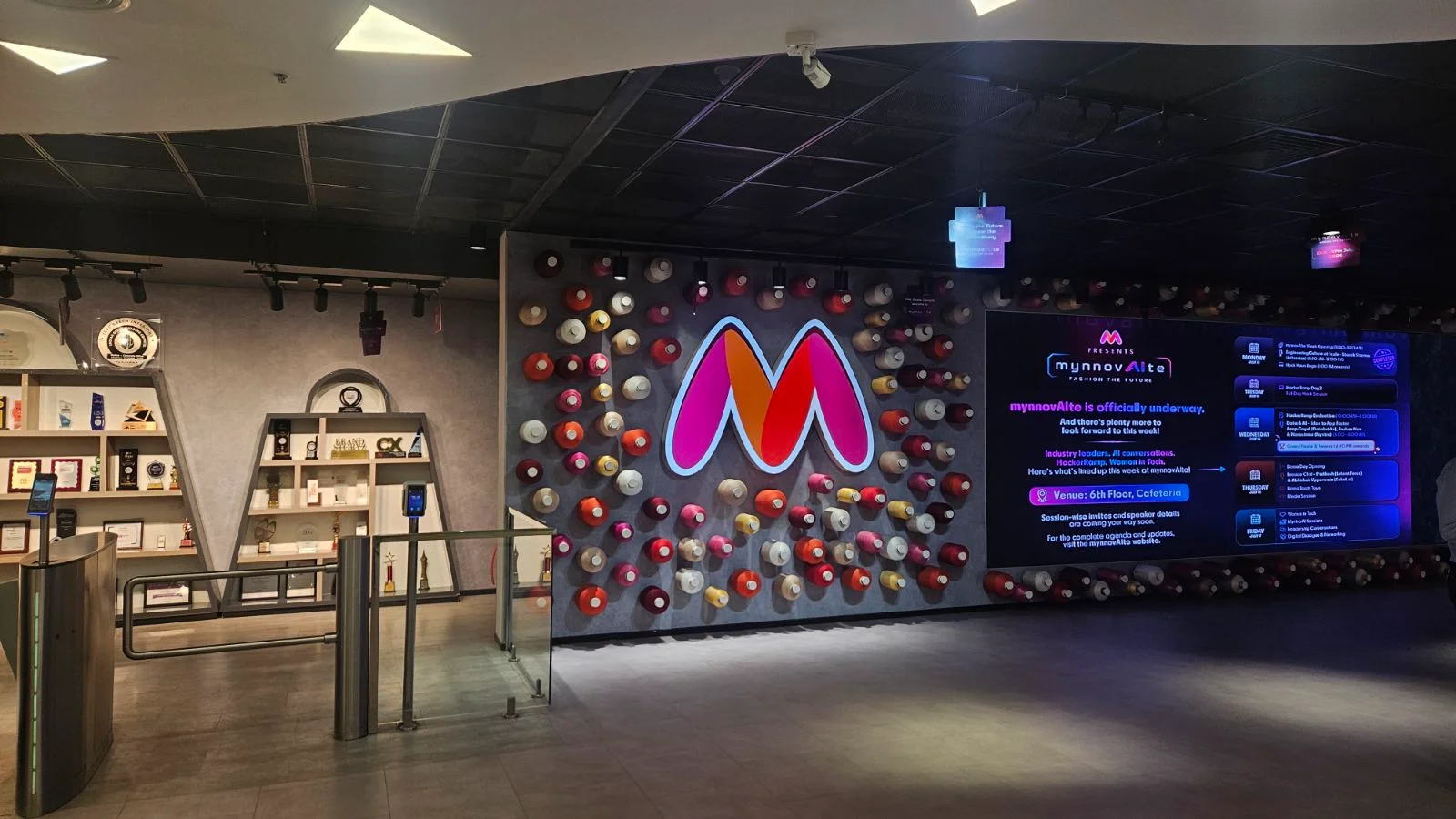
At the Myntra Tech Week 2026 held in Bengaluru earlier this month, the company showcased AI applications across customer discovery, seller onboarding, supply chain operations, product development, and enterprise analytics. Behind many of those demonstrations was BIRA (Business Intelligence Retrieval Agent), an internal analytics platform that allows employees to query business data using natural language instead of SQL.
AI Cannot Overstep
Unlike conventional chatbots that sit directly on top of enterprise databases, BIRA first checks whether an employee already has permission to access the requested information. If not, it simply refuses to answer the query.
“If a seller ops team member does not need access to PII (personally identifiable information), then they won’t be given access,” Patil says. “When they come through BIRA, it’s not suddenly that they need access.”
The same approach applies even when employees ask analytical questions involving customer information.
The architecture reflects a broader shift in enterprise AI. Instead of treating LLMs as the centrepiece, Myntra has built an internal semantic layer that understands its data infrastructure, metadata, and user permissions.
Models such as Anthropic’s Claude currently serve as the conversational interface, and Myntra is working on making it accessible through any UI. The company also avoids locking itself into a single foundation model.
“We are use case and quality first. As long as we get the right quality, then comes optimisation,” Patil elaborates. That means different products across Myntra use Claude, Gemini, OpenAI models, and open-source alternatives depending on the task rather than following a single AI strategy.
Beyond Chatbots and Shopping Recommendations
Beyond governance and access control, Myntra has also unveiled a broader AI roadmap spanning consumer and enterprise experiences. For customers, the company is extending AI beyond search into conversational shopping, creator moderation, styling assistance, explainable size recommendations, and fit visualisation.
Rather than only recommending a size, the platform now explains why a particular size suits a shopper using purchase history and product attributes. It is also progressively rolling out visualisations showing how garments may drape across different body types before purchase.
Another initiative, called Algorithmic Stores, dynamically changes storefront layouts based on customer behaviour. Patil explains that the system responds to intent in real time instead of relying only on long-term purchase history.
“Your needs per morning could be, I need to get socks, but the need in the evening could be like I would prefer planning a trip to go out.”
As a result, users casually browsing may see carousel-based interfaces, while shoppers with stronger purchase intent receive more direct product-focused layouts. The app and the website’s layout, the UI, and the format all change in real-time.
Scaling Operations Without Removing People
Much of Myntra’s AI investment targets internal operations rather than customer-facing experiences. It claims AI has reduced seller onboarding from up to 15 days to under two days while catalogue generation has dropped from around a day to four hours.
Supply chain simulations that previously required two days now finish within an hour. AI also supports engineering teams across coding, testing and deployment, contributing to faster product releases.
Despite those gains, Patil rejects the idea of fully autonomous AI.
“We are trying to solve scale problems,” he affirms. “AI gives you an advantage to scale up much more than without AI.”
However, he repeatedly stresses that quality determines how far automation goes. If 85% of tasks require the human in the loop, then humans will not be negated by the emergence of agents.
That philosophy also extends to customer support. Myntra’s conversational support platform, Meera, now handles around 31% of customer queries while AI assists with return approvals and fraud detection. Human reviewers continue to validate quality and investigate complex cases.
For Myntra, AI is less about replacing employees and more about expanding what they can do. As enterprises race to deploy generative AI, the retailer operates on the belief that the smartest system may not be the one with the most information, but the one that knows exactly when to stop.

Your reaction
Discussion
What's your take on this story?
No comments yet — be the first to share your view.