
5 min
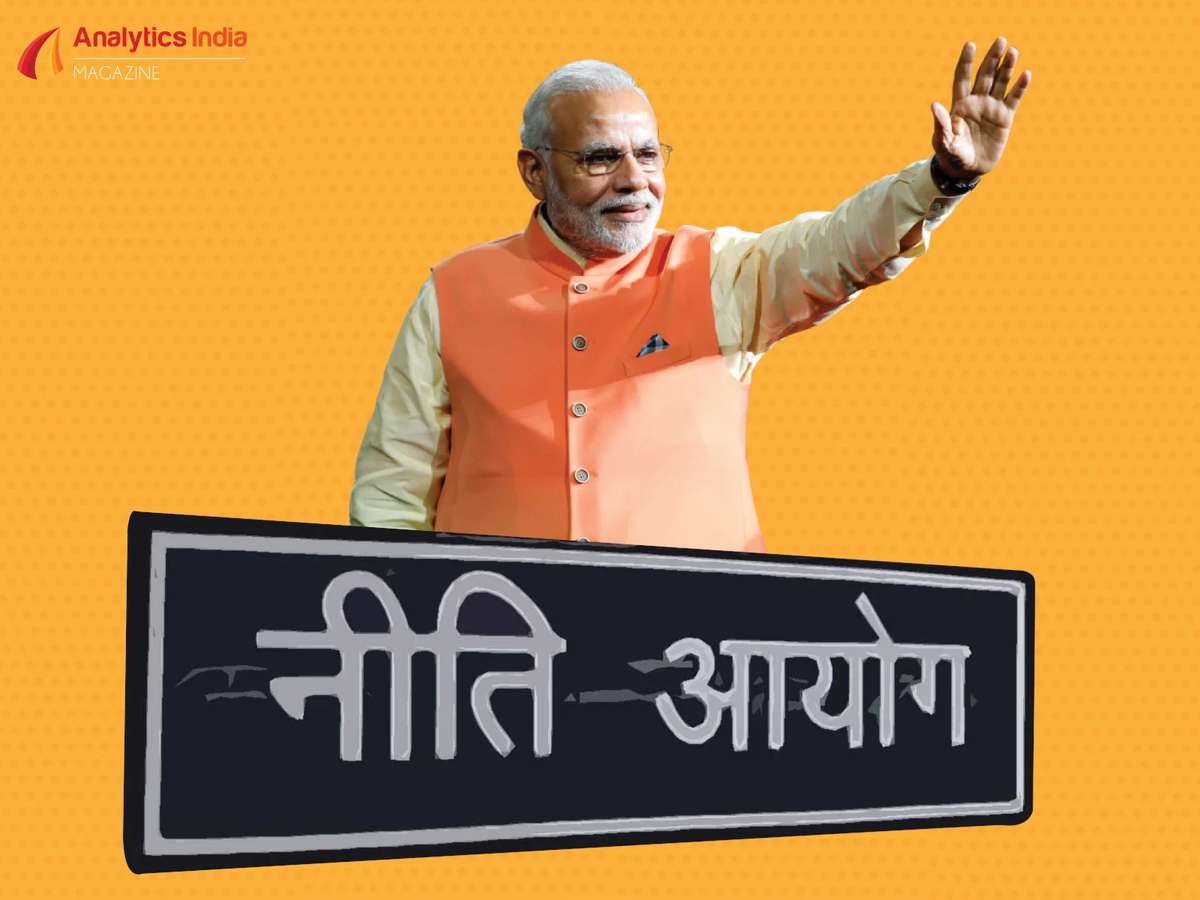
 The National Institution for Transforming India, better known as the NITI Aayog, has had a tumultuous year so far, especially when it comes to the emerging tech sector. From working closely with numerous tech behemoths to keeping their ears on the ground to understand the grassroots reality in a diverse country like India, the NITI Aayog has had their hands full with their work with technologies like artificial intelligence, internet of things, machine learning and data analytics, among others.
Formed via a resolution of the Union Cabinet on 1 January 2015, the NITI Aayog is the premier policy think tank for the Government of India. It has been providing both directional and policy inputs, designing strategic and long term policies and programmes, and has been helping with relevant technical advice to both the Centre and States since then.
But there were a few moments since the mid-2018 when the country, including the NITI Aayog itself, thought it was in trouble.
Existential Crisis
The BJP-led NDA government in 2014 had published their reform agenda, and had constituted the NITI Aayog to completely replace the Planning Commission, an institution, which was in existence since 1950. In his first Independence Day speech in 2014, Prime Minister Narendra Modi had announced the dissolution of the Planning Commission. PM Modi had said that it was done in order to better serve the needs and aspirations of the people of India. This was an important evolutionary change from the past as the NITI Aayog now functioned as the quintessential platform of the Government to bring States to act together in the national interest, and thereby fosters Cooperative Federalism. However, in March 2019, Congress (INC) president Rahul Gandhi had announced that if voted to power, his party would scrap the NITI Aayog and replace it with a "lean" Planning Commission. https://twitter.com/RahulGandhi/status/1111654170564661248 This announcement by the (then) prime ministerial candidate was a direct result of the controversy over official statistics that presented a different set of data regarding Gross Democratic Product (GDP) growth that allegedly favoured the Modi government over the draft data prepared by the National Statistic Commission.NITI Aayog 2.0?
Now, post the stupendous victory by the incumbent Bharatiya Janata Party (BJP) and PM Modi, several reports are suggesting that the NITI Aayog is set for a rejig. Called NITI Aayog 2.0 by the media, the think tank will is rumoured to see some large-scale changes internally. In a paper titled, Towards India’s New Fiscal Federalism, former Finance Commission chairman Vijay Kelkar has proposed several changes to the NITI Aayog, Some of the key changes are:- Create a distinct entity [NITI Aayog 2.0] to deal with the structural issues regarding the removal of regional imbalances in the Indian economy
- Make NITI Aayog 2.0 a permanent invitee of the Cabinet Committee on Economic Affairs (CCEA)
- Give NITI Aayog around 1.5% to 2% of the GDP every year in resources to provide suitable grants to the states for mitigating the development imbalances
- Give powers to NITI Aayog 2.0 to allocate developmental or transformational capital
- Seek NITI Aayog 2.0’s advice in national and long term perspective on the policy proposals
- NITI Aayog 2.0 must strive to be a think-tank with ‘praxis’ possessing considerable financial muscle
- NITI Aayog 2.0 must devote its energies to outline coherent medium and long term strategy and corresponding investment resources
Status Quo
As of now, the core of NITI Aayog’s creation are two hubs:- Team India Hub
- Knowledge and Innovation Hub
NITI Aayog’s Work In Emerging Tech: 2019
The Indian think tank has done extensive work in the field of emerging tech like AI, ML, IoT and data analytics, among others. They had also unveiled a discussion paper in 2018 which addresses the national strategy on AI and other emerging technologies in India. In the paper, the NITI Aayog had identified five sectors to focus its efforts towards the implementation of AI to serve societal needs:- Healthcare
- Agriculture
- Education
- Smart cities and infrastructure
- Smart mobility and transportation
Will Modi 2.0 Bring ‘Big Bang Reforms’ For NITI Aayog In Their 100-Day Plan?
Well before the BJP won the Lok Sabha Elections earlier, PM Modi had asked his party office, the NITI Aayog and Principal Scientific Advisor to prepare the agenda for the first 100 days after the for the next government. Now, Rajiv Kumar, the VC at NITI Aayog has told a noted news wire that the focus for this 100-day plan was going to be industrial development. To facilitate this, the Aayog has reportedly suggested reforms in labour laws, privatisation moves, and creation of land banks. “The government could also offer swathes of land to foreign investors from the land banks it plans to create from unutilised land controlled by public sector enterprises,” Kumar told the news agency. He added, "There will be a big bang, there will be 100 days action. We are all geared for that ... I have maintained that the fiscal policy should be countercyclical. There is scope for that."- India’s GCCs to Add 1.4 Million Jobs, Drive 170 Million Sq. Ft. Office Demand by 2031
- AI Can Be Cyborg or Centaur. But Can Enterprises Monetise It?
- AMD’s Server CPU Business Faces a New AI Boom
- How an Engineer Is Using AI to Bridge the Accessible Education Gap
- AI Agents are Making Human Customer Service a Specialist Job
- Why Nandan Nilekani-Backed F2A Believes India's Investment Opportunity Lies in Edge AI