
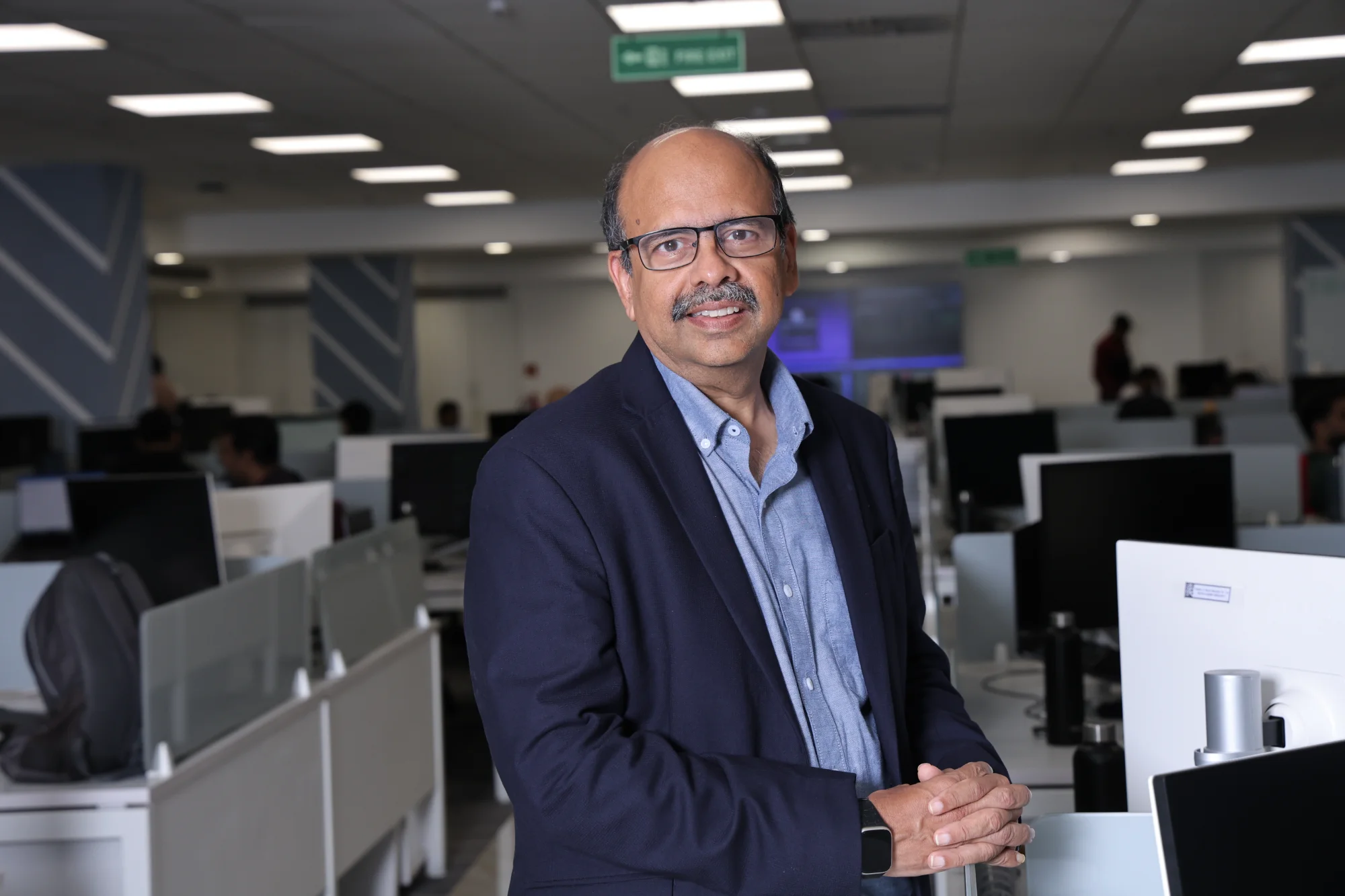
Calm. Composed. Unhurried.
That is how Sharad Sanghi comes across.
In an industry defined by breathless predictions, billion-dollar valuations and a constant race to announce what comes next, and where founders often speak in superlatives, Sanghi seems almost deliberately out of step. He pauses before answering. He chooses his words carefully. He does not appear particularly interested in sounding futuristic, even when discussing one of the most consequential technologies of the moment.
Asked about the challenges that concern him most, he responds with a wry confidence. “Nothing keeps me awake at night,” he says, almost amused by the question. “I make sure that I get a good sleep.”
It is not, he quickly clarifies, because there are no challenges. There are plenty. But worrying, in his view, does not solve them. That composure has been tested many times.
Three decades ago, Sanghi founded Netmagic Solutions. By the time the company was acquired by Japanese telecom giant NTT, it had quietly become one of the foundations of India’s internet economy, powering banks, e-commerce companies, cloud services and countless digital businesses.
For most founders, selling a company like Netmagic would mark the culmination of a career. For Sanghi, it became the beginning of another one.
At 59, he is starting again. With Neysa, Sanghi is attempting to build the infrastructure that will power India’s AI ambitions.
That ambition comes with a staggering price tag. Earlier this year, Neysa had raised over $1.2 billion in funding, but Sanghi believes even that barely scratches the surface of what the business needs.
“It hardly gets you anywhere,” he says. “We want to become gigawatt scale.”
It is an extraordinary ambition for an entrepreneur who has already built and exited one of India’s pioneering technology infrastructure companies.
“We literally don’t have time to breathe,” Sanghi says with a smile.
Supply chains remain stretched, memory prices fluctuate, financing AI infrastructure has become as important as engineering it, and demand continues to outstrip supply. This, he says, is unlike anything he has witnessed before.
The First Bet
Sanghi’s fascination with technology began at a time when computing itself was still changing rapidly.
As a computer science student at Columbia University in New York in the early 1990s, he found himself in the middle of a technological transformation that would eventually reshape almost every aspect of modern life.
The World Wide Web was emerging, Linux was gathering momentum, and researchers were experimenting with neural networks. AI existed, but largely as an academic pursuit rather than a commercial opportunity.
“We had exposure to AI because we studied computer science,” he recalls. “People used to talk about it, but nobody really took it seriously. The real time when AI became mainstream was the end of 2022, when ChatGPT went viral.”
For Sanghi, the more immediate opportunity was the internet.
When he returned to India in the late 1990s, internet adoption was still in its early stages. Businesses were only beginning to establish an online presence. Data centres were virtually unheard of. The infrastructure required to support the digital world elsewhere barely existed.
Sanghi saw an opportunity.
He founded Netmagic Solutions and began building what was then a distinctly unglamorous business—the infrastructure behind other companies’ technology. It was not an easy business to sell.
Data centres demanded enormous upfront investment, generated returns slowly and required entrepreneurs to think years ahead of the market. Sanghi, however, believed the economics would eventually become undeniable.
Sanghi raised just $4 million to get Netmagic off the ground, a modest sum even by the standards of the day, and began building what would eventually become one of India’s most influential digital infrastructure companies.
“We believed fundamentally that it was a great business model,” he says. “Customers should focus on their core competence while we managed the backend and shared that infrastructure across multiple customers.”
Then came the dot-com crash.
The timing could hardly have been worse. Around the world, internet companies collapsed, venture funding evaporated, and data centre businesses went bankrupt. To many observers, the model itself appeared fundamentally broken.
The market was telling Sanghi that his timing was wrong. He chose to believe his underlying thesis was right.
“It was only a matter of time before it worked.”
That conviction became one of the defining traits of his leadership. He prepared to wait. History proved him right.
Building the Backbone
Over the next two decades, Netmagic became synonymous with India’s data centre industry. As e-commerce, banking, cloud computing and online services expanded, so did the need for reliable infrastructure beneath them. Netmagic became one of the companies supplying it.
“Most of India’s e-commerce used to run on Netmagic,” he says. “It revolutionised digital infrastructure in the country.”
The significance of that achievement is perhaps easier to appreciate in retrospect.
Today, the infrastructure behind digital businesses is taken for granted. In the early years of India’s internet economy, it was one of the biggest barriers to growth.
Netmagic helped turn infrastructure into a service, allowing companies to focus on their products and customers while someone else handled the complexity underneath.
Yet, success never changed Sanghi’s approach to leadership. For him, people have always mattered more than technology. “The company is built by people. Invest in good people.”
Sanghi prefers teams that challenge him rather than agree with him. He believes leaders should surround themselves with people capable of making decisions independently. Teams, he argues, become stronger when they are independent enough to disagree.
“If you surround yourself with people who are better than you, you’ll never have a problem delegating,” he says. “If you surround yourself with yes-men, you’ll never grow.”
At Netmagic, that philosophy translated into early investments in engineering, research and development, employee retention and long-term incentives.
Those lessons would follow him into Neysa.
The Long Game
If there is one principle Sanghi returns to repeatedly, it is hard work.
“There is no substitute for hard work,” he says matter-of-factly.
He also believes entrepreneurs need the resilience to absorb setbacks without allowing them to alter the larger direction.
“If you believe in what you’re doing, then whatever small failures come your way, you don’t worry. You just continue.”
That mindset explains why Sanghi has never been drawn to chasing quick wins. Sanghi remains wary of businesses that optimise only for the immediate future.
“If you only have a short-term view, you could take the wrong decision,” he says. “You have to think about the medium term and the long term as well.”
Netmagic, however, isn’t the pinnacle of his career. “I think it’s still ahead,” he says.
When NTT Said No
The origins of Neysa can be traced to a moment when Sanghi saw an opportunity before his employer was ready to pursue it. It began with a decision to walk away from the familiar and start again.
During his time at NTT, he began noticing a sharp increase in demand for GPUs in late 2022 and early 2023. ChatGPT had gone viral, generative AI had suddenly entered mainstream consciousness, and businesses were beginning to realise that AI would require enormous amounts of computing power.
He brought the idea to NTT. It was a natural pitch because the company already ran SimpliCloud, which he describes as “India’s largest cloud platform” at the time. While it was nowhere near the scale of Amazon, Google or Microsoft, it had “a lot of mission-critical customers” that continue to run on it today. To Sanghi, extending that platform into GPU cloud services was simply the next logical step.
NTT disagreed. The decision was understandable. GPU infrastructure is a capital-intensive business built on hardware that depreciates quickly. Returns are uncertain and the market can change faster than a large corporation can redeploy capital.
But Sanghi interpreted the rejection differently. “When they said no, I said, look, let me then quit and start this on my own and explore.”
And so he did.
Walking away from a senior role at one of the world’s largest telecom companies to build a new company from scratch at almost 60 would be a daunting proposition for almost anyone.
For Sanghi, it was another opportunity to start before the market had fully arrived.
The Second Act
The early Neysa was not what it is today. Without the capital required to immediately build physical infrastructure, the company initially focused on software—building orchestration, observability, and security platforms for others to use.
The strategy soon evolved. Neysa became a service provider itself, inspired by the early success of GPU cloud players abroad. “We started seeing the success of folks like CoreWeave and Lambda in the US,” Sanghi says, adding that the success became the proof point Neysa needed to chase its own version of the model. Neysa raised $50 million across its Seed and Series A funding rounds from Z47, Nexus Venture Partners and NTTVC.
There was an element of symmetry in NTTVC’s investment. The parent organisation had declined Sanghi’s proposal to pursue the GPU business itself. Its venture arm later decided to invest in the company he built after leaving.
“Although they didn’t want to do this business themselves, they decided to invest in us,” he says.
Neysa initially deployed a couple of thousand GPUs to serve domestic Indian customers. Then demand began coming from outside India. The business was entering a different phase, one in which the limiting factor was no longer simply whether customers wanted compute, but how quickly Neysa could finance and deploy enough of it.
Subsequently, Blackstone became a major investor, providing the kind of capital required for an infrastructure business operating at the intersection of AI and physical computing.
“NTT Data Centre is doing the colo. They’re not providing GPUs as a service ,” he clarifies, when asked about how the company operates differently.
He explains that while NTT provides the facility, power and cooling, it is currently not in the business of owning GPU infrastructure and renting AI compute.
Sanghi knows the risks that come with it.
AI infrastructure companies must invest billions before meaningful revenue materialises. Every GPU cluster requires financing. Every new generation of chips threatens to make existing hardware less valuable. Unlike data centres, where land and buildings often appreciate over time, GPUs begin depreciating almost the moment they are installed.
Neysa today operates across three distinct layers.
At one end are bare-metal GPU clusters for enterprises running large-scale training and inference workloads. Above that is a cloud platform offering virtual machines, containers and AI development environments. And then there is what Sanghi calls a ‘token factory’, delivering inference through open-weight models as a service.
“We’re seeing a big shift from training to inferencing,” Sanghi says. “More than 60% of AI workloads are inferencing now.”
That transition is visible across Neysa’s customer base.
Banks are deploying AI while keeping workloads air-gapped for security. Pharmaceutical companies are exploring drug discovery. Financial institutions are using large language models to interpret regulatory circulars. Voice AI is finding applications in customer support, insurance workflows and loan collections, particularly in a country where multilingual interaction can make conventional digital interfaces difficult.
Friction Beneath the AI Boom
For all the ambition embedded in Neysa’s founding story, Sanghi is surprisingly candid about the ordinary, grinding difficulties of running the company today.
Talent acquisition tops his list, and his frustration on this point comes with a wry honesty rarely offered in public interviews.
He says that while India has a large talent pool, the focus should be on bringing in technically deep talent capable of tackling complex problems. “Unfortunately, not all the resumes are what they claim they are.” Building the right team, he admits, takes time, patience, and more interview rounds than anyone would prefer.
Then there is the geopolitical aspect of running a GPU business in the current moment—a dimension few founders in other industries ever have to think about. Sanghi recalls the uncertainty created during the transition of power in Washington, when outgoing policy sought to cap the number of GPUs that could be exported to countries like India.
“There was a brief challenge when the US Govt came up with a diffusion policy, which limited the number of GPUs to a country like India,” he recounts.
The policy was eventually reversed. For a company whose business depends on access to some of the world's most advanced chips, such policy changes are not abstract geopolitical events.
“Because those kinds of things can impact your business,” he adds.
Supply chain uncertainty, competitive financing pressure, and competition for capital add further pressure. And yet, none of it follows him home.
The People Who Keep Him Grounded
Sanghi’s family remains one of the strongest influences on his second entrepreneurial journey.
When uncertainty creeps in, his wife is the first person he turns to. Earlier in his life, those conversations often included his parents, particularly his mother, whose passing in 2022 marked a significant loss.
Professionally, he continues to rely on the people who have accompanied him through different chapters of his career. Among them is BV Jagadeesh, the entrepreneur who first believed in Sanghi and helped back him during Netmagic’s early years. “He's been my mentor right throughout.”
Over the years, he has leaned on his board members and investors, including Sandeep Singhal, Raj Dugar, Amit Dixit, Ganesh Mani, Nikhil Goyal, Jishnu Bhattacharjee and Rohit Kothari, for business advice.
But perhaps the most unexpected source of inspiration for his latest chapter was much closer to home.
The spark to build Neysa came from his children.
Both of Sanghi’s children had chosen careers at the intersection of AI and research. His son was applying AI to genetics and genomics, while his daughter was working on AI in education. They encouraged their father to revisit the classroom, recommending online courses and helping him navigate subjects that had evolved dramatically since his days at Columbia.
“My kids actually got me into AI,” Sanghi says with a smile. “They gave me a bunch of courses to do. When I got stuck on some Python programming, I would actually go to my daughter, and she would fix it for me.”
For a man who had spent decades building infrastructure, becoming the student again was both humbling and energising.
“The kids were one factor,” he says. “They gave me the conviction that this is something we could do.”
India Doesn’t Have to Win the Same Race
While much of today’s AI conversation centres around trillion-parameter LLMs, Sanghi sees a much bigger opportunity unfolding beneath the surface.
To understand India’s AI opportunity, he begins with what he describes as a five-layer stack.
At the base sits the physical infrastructure, land, power and data centres. Above that sit storage, networking and compute. Then comes the cloud software layer, followed by AI models, and finally the applications that people interact with every day.
India, he believes, is progressing at different speeds across each of these layers.
The most visible momentum today is in data centres.
Across the country, billions of dollars are flowing into AI infrastructure. New campuses are being planned in Mumbai, Hyderabad, Chennai and Visakhapatnam, while global cloud providers and infrastructure companies continue to scout India as their next growth market. To many observers, it resembles a gold rush.
Sanghi believes there are solid economic reasons behind the rush.
“India has data centre space and power available,” he says. “In the US, a lot of campuses have already been blocked by hyperscalers. Here, there is capacity. India is also the second-largest consumer of AI.”
The opportunity, however, extends well beyond domestic demand.
As geopolitical tensions reshape supply chains and governments tighten data localisation requirements, AI infrastructure is becoming increasingly regional.
Enterprises in banking, healthcare and regulated industries want sensitive data processed closer to home. International AI companies, meanwhile, are looking for additional compute capacity outside already congested markets.
India sits at the intersection of both trends.
For Sanghi, however, building more data centres is only the beginning.
“We are investing very heavily in layer one,” he says, referring to physical infrastructure. “But when it comes to storage, networking and compute, we are still way behind.”
That gap, he argues, represents one of India’s biggest opportunities.
Unlike the software industry, where India has accumulated decades of experience, AI infrastructure demands a completely different level of investment. GPUs, high-speed networking, liquid cooling and advanced storage systems require billions of dollars before companies can even begin serving customers.
That investment has only recently started accelerating.
Neysa is among the companies attempting to bridge this gap. Yet Sanghi remains realistic about where India stands.
“We are nowhere close to the US and China,” he admits. “But we are making those investments.”
The biggest constraint, in his view, lies deeper than infrastructure.
“We are totally dependent on the US today for chips,” he says. That dependence worries him, but not because he believes India lacks technical talent.
Instead, he sees it as a challenge that requires patience.
He points to emerging domestic chip initiatives as encouraging signs and believes India could become reasonably self-sufficient over the next decade if investments continue.
The global race is often framed as a contest between OpenAI, Anthropic, Google and Chinese labs. India’s efforts are frequently dismissed as too small to compete.
Sanghi disagrees with that narrative.
“It's not that we don’t have the talent,” he says. “Sarvam, Gnani and BharatGen are all building models.” The problem, he argues, is one of economics rather than engineering.
Compared with American AI companies spending billions of dollars every year on GPUs and training infrastructure, Indian startups operate with only a fraction of that capital.
“The biggest challenge is that there isn’t enough enterprise investment and there isn't enough risk capital in the country,” Sanghi says.
The cycle is difficult to break. Fewer enterprise deployments mean less commercial demand. Lower demand discourages investors from backing ambitious AI companies. Limited funding, in turn, restricts access to the massive GPU clusters required to train frontier models.
Even so, Sanghi does not believe India necessarily needs to replicate Silicon Valley to build a meaningful AI industry.
“I don’t think we necessarily have to build the biggest large language models,” he says. “We can focus on smaller models and specific applications that benefit the Indian population like UPI.”
It is a pragmatic vision rather than an ideological one.
India’s strength, in his view, lies in applying AI to real-world problems.
He points to startups that have successfully built global AI products, arguing that the country’s software talent remains one of its greatest competitive advantages. Applications, orchestration software and enterprise services are areas where India continues to perform strongly.
“I think we are okay in the application layer,” he says. “But we have some catching up to do in some of the other layers.”
The Man Beyond the Company
Later in the conversation, once the business talk is done, we see a different side of Sanghi.
He once played a great deal of sport, he says, though these days that has given way to yoga and long walks along the promenade. But it is when he mentions the tabla that his answer carries the most warmth.
He learned to play as a child, stopped for many years as the demands of building companies took over. Roughly a decade or so ago, he picked it up again, not for performance but for connection. “My daughter is a very good singer. My wife was a singer. So I basically accompany them with the tabla.”
Reading, especially on flights, and watching good films round out his list of pleasures. He also admits to a habit that many impatient cinephiles will recognise: if a film fails to hold his attention, he simply walks out rather than sit through it.
Among the films he has watched recently, Sanghi singles out the Hindi partition drama Main Vaapas Aaunga, featuring Naseeruddin Shah, and the science-fiction film Project Hail Mary as two of his favourites.
Then there is cricket.
Like millions of Indians, Sanghi remains an avid follower of the game, particularly Test cricket. While the modern world has embraced the speed of T20s, he still appreciates the format that rewards endurance over instant gratification.
Rohit Sharma is the player he enjoys watching the most. “He seems to have that extra millisecond,” Sanghi says. “Watching him play when he’s in form is just unbelievable.”
The answer says something about Sanghi himself.
He admires time. The extra moment before a shot. The patience to wait for the right opportunity. The ability to see what others might miss.

Your reaction
Discussion
What's your take on this story?
No comments yet — be the first to share your view.