
5 min
 The role of artificial intelligence (AI) and machine learning (ML) in driving the next phase of industry 5.0 is already a much sought after area, with key developments like industrial automation becoming an integral part of the industry floors.
As the consumer demand for good keeps rising on a yearly-base, the pressure on manufacturers to deliver goods to the end-users in a faster and efficient manner is even higher. Here is where the significance of AI coupled with robotics and Flexible Management Systems (FMS) comes into play.
While AI is leveraged to increase efficiency, bringing simplicity into the process of production through automation, robotics and FMS will ensure speedy processing and adaptability to changing demands of the customers. It is estimated that with AI being leveraged to its full potential, the technology can add $975 billion to India’s economy by 2035.
With schemes like Make in India and Start Up India, the country has witnessed an upsurge in manufacturing industries, enterprises and startups adopting AI and robotics, as it has the capacity to increase accuracy, productivity and efficiency.
Owing to the potential of the technology to transform India’s economy, think-tanks, educational institutes and independent researchers are conducting a number of researches which looks into integration emerging techs like AI, ML and robotics to various aspects of the economy.
Meet Custom Robots That Can Automate Tasks
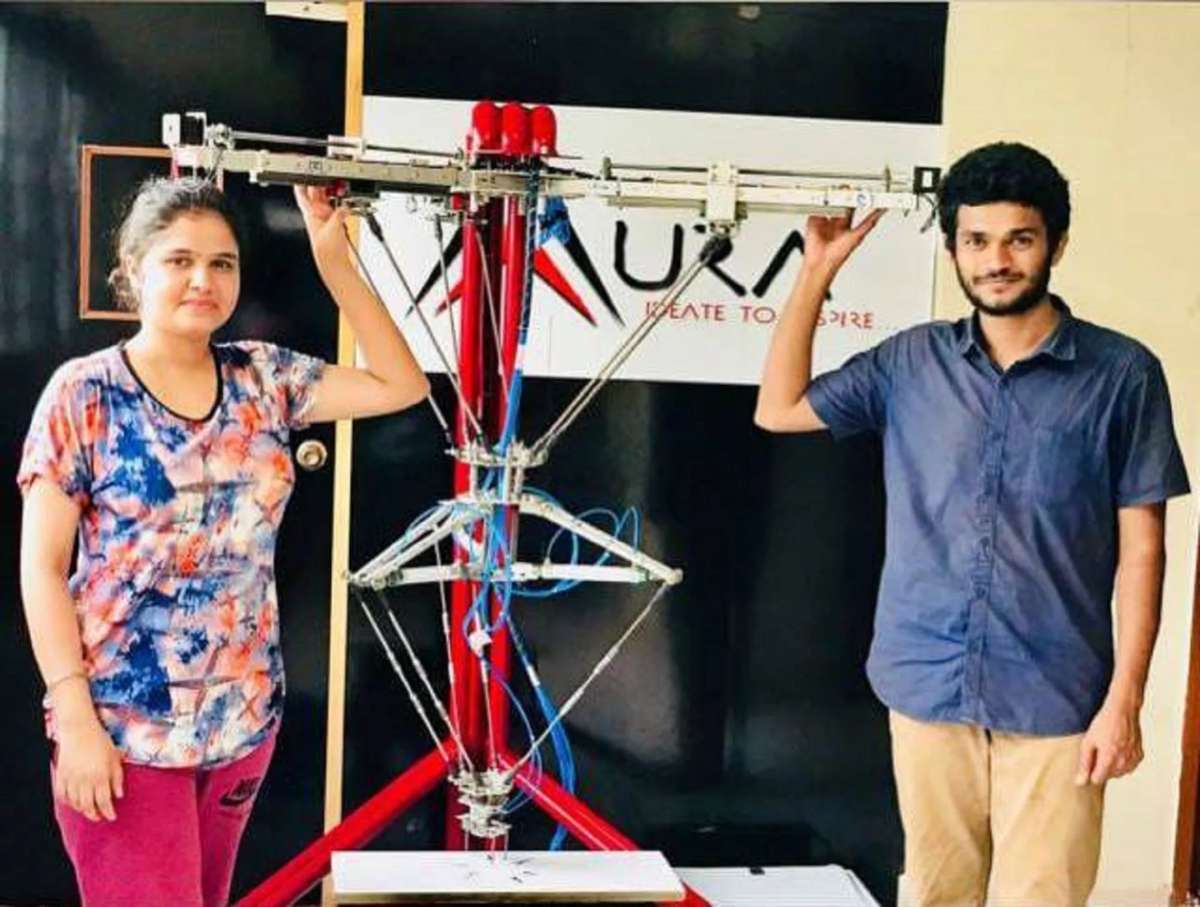
One such recent development was conducted by engineering students from SRM University, Chennai. A team of two students from the college developed a cheaper alternative for an existing model of delta robots that are capable of faster automation in plants in industrial floors.
Delta robots are traditionally used in manufacturing units for various pick and place, component assembly and 3D printing applications. However, the present models that are currently available in the market are fraught with the issue of overpricing depending on the application specifications such as payload capacities and work volumes of the device. As per the market rate, a simple robot for a uni-purpose can range from ₹3 lakh onwards.
The two students, Shylesh Srinivasa and Shilpa Thakur from SRM Institute of Science and Technology (SRMITS) collaborated to develop a tailor-made custom robot with better economy and payload capacity, “We came up with a unique multistage configuration of delta robot to attain better economy, comparable work volume and payload capacity as compared to the currently existing Industrial Delta robotic systems. Thus we developed a new concept of Tailor made robotics to encourage the extensive use of robots in modern automated industry,” says Shilpa Thakur, an M.tech Robotics student.
While finding an affordable solution was one among the key motive behind the project, the students say that the larger goal was to make their device ready for Industry 5.0. “The first and foremost aim was to reduce the cost of the system without compromising the speed and efficiency factor. We also aimed at developing a unique kinematic configuration of the delta robot system, improve the speed, the work volume of the system and payload capacity with regard to the existing delta systems. However, our larger aim is to make the system ready for industry 5.0 thus reducing the dependency on current expensive systems,” explains Shylesh Srinivasa, who is currently pursuing his B.Tech in EEE.
The project was a success as the duo was able to develop their multistage industrial delta robots within Rs 70,000 and has won the best innovation at the first International AI and Robotics Expo conducted by RAIF conducted in Chennai.
Key Features of the Multistage Industrial Delta Robot
- The Multi-stage Electro-pneumatic Delta Robot System consists of two independently, but simultaneously controlled stages of parallel link delta style manipulators being Stage 1 which is actuated by stepper motors coupled to lead screws and Stage 2 which is actuated by differentially pressurized pneumatic pistons.
- Each stage exhibits 3 degrees of freedom.
- The kinematic configuration of this robot itself is unique
- The cost-effectiveness of the system
- The system provides an increased work volume due to the introduction of a second stage.
- The control system used for the actuation of the robot is developed with an optimised implementation of electronics circuitry.
- The AI Slowdown Narrative Doesn’t Reflect Enterprise Reality
- India’s Enterprises are Scaling AI. Is the Infrastructure Ready?
- Industry Wants Faster Approvals and Cheaper Power in India’s Data Centre Policy
- Inside Jio Platforms: Its Tech Bets, Loss-Making Subsidiaries and Hidden Risks
- India’s GCCs to Add 1.4 Million Jobs, Drive 170 Million Sq. Ft. Office Demand by 2031
- AI Can Be Cyborg or Centaur. But Can Enterprises Monetise It?