
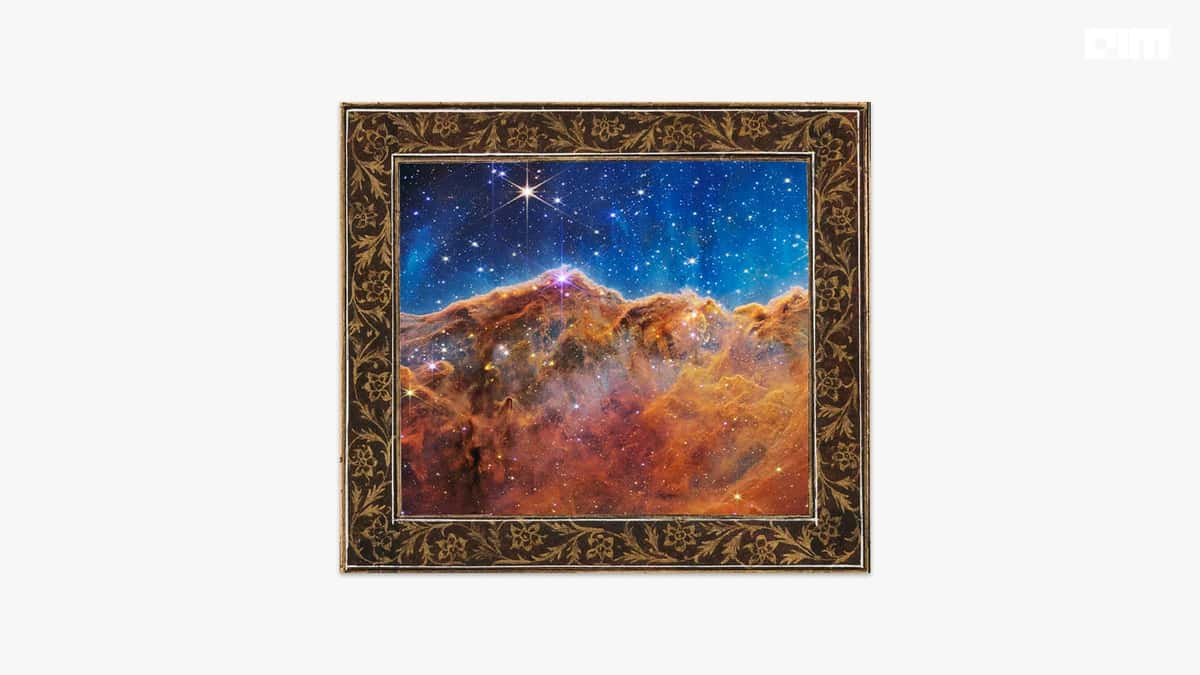
Recently, NASA shared the first images captured by the James Webb Space Telescope in a press conference. According to the space agency, it is “the deepest and sharpest infrared image of the distant universe to date.”

(Image source: NASA)
Some of the distant stars and galaxies captured in the image have never been seen before. Every picture is a new discovery and will offer a singularly unique insight into the universe that is yet to be discovered, according to NASA administrator, Bill Nelson.

(Image source: NASA)
The first set of images from the James Webb Space Telescope are spectacular and believed to be capable of changing astrology henceforth. However, it is noteworthy that the development of the telescope was undertaken almost two decades ago.

(Image source: NASA)
Everything to know about the James Webb Space Telescope
The telescope was developed by NASA in collaboration with the European Space Agency (ESA) and the Canadian Space Agency (CSA). Launched in December 2021, Webb is orbiting the Sun at a distance of 1.6 million kilometres from the Earth.
Although the satellite was launched recently, its development took decades to come to fruition. NASA’s ‘Webb' is named in the honour of James E. Webb, who led NASA from 1961–68 and oversaw the agency’s Apollo programme which spearheaded the first-ever manned missions to space and put Neil Armstrong and Buzz Aldrin on the Moon.

(Image source: NASA)
Developed as a successor to the well-known ‘Hubble Telescope’ at the stunning cost of US$10 billion, the James Webb Telescope has been designed with the purpose to observe space in infrared.
Webb versus Hubble
According to the European Space Agency, the Webb Telescope is 100 times more sensitive than Hubble— “Webb’s sensitivity to longer wavelengths allows it to peer inside dust clouds where stars and planetary systems are forming, revealing the composition of exoplanets’ atmospheres in more detail.”
Webb’s primary mirror consists of 18 hexagonal mirror segments which, when combined, create a 6.5-metres diameter mirror. By contrast, Hubble’s mirror measures 2.4 metres only. This gives the Webb Telescope a light-collecting area of about 25 square metres, about six times that of the Hubble.

(Image source: ESA)
While the Hubble operates from low-Earth orbit and is accessible by astronauts, the Webb is located in deep space at the second Sun–Earth Lagrange point, which is 1.5 million kilometres away from the Earth.
Another notable aspect that differentiates the two telescopes is that the Webb observes the sky in infrared while Hubble studies it primarily at optical and ultraviolet wavelengths.

The role of Python
“Bear in mind that 90 per cent or more probably, of the analysis tools, the simulators and so on, are developed in Python and use Python”, remarks Dr. Patrick Kavanagh, astrophysicist and software developer, while speaking at the 2022 EuroPython event.
Kavanagh further goes on to explain that the final images as seen above are not identical to the images transmitted from the Webb. What the telescope actually sends back to Earth is raw data which requires refining, and that is where Python comes in.
“You need some sort of software package that will take the data from the telescope automatically, run it through these steps and make that process data available to observers and scientists around the world so they can do science.” —Dr Patrick Kavanagh, Astrophysicist and Software Developer.
He further delves—“It’s a pipeline software suite. It does have some C plugins because speed is required for a very small part of the pipeline, with Python slowing things up quite a bit. But more than 90 per cent of it is written in Python. It automatically processes data that comes from the telescope.”
How will the James Webb Telescope see back in time?
It will not only look deeper into space but also further in time. The telescope is equipped with a 6.5 m-wide (21 ft) mirror and four super-sensitive instruments. It is capable of detecting light that has been travelling through space for more than 13.5 billion years.
But, how does it really look back in time?
The nearest star to Earth is four light years away, however there are several planets, stars and galaxies much farther away from us in time and space. The James Webb Telescope will be able to capture the light that left those planets or galaxies billions of years ago. Looking at those galaxies would mean we are looking at them back in time, as they would have been billions of years ago.
To achieve this, the Webb telescope must focus on one patch of the universe and collect the maximum amount of light from particular distant objects that the astronomers aim to study.
“The Webb telescope can look at the light that’s been stretched much more than Hubble, and if you want to look far out into the universe, which means far back in time, then the further out you look, the further back in time you go.” —Brian Cox, Physicist
He further elaborates, “So the Webb Telescope is able to look at the formation of the first stars and the first galaxies. It’s much more sensitive to the light from the most distant objects in the universe.”
The James Webb Telescope is expected to help astronomers observe planets that have been discovered around distant stars and apprise them of the potential presence of water vapour in their atmospheres.
It is believed that NASA’s ‘Webb’ is capable of probing the very origin of our universe as we understand it.
- India’s GCCs to Add 1.4 Million Jobs, Drive 170 Million Sq. Ft. Office Demand by 2031
- AI Can Be Cyborg or Centaur. But Can Enterprises Monetise It?
- AMD’s Server CPU Business Faces a New AI Boom
- How an Engineer Is Using AI to Bridge the Accessible Education Gap
- AI Agents are Making Human Customer Service a Specialist Job
- Why Nandan Nilekani-Backed F2A Believes India's Investment Opportunity Lies in Edge AI