
5 min
 Michael Atiyah is a mathematician who had single-handedly changed the face of differential geometry. He studied in Cambridge where he became a Fellow of Trinity College and later held professorships at Princeton and Oxford. He is best known for his work on K-theory and the Atiyah-Singer Index Theorem, which is considered as one of the most fundamental theorems that can be used to explain our universe.
A-S theorem occupies a vivid spot amongst the fundamental theorems. He has won the prestigious the Fields and Abel prizes for his remarkable contribution to the field of mathematics. He also had a brief stint as the president of the Royal Society of London, the oldest scientific society in the world, a former master of Trinity College, Cambridge; a knight and a member of the Royal Order of Merit.
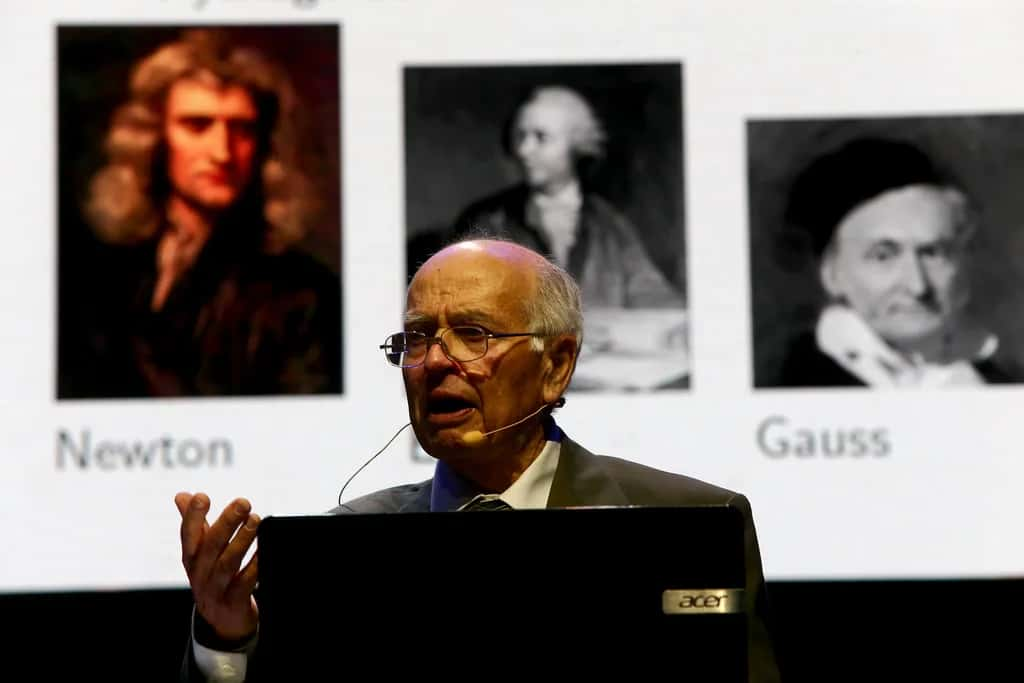
[caption id="attachment_33834" align="alignnone" width="512"]
 Source: Eric Weinstein[/caption]
The contributions of Atiyah to the field of mathematics are vast and equally complex. He has an intuition for arranging just the right intellectual liaisons, often times involving himself and his own ideas, and over the course of his career, which spanned over 50 years, he bridged the gap between disparate ideas within the field of mathematics, and between mathematics and physics.
He helped direct Ed Witten and Graeme Segal to demonstrate that Quantum Field Theory really was beyond a physical theory. This collaboration resulted in techniques for calculating and exploring the complexities involved with topology. For instance, the concept of vector bundles, which Atiyah pioneered in the early stages of his career, help to get an intuition about how planets with twists and turns behave. Here is an illustration of Planet Hopf.
https://youtu.be/rNyngHqnwxE
In the 1980s, methods gleaned from the index theorem unexpectedly played a role in the development of string theory.
Atiyah-Singer Index theorem has changed the face of mathematical physics forever and for good, one of its implications are in answering a few confounding questions in regards to String theory like:
- Can it explain three generations of chiral fermions?
- Can it explain the experimental results on proton decay?
- Can it explain the smallness of the electron mass?
- Can it explain [things about the cosmological constant]?
- The Nightmare at NVIDIA
- India’s Accessibility Rules are Forcing Software and App Design Rethink
- Succession, Scrutiny, and the Future of NVIDIA
- Can You Trust Your ‘Instinct’ and Not ‘Muse’ Over the Risks?
- Is AI-Powered Reverse Engineering the Death of Proprietary Software?
- Smaller Language Models Could Reshape How Enterprises Deploy AI