
Key takeaways
- Computer vision applications are evolving and expanding beyond traditional sectors like manufacturing.
- Convolutional Neural Networks are being utilised to enhance eye detection in facial images.
- Current eye detection methods struggle with accuracy and efficiency, necessitating further advancements.
- The integration of artificial neural networks promises to improve applications such as facial recognition.
 As technology gets smarter and powerful, computer vision applications are getting omnipresent and are pushing limits as to what can be achieved at a broader level. Computer vision (CV) is no longer restricted to a narrow range of inspection and automation evident in shop floors, or the manufacturing sector.
Be it autonomous driving or medical diagnosis, CV is exploring every critical and non-critical practical elements to resolve complexities associated with them. With areas such as artificial neural networks growing significantly, the field of CV can be coupled with them to augment applications such as facial recognition and video processing.
In this article, we will discuss a recent research study that has come up with detecting eye information in facial images through Convolutional Neural Networks (CNN). This will lay down a path in aiding CV applications that rely on facial features like eyes, in the future.
Current Eye Detection Methods
Eye detection in CV has been a subject of interest in the research community off late. Even though there are plenty of eye detection methods available, many of them lag at obtaining high-efficiency and accuracy in eye detection. Be it the standard oculography techniques, or detection through grey-level images of human faces, the results are not precisely accurate or robust. In fact, algorithms such as ensemble regression trees, Viola-Jones algorithm etc., have also looked into capturing eye positions and made noteworthy progress. But, then again, they face trouble due to certain factors like illumination and image noises (colour, contrast etc.) innate in the pictures. Now, a recent study by researchers Bin Li and Hong Fu, has worked on eye detection by adopting CNNs for the technique. Their method will help determine eye locations from images of human faces. Focussing on regions surrounding the eye for analysis, the CNNs would identify the exact eye details (right/left eye and centre of the eye)How It Works
For the study, the researchers consider databases from GI4E and BioID apart from their own created datasets, for facial image data. Using these data, the method is divided into three steps. The first step entails the calculation of extreme points and gradient values in the images, to generate candidate eye regions. The second step involves deploying a set of CNNs which identifies the eye class (left/right eye) while the third step has another set of CNNs to locate the centre position of the eyes.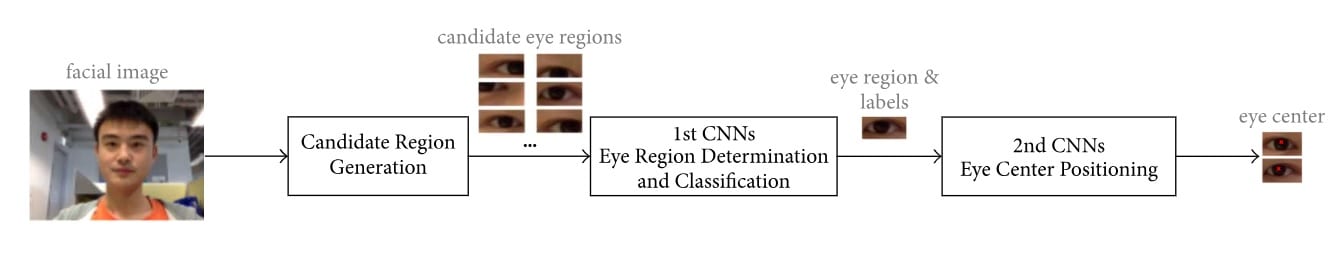
Creating CNNs, Training and Evaluation
Once eye regions are generations, two sets of CNN are built to analyse these Gaussian images for eye classification (right/left eye) and eye centre detection respectively. The CNN architectures are given below.
Conclusion
Compared to earlier research in eye detection methods, Li and Fu’s study fare really good in accuracy as well as in terms of efficiency for eye detection. In addition, their study was quick and reduced training time significantly (just four hours). Although, their implementation needs to be tested on a large scale nonetheless the study offers a benchmark status for niche facial feature recognition such as eyes.Spotted an error? Tell our editors. Read our editorial standards and corrections.