
India’s innovation model has long been criticised for chasing short-term gains while overlooking long-term needs. From drones to health AI, much of the country’s technology ecosystem still depends on imported systems. But the question that looms large is: what will India really need in five or 10 years?
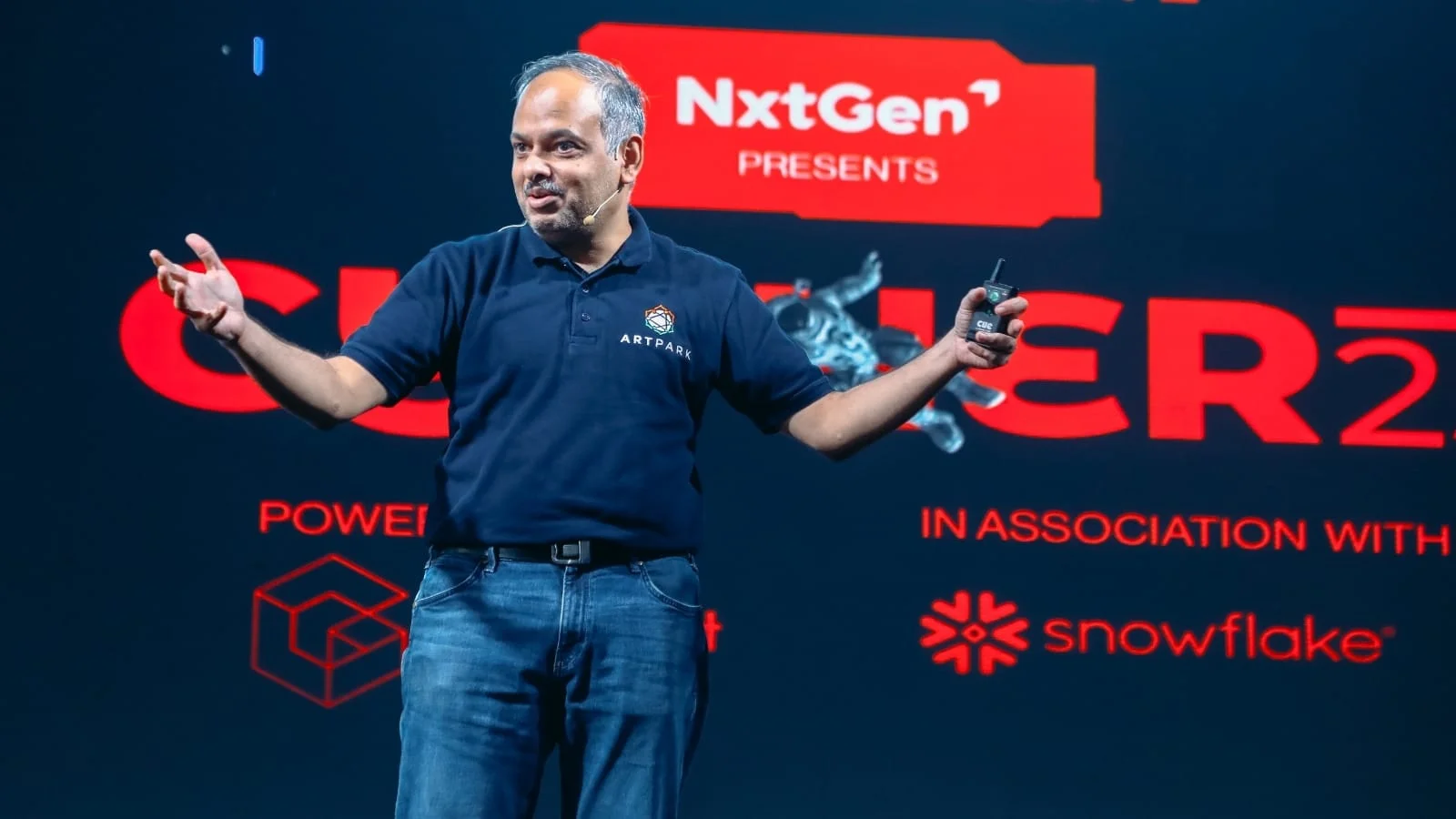
At Cypher 2025, India’s biggest AI summit and expo in Bengaluru, Raghu Dharmaraju, CEO of ARTPARK-IISc (AI & Robotics Technology Park) at IISc, said this is the foundation of his organisation’s work. With over two decades of experience in building institutions for impact, he leads ARTPARK-IISc, a public-private initiative that connects academia, government, and startups. Its focus is translational and application-driven, taking research from labs into societal deployment.
In the past few years, ARTPARK-IISc has incubated 23 startups, developed seven award-winning social innovations—mostly in health—and built two India-scale data initiatives. Its Bengaluru “garage” spans 75,000 square feet and provides space for drones, robotics experiments, and AI infrastructure.
Innovating for India’s Needs
Dharmaraju argued that India cannot rely on imported technology to address future challenges. He cited drones with four-metre wingspans built from scratch, domestic sensors and chips, and harmonic actuators engineered by ARTPARK-IISc startups. “Physical AI is a very important element of what India needs to build,” he said, noting that actuators alone make up 60% of a robotic system’s cost.
This approach extends to AI for science and engineering. Dharmaraju pointed to Zenteiq, a startup that won the IndiaAI Mission’s foundational model challenge, for developing AI-based thermal analysis. These projects, he said, show how ARTPARK-IISc answers its guiding question: What does India really need?
Health has been one such priority. Reflecting on COVID-19, Dharmaraju said the pandemic was “a war”, but warned that its lessons are fading fast. “If there were one more COVID-19 (pandemic) to happen, how would Bangalore be different? I hear all of you shake your heads. Why not? Because we tend to forget.” For him, preparedness cannot be reactive.
Societal Impact with Inclusive AI
Dharmaraju argued that climate change is increasing zoonotic events, making future pandemics likely. To respond, ARTPARK-IISc created the “One Health and Climate” platform, which integrates data on climate, movement, and health to predict outbreaks like dengue two to four weeks in advance. “An imperfect prediction is okay, as long as it is two to four weeks ahead of time,” he said.
The organisation has also worked on AI screening for oral cancer, tuberculosis detection, and equitable deployment of health algorithms with ICMR and IISc. Another project, Midas, is building datasets and digital public infrastructure to ensure AI is trustworthy and benchmarked for Indian contexts.
Generative AI is being applied to help frontline health workers. In Uttar Pradesh, ARTPARK-IISc designed an AI assistant to respond in local dialects and Hindi-English mix. User research revealed that female workers preferred short text responses to long voice messages during visits. This change reduced escalations from 40% to 20%, with 97% of workers rating the tool satisfactory.
“It is not about AI. It is about solutions based on AI,” Dharmaraju said. For him, true impact comes from workflows, user insights, and systems thinking. That is why ARTPARK-IISc insists there are “no plug-and-play solutions” in health AI.
Towards Equitable Innovation
Dharmaraju said inclusion must be central to India’s AI future. Language, equity, and accessibility are key to building digital public goods that serve all citizens. Whether in drones, robotics, or health AI, ARTPARK-IISc’s vision is to create infrastructure that meets India’s most urgent needs.
“Moving bits is not enough,” he told the Cypher audience. “Physically, atoms need to move if there is going to be a healthcare impact.” In this spirit, ARTPARK-IISc continues to blur the boundaries between research, startups, and public systems. It reminds India’s tech ecosystem that real innovation is measured not in hype cycles, but in healthier lives and stronger communities.

Your reaction
Discussion
What's your take on this story?
No comments yet — be the first to share your view.