
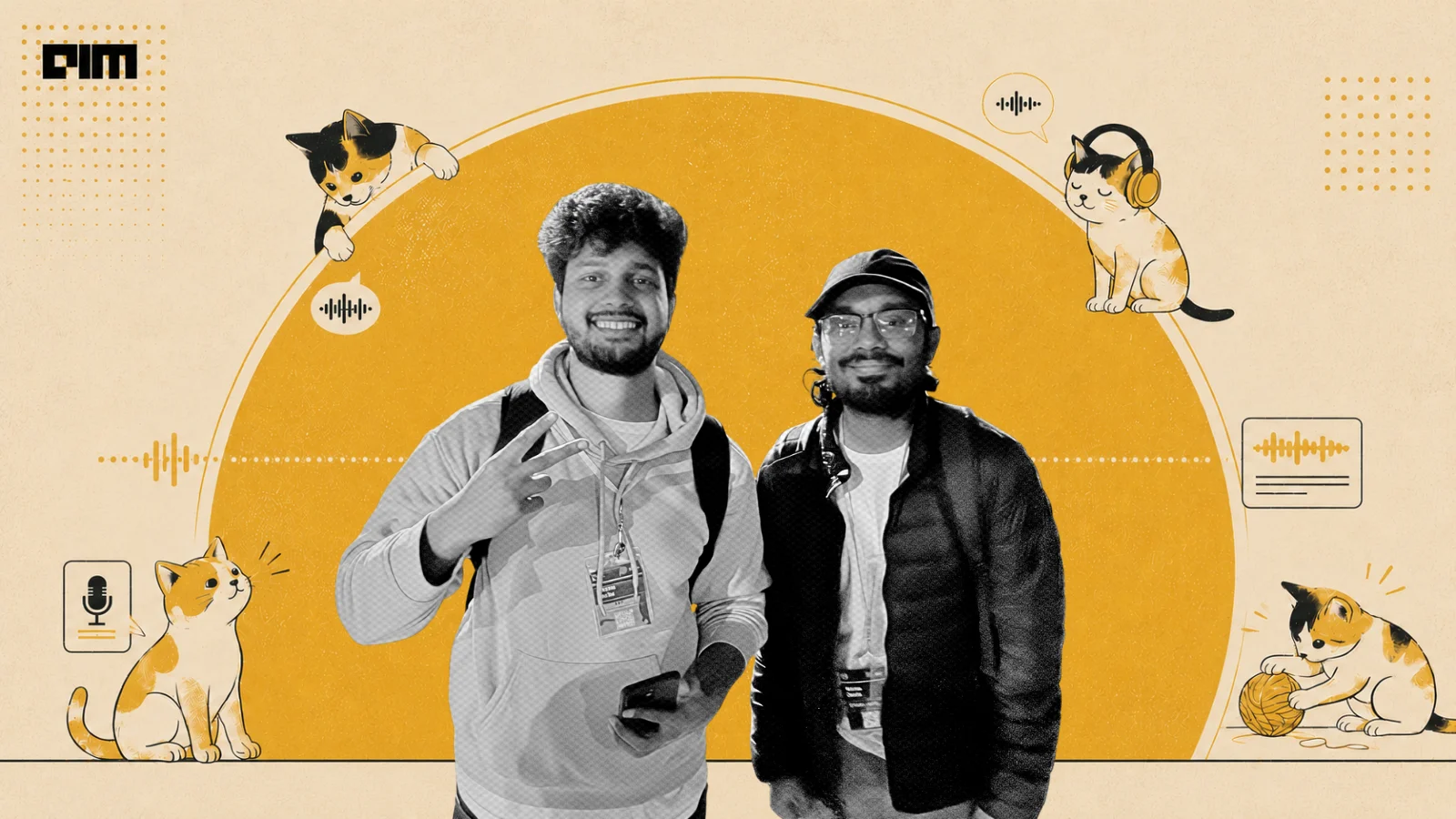
It is strangely fitting that the most consequential result of nearly two decades of cumulative experience accumulated by Rohan Joshi and Divam Gupta across Carnegie Mellon, Meta, Microsoft, and beyond would ultimately take the form of something as small as a 25 MB software package
And a lot of love for cats.
The homepage of KittenML, an open-source project born out of AI research lab Stellon Labs, greets visitors with playful images of cats and an unmissable tagline: “For Kittens By Kittens.”
KittenML’s KittenTTS family of text-to-speech (TTS) models is designed for lightweight, on-device use and comes in three variants—80 million, 40 million, and 14 million parameters. The smallest model occupies less than 25 MB, while the largest remains under 170 MB.
In an interaction with AIM, Co-founder and CEO Joshi says the technical idea behind KittenTTS is deeply reflected in its playful cat-inspired branding, an attempt to make advanced AI feel approachable, welcoming, and accessible rather than intimidating or distant.
Voice AI For Everyone–and Everything
KittenTTS has amassed over 13,700 stars on GitHub, objectively signalling a strong developer adoption, and the models are inching closer to a million downloads on HuggingFace.
The research lab, currently run by just five people, is working on broader goals of inventing new ways to train lightweight AI models, and KittenTTS is its first result.
While several developers on Hacker News praised the model’s ability to run entirely on CPUs at such a small footprint, others noted that larger open-source TTS systems still outperform it in raw voice realism and naturalness. For KittenML, however, the focus appears less on competing with heavyweight frontier voice models and more on unlocking a category of lightweight, locally deployable AI systems that can run virtually anywhere.
“For real accessibility, the cost of delivering AI has to be a lot lower,” says Joshi. Beyond smartphones and laptops, Joshi sees a future where lightweight TTS models power voice interfaces across everyday household appliances, from washing machines to air conditioners—categories where integrating GPUs or expensive AI hardware may neither be practical nor economically viable.
“We can get extremely high quality at 25MB,” he claims.
The Incentive Problem With Cloud AI
KittenML also builds on Joshi's thesis that the incentives in cloud AI are flipped.
“A cloud-based model has three competing sets of incentives. The first is for the companies that make the models, the second is for the ones who provide compute and infrastructure to run the models, and the third is for the end user.”
But he states that in this model, the user becomes the weakest stakeholder, as resource-intensive cloud-based models could eventually optimise not for user interests but for monetisation or for maintaining overall platform economics.
“But if inference happens on devices that the users already own, the incentive is not to make them use more tokens. This on-device AI model is not incentivised to make more money off the users,” Joshi adds.
In terms of the company’s research and engineering, which KittenML is set to also release a technical paper on, Joshi says the lab has found “ways to simulate expressivity without adding new parameters.” The lab has also internally developed methods to measure token efficiency and remove noise tokens from the dataset, making it possible for models to be that small.
Bringing KittenTTS to the Wild
The team is also planning to build implementations on top of the models, the first of which will be a fully local application that uses the models to narrate offline PDFs, articles, and e-books, essentially becoming an offline competitor to apps like Speechify and Eleven Labs’s ElevenReader apps.
Joshi also says developers in the open-source community have expressed interest in the hardware and robotics industry, where GPUs and NPUs are mostly used for vision model computation, but they won’t be able to accommodate the voice model. KittenTTS can instead run on the CPU, consuming fewer resources.
Another area of interest is mobile apps, where Joshi argues that the economics of cloud-based voice AI make it unviable for most consumer applications. He points out that many apps generate less revenue per user than what they would spend on cloud inference costs alone.
“You are going to lose money on every user you get—but not if your voice AI inference is free,” says Joshi.
Developers have already begun tinkering with KittenTTS. One recently shared an iOS implementation built with the Python version, and another added Kitten TTS as a model on their Claude Code plugin. PocketPal, a popular iOS and Android app that helps users access AI models locally, now also supports KittenTTS.
Besides, the model is built under the Apache 2.0 license, so users can fine-tune it to add extra features, improve its quality, or add more languages. While it currently only supports English, Joshi says inclusion of a broader set of languages, especially Indian regional languages, is on the cards.
Released in February, KittenTTS also arrives amid a broader push toward lightweight and locally deployable AI models. Open-source projects such as Piper, Kokoro, Bark, and Coqui XTTS have already demonstrated growing demand for text-to-speech systems that can run outside large cloud infrastructure.
Early community benchmarks shared by developers also showed that KittenTTS achieved faster real-time inference performance than several larger open-source alternatives on CPU-based workloads, despite operating at a substantially smaller model size.
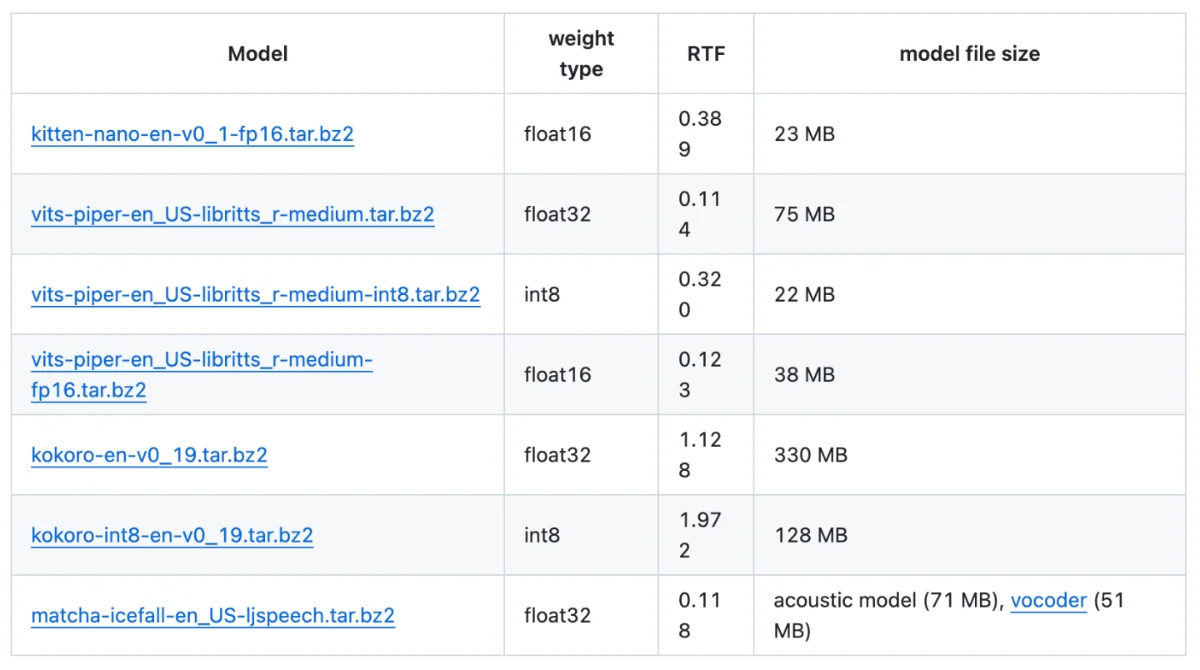
Source: Community benchmark comparison shared on GitHub issue #40 for KittenTTS
What differentiates KittenTTS is the degree of compression it achieves while still retaining expressive speech generation.
Why Quit Big Tech
Reflecting on his personal journey, Joshi says that while his goal was always to be an entrepreneur, in university and when he worked in Big Tech, he wanted to achieve single-domain expertise. “I got to a point where I realised that I can now build a world-class product using this experience,” says Joshi.
“I’ve always wanted to do things that wouldn’t exist if I decided not to work on it,” he adds. He says that this is contrary to how Big Tech works, where institutions are built on robust foundations, and the direction seldom changes if an engineer or two leaves the company.
Joshi also takes pride in how KittenTTS was received on GitHub, where its repository gained more stars than some of the industry's biggest projects, including the European open-source giant Mistral AI. “I did not expect that, and I had to double-check if it was true,” he recalls.
Joshi’s long-term vision for KittenML is anchored in the rapid growth in the amount of intelligence that can run on a fixed compute budget.
“Every few years, the quality of median hardware is improving, and the amount of intelligence you can pack per dollar of compute is rising exponentially,” says Joshi. “It might take the best iPhone to run a 100 million parameter [voice] models, but three years from now, it may run a two billion parameter model.”
By the end of the year, KittenML also plans to release vision models.
“We will continue to build models sized under 25 MB, but there are also a lot of edge devices capable of running larger models, for which we also plan to build,” he says. “Overall, the tech we are trying to build will not be restricted to text-to-speech, but to increase the efficiency of any AI models.”

Your reaction
Discussion
What's your take on this story?
No comments yet — be the first to share your view.