
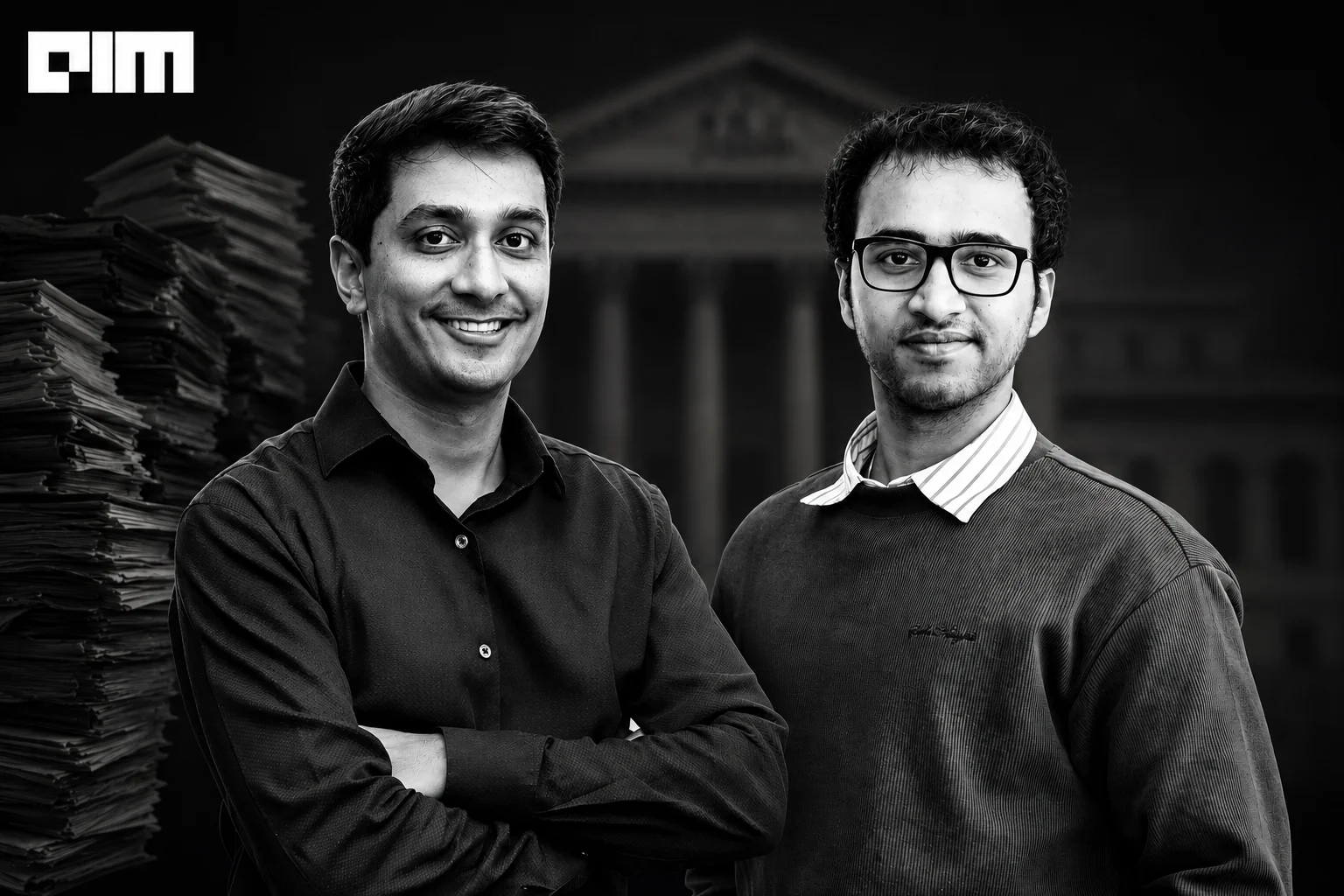
Last week, Y Combinator announced an unusual bet on India’s judiciary. The Silicon Valley accelerator has selected Adalat AI, an Indian legal-tech nonprofit founded by lawyer Utkarsh Saxena and AI researcher Arghya Bhattacharya, for its Fall 2026 batch.
For Adalat AI, the timing is significant. Its Co-Founder and CEO, Saxena, was named among TIME’s 100 Most Influential People in AI for 2026 just days after the YC announcement. TIME’s recognition puts an unusual spotlight on a category of AI that rarely gets the attention of frontier models, chips or billion-dollar infrastructure projects: technology being built for public institutions.
Now, with YC backing the company, Adalat AI wants to take what it has built in Indian courtrooms beyond India. Its founders, Saxena and Bhattacharya, will spend September to December in San Francisco as part of the programme.
For Bhattacharya, the CTO, YC is less about changing what Adalat AI is building and more about helping the organisation figure out how to take it to a much larger scale.
“Well, you never quite expect any of this, especially given we are a nonprofit, and that’s generally not what happens. But we are extremely grateful to YC for knowing this opportunity, and we’re really looking forward to learning how to scale this and learning the best of how to build technology from them,” Bhattacharya tells AIM.
Why This Problem?
Adalat AI has been building AI infrastructure for courts for roughly two and a half years. Its technology includes live speech-to-text transcription, case-flow management and paperless court workflows. The company says it now works across 11 states and has reached more than 6,000 judges, covering roughly 20–25% of courtrooms nationwide.
Bhattacharya says that when he first met Saxena, he did not immediately believe that something as simple as speech-to-text could make a meaningful difference.
He changed his mind after entering a courtroom.
“We were walking past this courtroom, and there were these 10 foot towers of paper inside the rooms. And then there was a person standing outside the room, and their full-time job was to take chits of paper from outside, and then look at the chit of paper, and then spend the next few hours looking for the right files amongst those towers of paper,” Bhattacharya says.
Its first product was built around one of the most basic bottlenecks inside courtrooms: transcription. In many courts, there is no stenographer. Bhattacharya says only about 10% of Indian courts have one.
That makes courtroom speech recognition much harder than simply putting a voice assistant in front of a judge. A system that works well in a controlled environment can fail quickly inside a district courtroom.
“We needed to build a system and move away from a pilot to a system that was actually secure, ready, reliable, and could yield the benefits and the promise that transcription was making in the lives of judges.”
But Technology Alone Was Not Enough
This is where being a nonprofit became part of Adalat AI’s strategy rather than simply its legal structure. Courts are deeply institutional environments, and convincing judges and court staff to adopt a new technology requires a degree of trust that cannot be created by a better model alone.
Bhattacharya describes Adalat AI as a “twin-engine system”. One side is technology. The other is its partnerships team, which works directly with judges and court staff, collects feedback and helps them use the systems.
That approach appears to be paying off. Kerala’s High Court mandated Adalat AI’s speech-to-text system for witness depositions in November 2025. Sikkim subsequently became the country’s first paperless High Court, with digital filing becoming part of its workflow.
Andhra Pradesh has also announced a statewide rollout covering transcription, case management and courtroom workflows from October.
No Judgements
Adalat AI does not decide cases, predict outcomes or recommend sentences. Even its transcription system is designed around keeping a human in the loop.
The concern is obvious. If an AI system incorrectly transcribes a witness deposition, the mistake could potentially affect a case.
“There is no world where every line is not checked by the lawyers itself. So even if a model gets something wrong, which it does very little now, our transcription rates have been improving quite a bit. It's always scrutinised. There is someone correcting the output,” Bhattacharya says.
The company says its early measurements suggest judges using Adalat AI can become two to three times more productive. Its initial studies also suggest that this could reduce overall case-resolution timelines by around 30%.
Those figures are still being tested, and the company is conducting a randomised controlled trial to measure the longer-term impact on productivity, case throughput and undertrial populations.
Adalat AI has so far been funded through CSR partnerships, fellowships and prize money rather than the conventional venture-capital route. YC gives it access to a network and a playbook built around scaling technology organisations, even though the organisation itself is structured as a nonprofit.
Bhattacharya sees two distinct directions for that scale.
The first is India.
“We want to do this in all courtrooms in India, and I see a future where you know you can file cases in any state, in any district online,” he says.
The second is the Global South. Many countries across Africa and other parts of the developing world inherited legal and administrative systems shaped by colonial rule.
“It’s almost like a copy paste artifact, you know, the laws as well. And so that’s the second dimension along which we aspire to scale, which is you know kind of have this be that make in India product that we build in India and then sort of scale and contribute back to the rest of the world as well.”
That ambition also gives the YC announcement a larger significance.
Saxena’s inclusion in TIME100 AI had already placed Adalat AI in a global conversation about what influential AI work looks like. His experience as a Supreme Court law clerk and lawyer led him towards the administrative machinery behind justice, and then towards AI as a way of improving it.
For now, the company remains cautious about moving from administrative assistance into legal reasoning. There may eventually be room for AI to handle some categories of cases or processes that require little judicial discretion, but Bhattacharya described that as an idea rather than a current product direction.
“I think we need to bring back a culture of building tech for good and making the idea of building tech for good sexy. And I think there is so much good that tech can do. We don’t realise how much diffusion work is left of diffusing all this good tech and AI solution that we're kind of building in the systems that need it the most.”
With YC now behind it, Adalat AI has a chance to test that idea at a much larger scale.

Your reaction