
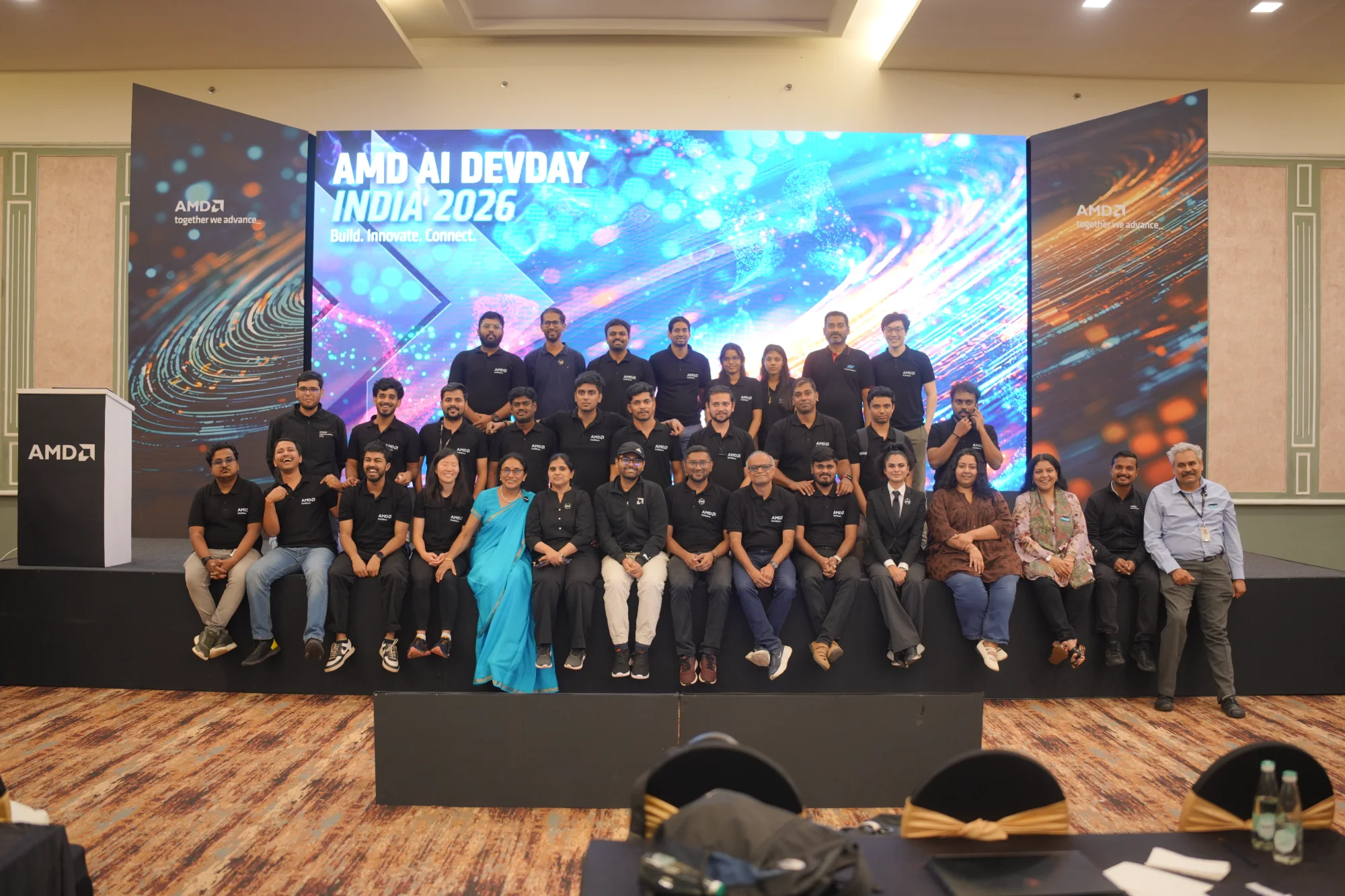
AMD AI DevDay India 2026 brought AI developers, ML engineers, researchers, LLM practitioners, startup founders, students and technology leaders together at Taj West End in Bengaluru on August 8th.
The event explored how developers are building AI applications with open-source models, agentic systems, fine-tuning, inference and workload optimisation.
Over 380 developers showed up, pushing registrations to capacity. The day moved between technical sessions and hands-on labs, letting attendees go from listening to building.
Building, innovating and connecting formed the three themes of the event. The morning covered AI infrastructure and software optimisation, before the programme shifted to practical GPU workshops in the afternoon.
From LLM Training to Physical AI
Deepak Agarwal, Corporate Vice President of Silicon Design Engineering at AMD, opened the event with the keynote.
“I truly believe that developers are at the centre of innovation,” Agarwal said in his keynote. “We at AMD can build all the wonderful hardware that we want. But without the developers developing the key and the right application, there won't be someone to take and extract the true value of that hardware.”
He said AMD’s strategy rests on three areas: compute leadership, an open ecosystem and bringing intelligence across the cloud, on-premises infrastructure and edge devices.
The keynote was followed by Adithya S Kolavi of Hugging Face, who discussed scaling reinforcement learning for LLMs, including the infrastructure, environments and training systems required to run RL workloads at scale.
Chandra Mohan Singh Negi, Senior AI Architect at Siemens, explored shared autonomy with PyTorch and how AI systems can support human-robot collaboration.
The programme then moved towards coding agents and model optimisation. Dr Pratik Prabhanjan Brahma, Generative AI Lead at AMD India, discussed building AI coding agents and applications, along with techniques for model and kernel optimisation.
The morning concluded with a session on AMD’s University Program, led by Dr Jayashree HV and Dr Prakash Raghavendra, exploring how campus projects can translate into practical AI development and strengthen the developer and academic ecosystem.
Developers got hands-on with AMD hardware
During the afternoon, two parallel workshop tracks allowed attendees to build and run AI workloads on AMD hardware.
The workshops covered building an OpenClaw agent using open-source multimodal models. Participants also learnt how to set up an open-source model server using vLLM or SGLang and connect it to their agent.
Running local AI development through the AMD Ryzen AI Max 395. The workshop used Lemonade Server and Qwen Coder to demonstrate how coding models can run locally without relying on cloud APIs.
The Unsloth workshop took developers into the practical side of LLM customisation, showing how models can be fine-tuned through Unsloth Studio on AMD Radeon GPUs.
The ComfyUI workshop shifted from text to video, using PyTorch and ComfyUI to build open-source video-generation workflows. Developers also explored how to make these pipelines more compute-efficient, addressing one of the central constraints in running increasingly demanding generative video models.
The workshops were structured for developers with experience in areas such as LLM training and fine-tuning, agentic systems, Python and Jupyter Notebooks using their own laptops.
AMD Targets Lower AI Inference Costs
The growth of AI usage is also putting pressure on inference economics.
Deepak said around 35 quadrillion tokens were generated globally in the previous month, with the volume continuing to increase. Lowering the cost of processing those tokens will therefore become increasingly important.
“It’s very easy to write a query and send it to AI, but there is a cost involved in that,” he said.
AMD is targeting higher token throughput across its Instinct GPU roadmap. Agarwal said the MI455 delivers an 18x improvement in tokens compared with its predecessor, while the MI500 series is expected to deliver more than 2,000 times the inference throughput of AMD’s comparable offering from four years earlier.
AMD is also bringing CPUs, GPUs and networking components together through its Helios rack-scale platform. Agarwal said a single Helios rack can pack 18,000 GPU compute units, 4,600 CPU cores and 31 TB of HBM4 memory.
That said, Agarwal also mentioned the rise of smaller open models as a shift that could move more AI workloads away from the cloud.
He argued that smaller models are increasingly capable of matching or outperforming older, much larger models, reducing the need for trillion-parameter systems for some workloads.
This is opening the door to personal AI running locally on PCs and other devices. AMD is targeting this market with its Ryzen AI Max series, while its Ryzen AI Halo platform can run models with up to 200 billion parameters locally. The upcoming Ryzen AI Max PRO 400 Series is expected to take that capability to 300-billion-parameter models.
AMD is now increasing its focus on developer experience, with more frequent ROCm releases, additional features and greater abstraction.
Open source takes centre stage
Open-source AI ran through much of the day’s programme. AMD brought in speakers and technologies from across the ecosystem, including Hugging Face, PyTorch, Unsloth, vLLM, SGLang and ComfyUI.
The focus was not limited to models. Sessions looked at the infrastructure and software layers needed to take AI applications from experimentation to working systems.
That included reinforcement learning infrastructure, coding agents, model servers, local inference, fine-tuning and GPU optimisation.
For developers, this made the event less about AI as a finished product and more about the tools required to build with it.
A developer community around AMD
Beyond the technical sessions, AMD AI DevDay also created space for developers, researchers, students, founders and technology leaders to interact.
The event included networking sessions, live Q&A with speakers and discussions between sessions. AMD’s featured speakers included engineers and technical leaders from AMD, Siemens and Hugging Face.
The event was supported by PyTorch, Hugging Face and Analytics India Magazine.
With its combination of technical talks, open-source tools and hands-on GPU sessions, AMD AI DevDay India gave developers a closer look at how AI workloads can be built and optimised across the software and hardware stack.

Your reaction
Discussion
What's your take on this story?
No comments yet — be the first to share your view.