
The years 2023 and 2024 have been game-changers in the world of AI. What initially started as a subtle shift towards automation has now turned into a full-blown revolution, disrupting traditional ways of doing business. Generative AI is no longer seen as just an extension of AI but as a distinct technology with diverse applications.
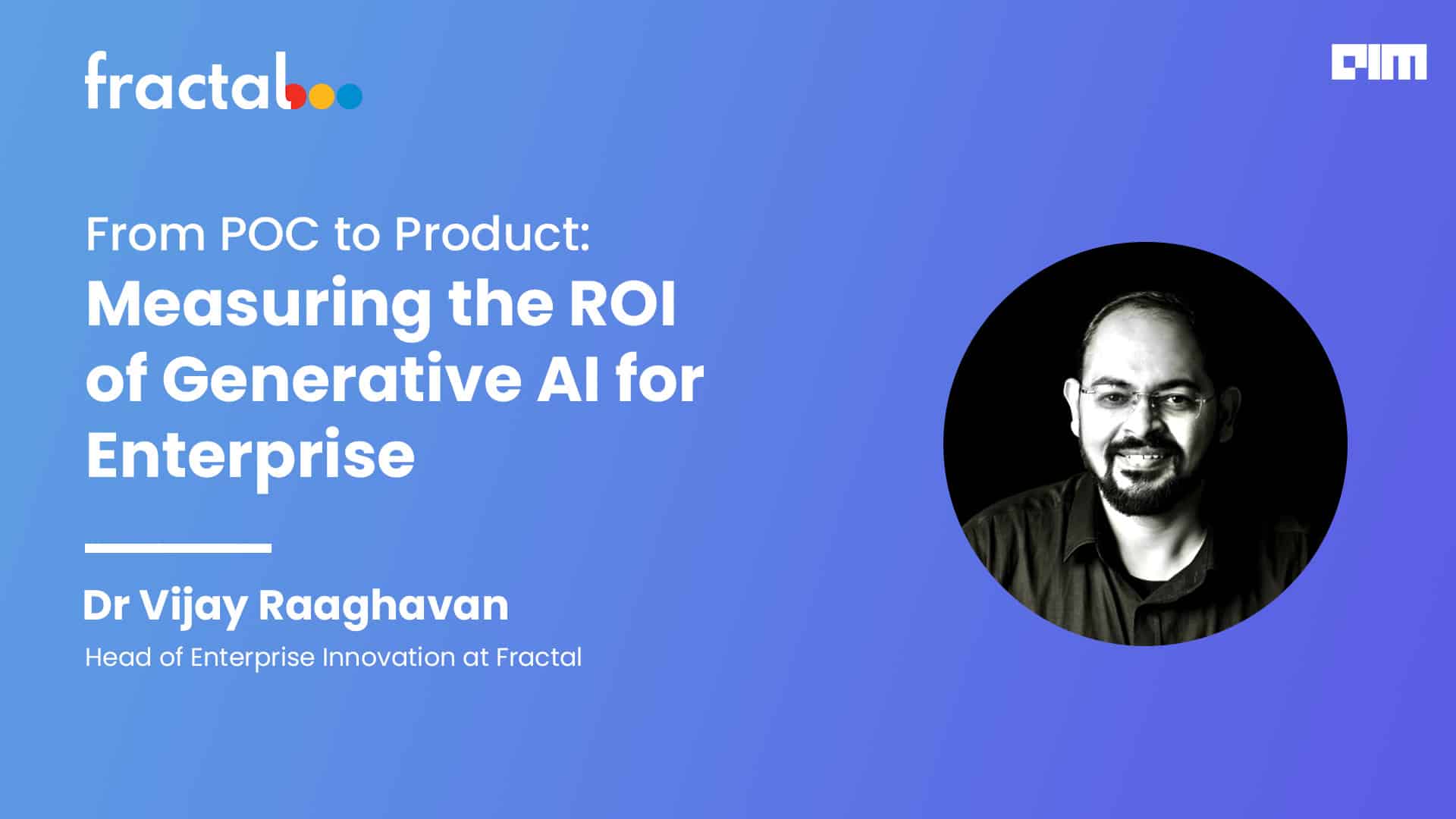
Vijay Raaghavan, the head of enterprise innovation at Fractal, highlights this transformation, particularly focusing on how organisations are now moving beyond experimentation to actively invest in generative AI solutions and maximise their value.
Consumers Lead, Enterprises Follow
Interestingly, Raaghavan noted that the early traction for GenAI wasn’t driven by businesses but by consumers. The virality of tools like ChatGPT caught the attention of millions, compelling enterprises to take notice. Since it only took a few weeks for ChatGPT to reach 100 million users, the business world couldn’t ignore the potential of generative AI, and more specifically, LLMs.
Soon, enterprises began experimenting with LLMs, and some eventually started building generative AI solutions. After two years of ChatGPT, it is no longer an experiment but becoming a reality.
“Leaders in the boardrooms began to ask whether their organisations should start building GenAI products,” Raaghavan said.
POCs to Real-World Applications
By late 2023 and into 2024, the GenAI landscape experienced yet another shift. By now, what began as exploratory proof-of-concept (POC) projects with conversational AI tools and chatbots had turned into serious discussions about investment. If 2023 was a breakout year, 2024 turned out to be the build-out year.
At present, the conversation has veered away from experimentation to figuring out whether GenAI can be turned into a product for the company or if it’s just plug-and-play. This transition from POCs to real-world applications has presented new challenges, particularly when it comes to measuring value, which is still the toughest part of driving investment in generative AI.
This is the “moment of truth” for enterprises. “During the experimentation phase, companies asked if it made sense for their organisations. Now that they’ve moved past that, the question is about return on investment (ROI),” Raaghavan pointed out.
Possibly, 2025 and beyond will be about scaling these investments and realising their full potential. “We’ve moved from POCs to full-scale deployment. The next step is value maximisation,” he said. This is also visible among several Indian enterprises and IT giants as they increasingly push POCs to products for their clients.
Quantifying ROI: From FTEs to Conversion Rates
Measuring the ROI of GenAI investments is not as straightforward as calculating the savings from a new software tool. It involves a blend of quantitative and qualitative factors, from time saved to human value unlocked. “Whenever you talk about any investment, the CEO conversation is all about value and ROI.”
As the world speaks of replacing workers with generative AI, the most basic form of value measurement is productivity gains, typically measured in hours saved or full-time employees (FTEs) freed up. People aren’t discussing replacing people outrightly because it’s a sensitive topic, but some leaders are reallocating roles.
For example, many content writers are becoming content reviewers because GPT models can generate drafts which humans just need to review and refine.
This shift is what Raaghavan describes as “human value unlocking”. GenAI allows organisations to elevate employees from mundane tasks to higher-order roles, which can lead to a more engaged workforce. While AI performs the redundant tasks, humans have elevated to performing more meaningful roles.
While some aspects of GenAI’s value are difficult to quantify, tangible metrics are emerging, particularly around FTE savings. Some organisations are measuring how many FTEs have been saved by introducing GenAI. For example, if a task previously required 10 full-time employees, introducing GenAI might save two, freeing them up for other projects.
In addition to FTE savings, companies also measure digital engagement and conversion rates, especially in sectors like e-commerce. Organisations use metrics like percentage engagement and conversion to measure the impact of GenAI. For instance, a consumer might use GenAI to make a more informed purchase decision faster, which improves conversion rates.
With so many companies adopting GenAI, staying competitive requires strategic investment. Raaghavan outlines a multi-layered approach: “Generative AI is not a plug-and-play solution. It requires the right data, hyperscale strategy, and long-term commitment.”

Your reaction
Discussion
What's your take on this story?
No comments yet — be the first to share your view.