


India’s hospitality landscape is changing rapidly. As incomes rise and a growing middle class seeks international standards, travellers are rethinking what they expect from their stays. Many now look for experiences that feel personal, sustainable, and unforgettable.
At the same time, technology is transforming hotel operations, while economic shifts are forcing Indian destinations to reconsider what makes them competitive.
At Amadeus, we closely monitor these changes, turning complexity into actionable insight so hotels and destinations can move forward with confidence.
Our latest research, Travel Dreams 2026: From data to delight, draws on insights from 6,000 global travellers, 500 hoteliers—including 50 in India—and leading destination management organisations (DMOs). The findings highlight a market ready to embrace innovation, where AI, personalisation, and sustainability are the key drivers of future growth.
Let’s take a closer look.
Personalisation Can Unlock New Opportunities
Travel Dreams 2026 reveals that personalisation is a major driver for Indian travellers, many of whom are willing to pay extra to have their preferences met. Our research shows that 95% of Indian travellers would pay more for a specific room view or floor, with an average premium of 13.9% to secure, for example, a sea vista.
Similarly, 88% would pay for an ‘Instagram concierge’ to help identify the best local photo opportunities, adding an average of 11.3% to the room cost. Health and wellness personalisation also resonates strongly, with 90% willing to pay for enhanced oxygen in their hotel room, at an average of 13.1% above the standard rate.
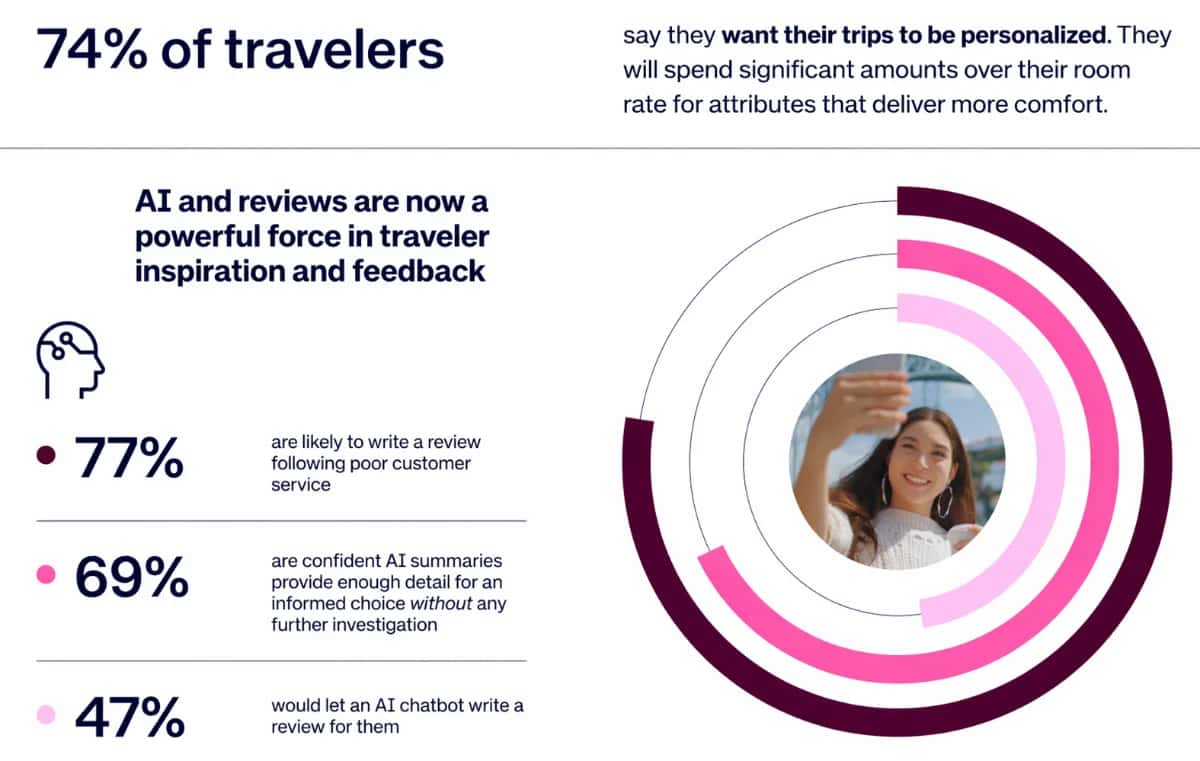
Overall, 89% of Indian travellers say they want personalised trips, compared with 74% globally. The research suggests that by offering modern retailing options such as tailored room attributes, hotels in India can meet guest expectations while unlocking significant financial returns.
Hoteliers are responding by using new technology to tailor trips. For example, 42% of Indian hotels already offer AI-enabled booking, with a further 22% planning to introduce this facility within the next year. Meanwhile, half allow self-check-in, biometric or other contactless experiences, with another 24% planning to follow suit.
With the right tools and data, 52% of Indian hoteliers say they would create tailored packages and bundles, such as combining rooms with wellness or customised food and beverage offerings. A similar proportion would offer unique or authentic local experiences, while 40% would upsell all aspects of the hotel.
The findings are clear: there is strong demand from Indian travellers for tailored stays—and a clear willingness from hotels to deliver them.
Open to Intelligent Assistance
AI is already playing a significant role in how Indian travellers choose hotels. Nearly nine in 10 (87%) are confident that AI-generated summaries provide enough detail to make informed decisions without further investigation. Notably, confidence is highest among women and business travellers (91% and 90%, respectively), while leisure travellers are slightly less confident (83%).
Overall, travellers find AI most useful during the planning stage (53%), followed by during the trip itself (47%), inspiration and discovery (46%), and booking (45%). Only 2% say they do not find AI helpful at any stage.
Trust in AI is also growing. Over two-thirds of Indian travellers would trust an AI chatbot to book them a hotel room (69%), make a restaurant reservation (68%) or arrange a local attraction (67%). Slightly fewer would trust it to book flights (63%).
Indian hoteliers are equally taking advantage of AI’s potential. Around 56% are already deploying dynamic pricing and revenue management systems, while 44% use AI for forecasting occupancy and labour scheduling. The same proportion uses it for competitor rate analysis, market intelligence, as well as review and sentiment analysis.
Every Indian hotelier surveyed plans to invest in AI this year, with an average spend of ₹18.5 million (~$200,000).
India Leads the World in Sustainable Demand
Sustainability is a critical factor for Indian travellers, both in practice and perception. A striking 93% say a property’s sustainability credentials are important when they consider booking, with 60% rating them as very important. This is higher than global averages, where 75% consider sustainability important and 35% rate it as very important.
Indian travellers are also willing to pay more for sustainable stays. On average, they would pay 15.5% extra per night for hotels with strong sustainability practices, compared with a global average of 11.7%. Younger Indian travellers are even more willing, with Gen Z indicating a readiness to pay an additional 16.6% per night for strong sustainability practices.
As younger generations gain spending power, this trend is likely to accelerate.
Indian hoteliers recognise this pattern. All those surveyed in Travel Dreams 2026 plan to spend on sustainability initiatives in 2026, allocating an average spend of around 5.4% of total business expenditure. Over a third of Indian hoteliers (38%) say sustainability is a key differentiator for their property.
India’s hospitality market is clearly moving away from standardised stays towards intelligently tailored experiences, where personalisation, AI, and sustainability directly shape revenue. The opportunity lies with those who can turn data into meaningful guest value and help shape the next phase of growth.
[Jan Tissera is the President of Global Accounts and Destinations, Hospitality at Amadeus in Europe, Africa, the Middle East, India and the Subcontinent.]
- The Economics of Continuous Inference
- [Webinar Alert] Building Secure and Scalable Enterprise Applications in the Age of AI With Aurigo
- Hexaware Certified as Best Firm for Forward-Deployed Engineers by AIM
- Meet the Winners of AIM Chess League 2026
- Cypher 2026: AIM’s Best Firm Awards Spotlight 22 Companies Shaping India’s AI Workforce
- 2026 Minsky Awards for Excellence in AI Winners