
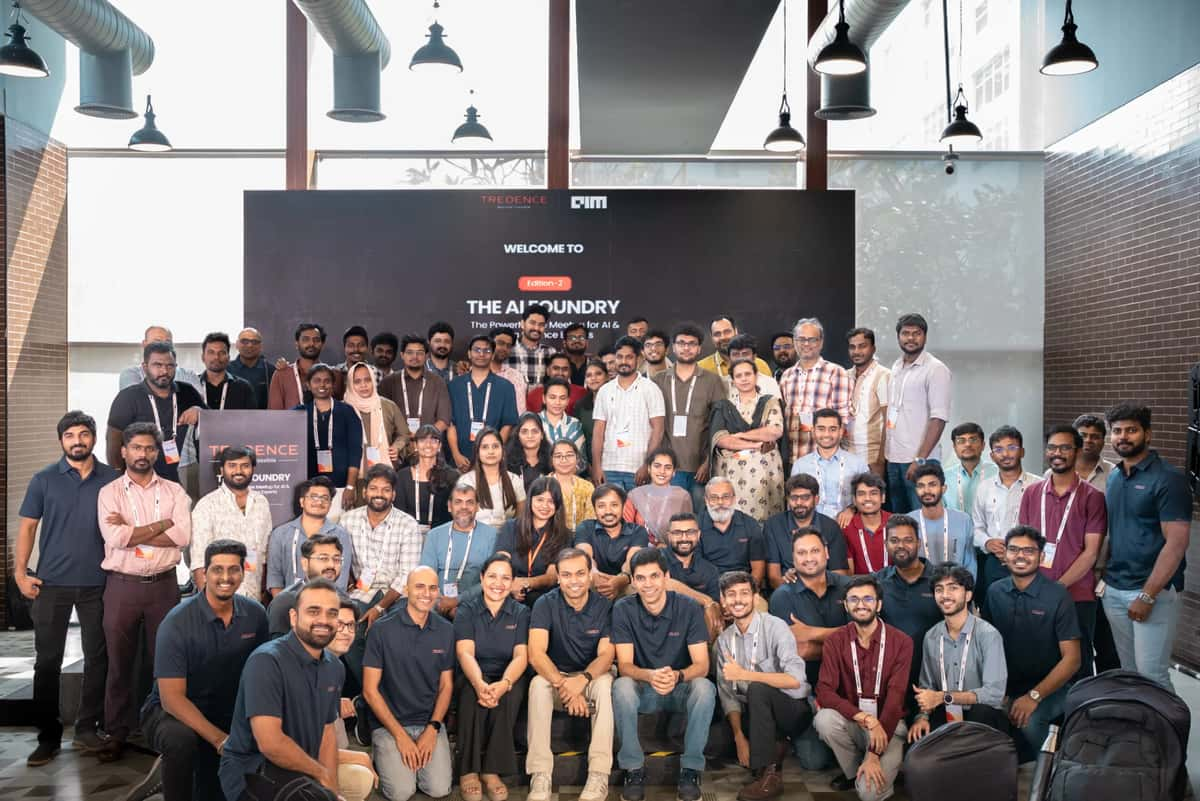

When Tredence hosted its AI Foundry at its Chennai delivery centre last week, the company made one thing clear from the outset: this was not another AI conference filled with slide decks and demos. Instead, the invite-only gathering was designed as what organisers repeatedly described as a ‘builder’s room’, a working session where participants would be pushed to think through real-world business problems using generative and agentic AI, and confront the practical realities of deploying such systems at scale.
Held on February 7 at Global Infocity Park in Perungudi, the Chennai edition brought together AI engineers, data scientists, architects, and students from premier institutions, including IIT Madras.
Participants were divided into small groups, or ‘pods’, each assigned a specific enterprise problem statement. Every pod was anchored by a senior leader from Tredence, whose role was not to lecture but to guide discussion, challenge assumptions, and steer teams back to business fundamentals when conversations drifted into abstraction.
From experimentation to execution
“The AI Foundry is about narrowing the gap between experimentation and execution,” said Karthik Ragunathan, AI Head, India at Tredence, during the event. “As organisations move from pilots to production, the complexity shifts from the models themselves to the systems that govern them.” According to Ragunathan, the goal was to help practitioners design AI that is “usable, trusted, and resilient when the stakes are real.”
That framing shaped the day’s structure. Rather than focusing on prompt engineering or model comparisons, discussions centred on system architecture, orchestration, security, scalability, and adoption. Each group worked through how an AI solution would actually function in production, how agents would interact with humans, where guardrails would sit, and how failures would be detected and handled.
Prakash Prabhu, Tredence’s Delivery Centre Head for Chennai, reinforced this intent. “The AI Foundry is designed as a builder’s room, not a showcase,” he said. “We’re giving practitioners a space to pressure-test ideas, architectures, and deployment strategies against real enterprise constraints.”
Inside the pods
Across the room, problem statements spanned industries. Tredence works closely with retail, travel and hospitality, CPG, marketing, data engineering, and healthcare. One group was tasked with designing an agent-led, self-healing data pipeline. Another explored AI avatars and kiosks to enhance the in-store retail experience. Others worked on hyper-personalised marketing engines, AI booking concierges for hotels, and recommendation systems that move beyond static filters.
Blessy, a machine learning engineer attending the foundry for the first time, described her group’s challenge as “how to bring in an agent to heal the data engineering pipelines that we have.” The aim, she explained, was to enable agents to identify root causes of pipeline failures and assist support engineers. “It’s not like the agent is going to replace what we are doing,” he said. “Rather, the agent is going to assist us… while also keeping a human in the loop.”
For Ramaswami, a data science lead at Beckman Coulter Diagnostics, the exercise underscored the importance of context. His group worked on building an AI avatar for retail. While agentic AI can add value, he cautioned against overuse. “If it’s applied everywhere, even without any context, it will turn out to be snake oil,” he said, noting that many enterprise problems remain deterministic and don’t require agents.
The Role of the Group Leader
A defining feature of the foundry was the presence of pod leaders, senior Tredence heads embedded within each group. Participants repeatedly credited these leaders with preventing discussions from defaulting to code-first thinking.
Reflecting on the format, Pavan Nanjundaiah, VP and Head of Innovation at Tredence, said the foundry was designed to be participatory by default. “The programme does two things: it’s a great way to network, and the workshop format makes it very engaging,” he said. “You use the whiteboard, you brainstorm, you challenge each other. That combination works really well.”
Looking back on his own early career, he noted that such environments were rare. “When I was starting out, I was never exposed to a format like this. If I had to start again, I would have loved to participate in something like this.”
The participants were particularly excited about the format and the pod leaders’ role in guiding them through the four phases. “Usually, for developers, whenever some problem statement comes, we immediately start thinking from a coding perspective,” said a participant from Deloitte Tech. “Today, they guided us to first understand the problem, build the architecture, and get the flow right before even thinking about implementation.”
Another participant described pod leaders as “the backbone of our team”, explaining that they helped refocus conversations on core pain points when debates became too expansive or unfocused.
This emphasis on design thinking was intentional, according to Soumendra Mohanty, Chief Strategy Officer and Chief Innovation Officer of Tredence. Reflecting on why the foundry was conceived, he said traditional project environments can become hierarchical, leaving little room for open exploration. “Coding has become easy,” he noted. “Now the focus and skill set required has shifted to design thinking, problem solving, and understanding patterns and anti-patterns.”
Students and professionals in the same room
One of the more distinctive aspects of the Chennai foundry was the mix of experience levels. In several pods, undergraduate students from IIT Madras worked alongside professionals with over a decade in data science and engineering.
For Om, a second-year IIT Madras student, the exposure was eye-opening. “It wasn’t a passive lecture,” he said. “We were actually solving real-world problems, collaborating with people we didn’t know, and getting industry exposure.”
Senior participants echoed this sentiment. Nithya, a lead data scientist at a fintech firm, said she had “never thought of the problem from a data engineering perspective” before working on a self-healing pipeline problem. “In a single day, I learned a lot,” she said, adding that the interactive format made the experience far more impactful than typical weekend events with lectures.
Beyond Pilots and Buzzwords
Throughout the day, a recurring theme emerged: moving beyond buzzwords towards systems that deliver measurable business value. Conversations around cost, maintenance, trust, and explainability surfaced repeatedly.
“If you don’t know how to handle it and it runs on its own without people taking care of it, it’s going to be a big chaos,” Ramaswami said, pointing to the operational risks of autonomous systems. “People care about how money is being saved by the company.”
Tredence leaders acknowledged these concerns. The foundry, they said, was designed precisely to surface such tensions early, before AI initiatives reach production and fail silently.
For now, the Chennai event offered a snapshot of how India’s AI ecosystem is maturing, not through grand announcements, but through whiteboards, debate, and uncomfortable questions about what it actually takes to make agentic AI work inside enterprises.
As one participant summed it up: “The biggest takeaway is understanding how different people think about the same problem, and how that changes the solution entirely.”
- Hexaware Certified as Best Firm for Forward-Deployed Engineers by AIM
- Meet the Winners of AIM Chess League 2026
- Cypher 2026: AIM’s Best Firm Awards Spotlight 22 Companies Shaping India’s AI Workforce
- 2026 Minsky Awards for Excellence in AI Winners
- What Enterprise Vendors Need to Rethink About AI Agents
- The Industrialisation of Enterprise Intelligence