

A bank with 200 AI models in production can still be a Stage 1 company. A retailer with a single production model can already be at Stage 4. The number of pilots, the size of the platform team, and the maturity of the MLOps stack tell you almost nothing about whether AI is changing the business.
This is the uncomfortable conclusion most enterprise leaders will arrive at over the next twelve months, when the AI investment cycle that began in 2023 starts producing earnings-call answers rather than slide-deck ambitions. Boards that funded "AI transformation" will discover that they got AI automation. CFOs that reported cost savings will discover the market priced those savings in months ago. CEOs who promised differentiation will discover their competitors shipped the same vendor stack.
The problem is not the technology. It is the measurement.
The wrong question
Every enterprise AI maturity model on the market measures the same thing. Awareness. Pilots. Industrialisation. Transformation. The arrow points up and to the right. The conclusion is always that the company is somewhere between steps three and four and needs to invest more to reach five.
These models are not wrong. They are simply not strategic. They measure the maturity of the AI factory — how many models, how much governance, how mature the platform — without asking the only question that matters to the board. What is AI changing about the business?
A maturity model treats every use case as equivalent. Automating customer support, redesigning underwriting, building a new revenue line, rebuilding the operating model around agents — they all count as "AI in production". They are not the same activity. They are not the same kind of bet. They are not the same kind of advantage.
The five postures
There is a more useful way to map an enterprise's AI posture. Not by execution maturity, but by strategic intent. Five postures, ordered by ambition rather than activity.

Stage 1 — Cost Optimisation. Doing the same thing for less. Customer support deflection, document processing, first-line review, code generation for boilerplate. Sponsor is the CFO. Returns are real but linear, bounded, and zero-defensibility. Whatever you save, your competitor will save next quarter.
Stage 2 — Process Reinvention. Redesigning the work itself, not automating it. Underwriting in ninety seconds instead of five days. The monthly close becomes continuous. The supply chain replans hourly. Sponsor is the COO. Returns compound because faster processes change what is possible downstream. The blocker is rarely technology — it is that the existing process is also the existing power structure.
Stage 3 — Product and Experience Differentiation. AI moves from the back office to the customer. Personal stylist agents per shopper. Wealth advice at mass-affluent price points. Patient-facing triage that genuinely substitutes for the specialist call. Sponsor becomes the CEO and CRO together. Returns shift from cost to revenue. Competitors must respond, not just copy. The constraint is no longer the model — it is the risk function, which was built for internal AI and cannot govern customer-facing AI at speed.
Stage 4 — Business Model Reinvention. Changing what you sell and how you charge. Retail media networks. Embedded finance as a primary line, not a side bet. Equipment-as-a-service priced on customer outcome. Consulting methodology productised as software and agents that compete with the firm's own hours. Sponsor is the CEO and the board together. New revenue lines suppress reported earnings for two to four years before they replace what they are cannibalising. This is the stage public companies with quarterly earnings pressure rarely make cleanly.
Stage 5 — AI as the Enterprise. The firm rebuilt around AI capability. Small senior teams orchestrating large agent workforces. Revenue per employee an order of magnitude above industry norms. The moat is data, agents, and judgment systems — not headcount, not process IP. Mostly theoretical for incumbents today. The companies operating closest to this are AI-native firms born after 2022 and a handful of private-equity-owned businesses whose capital structures tolerate radical reorganisation.
The gap that explains the disappointment
The single most common diagnostic finding inside large enterprise AI programs is this. The board talks about Stage 3 and Stage 4. The portfolio funds Stage 1. The CFO measures it as Stage 1 — and reports a win. The CEO sees no market separation and concludes AI did not work.
Both are right about their own slice. The intent and the execution were never aligned. The language said differentiation and reinvention. The cheques wrote automation and cost takeout. Three years later, the company has saved real money, and the competitor down the road has saved exactly the same money, because they bought the same software from the same vendor and pointed it at the same processes.
This is what intent-investment gap looks like in practice. It is not a model performance problem. It is not a data foundations problem. It is a strategy problem, dressed up as a technology problem because that framing is easier to fund.
The 2026 frontier
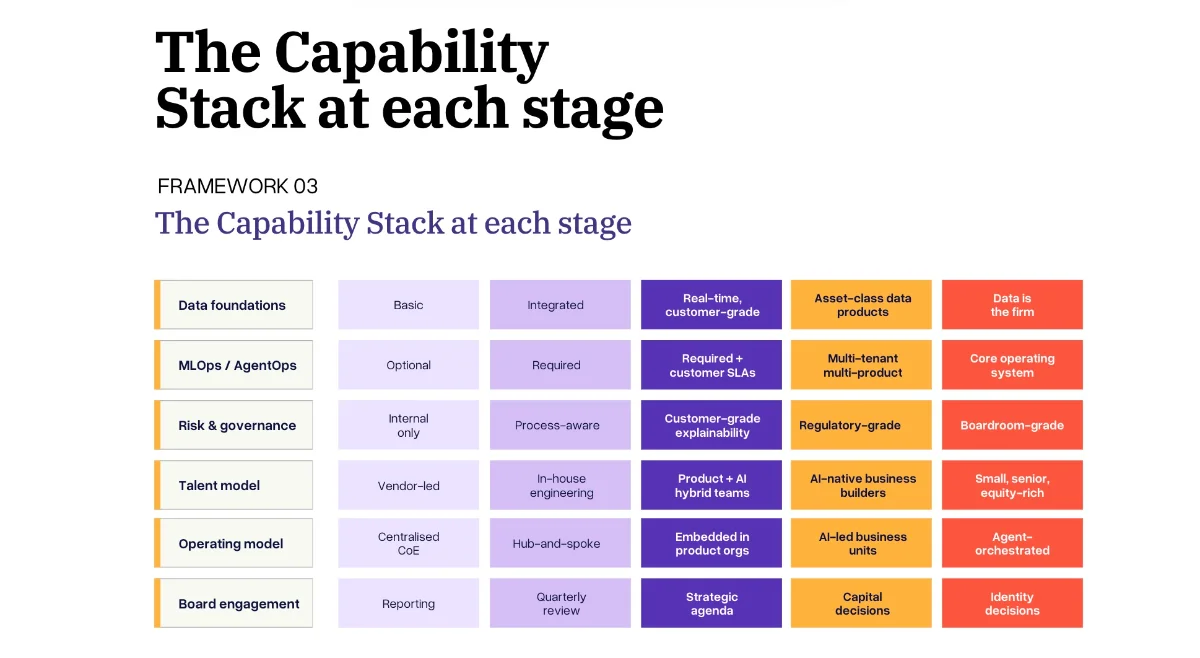
Most large enterprises today are honestly at Stage 1, talking like Stage 3, and surprised they are not at Stage 4. The realistic frontier for most industries in 2026 is solid Stage 2 execution across the company with selective Stage 3 product bets in defined parts of the portfolio. Stage 4 moves are concentrated in retail media, embedded finance, equipment-as-service, and services productisation. Stage 5 is being built by new companies, not converted to by old ones.
This is not a counsel of despair. It is a counsel of honesty. Stage 1 is rational. It is measurable. It produces returns inside a single budget cycle. Many large enterprises are best served by a serious commitment to Stage 2 across the company and a small number of well-resourced Stage 3 bets in product areas where the data and the brand can support customer-facing AI. Trying to do all stages at once produces no progress on any.
What to do about it
Three moves, in order.
First, run the diagnostic honestly and publish the result internally. Classify every AI initiative against the five stages. Compare to the language in the most recent board materials. If the language is dominated by Stage 3 and 4 terms but more than seventy per cent of the portfolio is Stage 1 work, the gap is real. Closing it requires either pulling the language back to honest Stage 1 framing or restructuring the portfolio to match the ambition. Both are healthy. Doing neither produces the eventual conclusion that AI was a disappointment.
Second, separate Stage 1-2 work from Stage 3-4 work organisationally. Internal AI and customer-facing AI need different governance, different talent, different funding cycles, and different tolerance for failure. Running both through the same operating model handicaps the more ambitious one.
Third, make the CFO accountable for cost AI and the CEO accountable for revenue AI. Sponsorship determines outcome. If the only executive measured on AI is the CFO, the company will be at Stage 1 in five years regardless of board ambition.
The headline is this. AI maturity is not measured by what an enterprise has built. It is measured by what the enterprise has become because of what it has built. Most enterprises today are at Stage 1, talking like Stage 3, and surprised they are not at Stage 4. The work of the next twenty-four months is to align all three.
Bhasker Gupta leads AIM Media House and AIM Research. This article is drawn from the AIM Research strategy brief on the Strategic Intent Ladder.

Your reaction
Discussion
What's your take on this story?
No comments yet — be the first to share your view.