
Artificial intelligence is rapidly changing how software is built inside enterprises. Tasks that once took teams of developers weeks to complete can now be generated in hours with AI-assisted coding tools. However, as companies race to adopt these technologies, a new challenge is emerging revolving around how organisations govern the growing number of AI-generated applications and how agents are being deployed across their systems.
According to Gartner, nearly 90% of enterprise software engineers are expected to use AI-assisted coding tools within the next 12 to 18 months. More than 40% of code today is already generated with the help of AI, while close to 60% of developers actively use AI tools in their workflows.
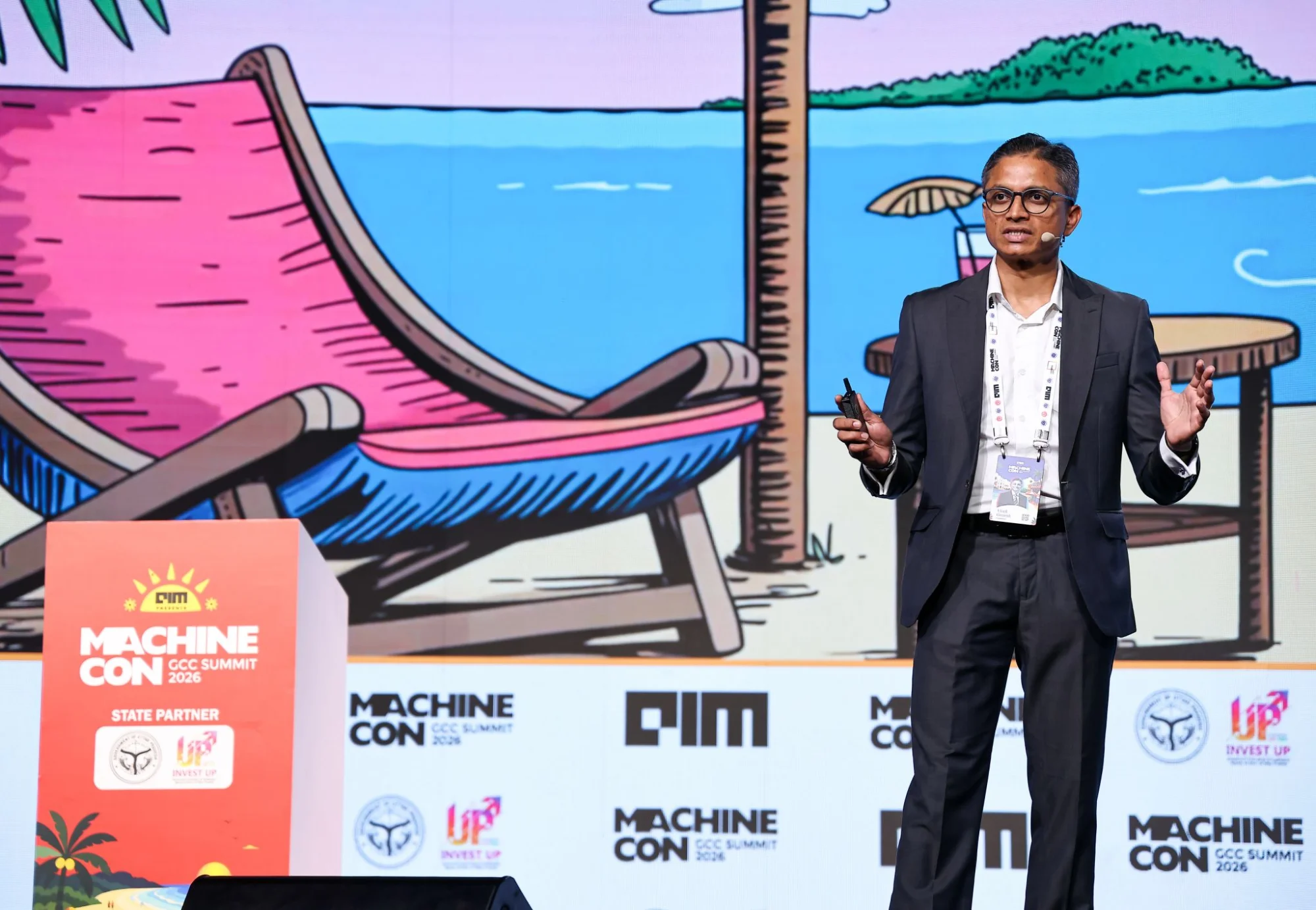
For Vivek Ganesh, Country Head and Regional Vice President, India at OutSystems, the question is no longer whether enterprises will use AI for software development. The bigger concern is what happens when hundreds of developers begin building AI-powered applications and agents simultaneously.
“The problem that CIOs are trying to solve today is no longer application development. It is agent sprawl,” said Ganesh during the MachineCon GCC Summit 2026.
From Application Sprawl to Agent Sprawl
Over the past two decades, enterprises have gone through several waves of software development from traditional coding to rapid application development, low-code platforms and no-code tools.
AI-assisted development represents the latest evolution.
However, while AI is making software creation easier, it is also creating a governance challenge. Ganesh warned that if hundreds of developers across a GCC begin creating AI agents every day, organisations could quickly lose visibility and control over what is being deployed.
“Imagine if 500 or 600 developers start building agents every single day and deploying them across the enterprise. The amount of agent sprawl that would happen is unimaginable,” he added.
The concern is particularly relevant for large enterprises operating across multiple geographies, where security, compliance and data governance requirements remain critical.
Why Most AI Projects Never Reach Production
Despite growing enthusiasm around generative AI and agentic systems, many organisations continue to struggle with moving AI initiatives beyond pilot stages.
Ganesh pointed to a commonly cited industry statistic suggesting that nearly 90% to 95% of AI projects fail to reach production environments.
According to him, the issue is often not the AI model itself but the lack of enterprise-grade governance frameworks.
“The reason many AI projects get stuck at the proof-of-concept stage is that the tools being used cannot easily go into deployment. Security guardrails and compliance requirements are often missing,” he explained.
As a result, CIOs are increasingly looking for ways to establish common orchestration layers that can manage application development, AI agents, security controls and enterprise data from a single platform.
AI is Reshaping Business Processes
Beyond software development, enterprises are also using AI to transform operational workflows.
Ganesh shared the example of a banking organisation that sought to reduce customer onboarding timelines. What previously took three to four weeks was first reduced to one week, then to just four hours. The bank is now aiming to bring that process down to 40 minutes.
Such improvements are being driven through a combination of AI-powered automation, business workflow optimisation and human oversight.
Rather than replacing employees entirely, organisations are increasingly adopting a ‘human-in-the-loop’ approach where AI agents handle repetitive tasks while humans remain responsible for validation and decision-making.
“If 30% to 40% of a business process can be automated through agents while maintaining human oversight, that is the ideal situation,” he noted.
The Rise of Agentic Systems Engineering
As enterprises expand their AI initiatives, a new concept known as agentic systems engineering is gaining attention.
The idea centres on creating environments in which applications, AI agents, security controls and enterprise data can work together within a unified framework.
This approach becomes particularly important for legacy modernisation efforts. Many organisations continue to rely on decades-old ERP systems, core banking platforms and customer relationship management software. Replacing these systems entirely is often impractical.
Instead, companies are exploring ways to modernise surrounding applications while keeping core infrastructure intact.
“Your core ERP is not going to change. Your core banking platform is not going to change. But the application architecture around it needs to be modernised,” Ganesh said.
Agentic systems can help bridge that gap by connecting modern AI-powered services with existing enterprise infrastructure.
The Next Phase of Enterprise AI
For enterprise leaders, the focus is gradually shifting away from experimenting with AI and toward scaling it responsibly.
The conversation is no longer centred on whether developers should use AI coding assistants or whether enterprises should deploy AI agents. Those shifts are already underway.
Instead, CIOs are increasingly being asked to define governance frameworks, establish security guardrails and ensure that AI systems align with business objectives.
As AI-generated code becomes commonplace and autonomous agents become embedded within business workflows, enterprises may find that managing AI is ultimately more challenging than building it.
“The biggest question organisations need to ask is not what AI can do. It is what business problem needs to be solved first,” Ganesh opined.

Your reaction
Discussion
What's your take on this story?
No comments yet — be the first to share your view.