

Software testing has always been one of the most time-consuming parts of product development. Writing test cases, running them across devices, catching bugs, and ensuring every release works as expected takes significant time and effort. AI agents are now changing that by taking over repetitive work, identifying issues humans may miss, and helping teams maintain testing speed without slowing down releases.
From browser automation to full test orchestration, these agents cover a wide range of testing needs. Some are built for large-scale teams, some help developers move quickly with minimal setup, and others sit inside the tools teams already use.
What are AI Agents in Software Testing?
AI testing agents are autonomous programmes that handle the software testing cycle, including planning, test creation, execution, updates, and reporting. They learn from application data, previous runs, and test results to improve over time.
Unlike traditional scripts that follow fixed steps, these agents behave more like human testers. They review requirements, understand application behaviour, create or update test cases, and adapt when systems change, with minimal manual input.
Their key purpose is to speed up testing, improve coverage, and catch critical issues before production. They stand out because they can make decisions independently, adjust their strategy based on earlier results, understand what needs to be tested and why it matters, and continuously learn from every test and defect.
Top AI Agents in Software Testing
KaneAI by TestMu AI (formerly LambdaTest)
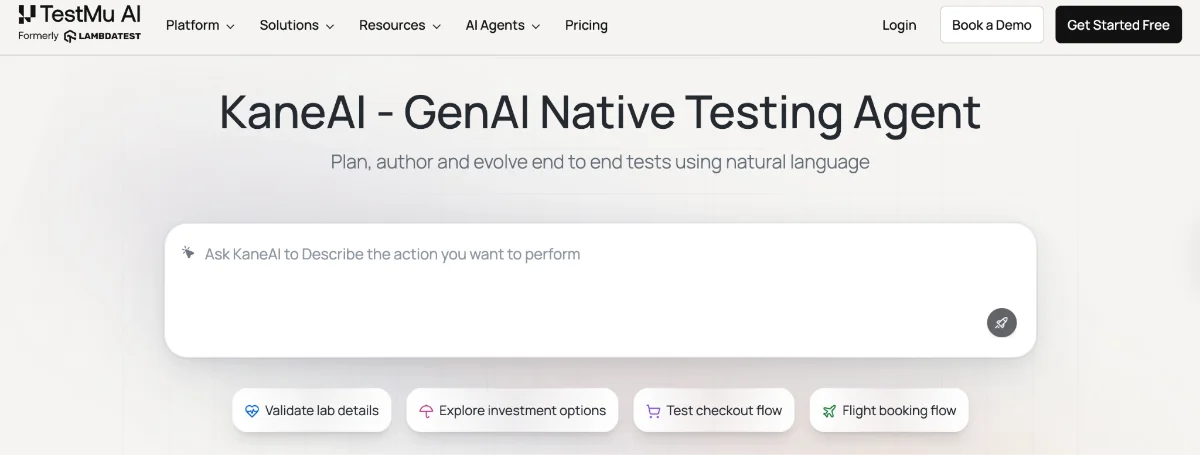
KaneAI by TestMu AI is a GenAI-native testing agent that helps teams plan, write, and update tests using natural language. Built for high-speed quality engineering teams, it connects with TestMu AI’s wider platform across test planning, execution, orchestration, and analysis.
TestMu AI positions itself as a full-stack AI Agentic Quality Engineering platform, offering a testing cloud with over 10,000 real devices and 3,000 browsers, AI-native test management, MCP servers, and agent-based automation. It supports Selenium, Appium, Playwright, and other major frameworks.
KaneAI’s key strength is its end-to-end capability. Teams can move from intelligent test creation to large-scale execution using natural language inputs. It supports web, mobile, API, database, accessibility, and UI testing, helping reduce QA complexity while improving speed, accuracy, and scale.
Its Intelligent Test Generation capability allows users to describe tests conversationally, while the Intelligent Test Planner converts high-level goals into detailed automated plans. Kane CLI runs from the terminal and bridges code generation with verified browser execution. It can be installed via npm or Homebrew and works in interactive terminal, headless CI, and agent-callable modes, with native support for Claude Code, Codex CLI, Cursor, and Gemini CLI.
The KaneAI GitHub App brings the agent into the pull request lifecycle, allowing developers to trigger test generation, execution, and reporting with a single comment. KaneAI also supports multi-language code export into Selenium, Cypress, and Playwright, enabling teams to retain their existing setups.
Its integrations with Jira, Slack, and GitHub allow tests to be generated by tagging KaneAI. Show-Me Mode lets users perform actions while KaneAI converts them into automated test flows. Two-way test editing keeps natural language and code changes synced, while smart versioning tracks every test change and enables rollback. KaneAI also detects bugs during generation and execution, uses auto-healing to fix broken steps when applications change, and offers enterprise features such as SSO, RBAC, audit logs, and compliance controls.
Testers.ai
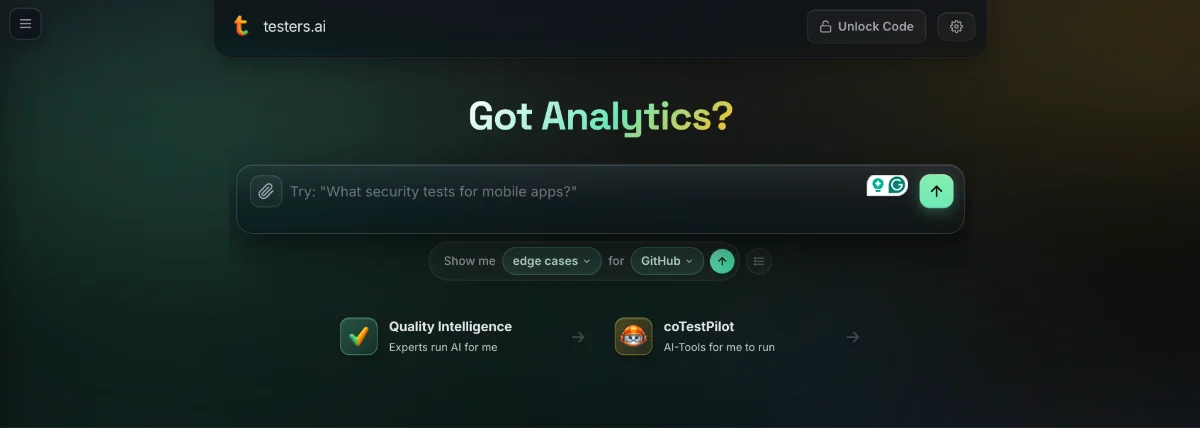
Testers.ai is a quality intelligence platform for QA teams and developers who want autonomous AI-driven testing without heavy coding. It uses AI Testing Agents to automate functional testing and bug detection for web applications, helping teams achieve broader coverage quickly.
The platform supports autonomous testing across functionality, performance, API, and accessibility. It can handle full regression cycles, reducing the need for repetitive test maintenance. Its agents scan for vulnerabilities and performance gaps during execution, and generate fix prompts that can be pasted into GitHub Copilot or Cursor to resolve issues. Testers.ai also integrates with Jira, TestRail, Claude, and VS Code, making it useful for teams across different skill levels.
CrewAI
CrewAI is an open-source, Python-based multi-agent orchestration framework created by João Moura. It enables teams to build role-playing autonomous AI agents that work together to complete tasks. While not limited to testing, it can be used to design agentic testing workflows and broader enterprise automation systems.
CrewAI manages the full agent lifecycle, including building, testing, deployment, and scaling. It offers a visual editor and ready-to-use tools, and allows users to build crews of AI agents connected to Gmail, Microsoft Teams, Notion, HubSpot, and Salesforce without writing code.
Its real-time tracing shows every step agents take, from task interpretation and tool calls to validation and final output, giving teams visibility into agent behaviour. CrewAI also supports automated and human-in-the-loop training to produce repeatable outcomes across simple and complex workflows. It can be deployed on CrewAI’s cloud or private infrastructure, including on-premise environments and private VPCs in AWS, Azure, or GCP.
AutoGen

AutoGen is Microsoft’s AI framework for building scalable, event-driven multi-agent applications. It helps developers create, orchestrate, and manage multiple AI agents through a modular API stack. With asynchronous messaging, conversational workflows, third-party integrations, and no-code tools, AutoGen provides a strong base for collaborative agentic systems.
Its AgentChat framework coordinates conversational agent teams, while the Core API supports asynchronous messaging and event-driven workflows. The Extensions package connects with OpenAI, Azure, and other third-party tools, and Studio offers a no-code interface for prototyping and managing agents. This makes AutoGen useful for both technical and non-technical users exploring agentic systems.
Agent.ai
Agent.ai makes AI agents accessible for business and technical workflows, including software testing. It offers a marketplace of specialised agents that teams can connect and configure without building everything from scratch.
For QA teams, Agent.ai can help add intelligent automation with less setup. It offers pre-built agents for specific testing and workflow tasks, and teams can combine specialised agents to manage different phases of a testing pipeline. It can automate repetitive QA activities such as test scheduling, result logging, and defect reporting.
Agent.ai also connects with development and project management tools, keeping testing activities tied to the wider delivery process. For teams experimenting with agentic workflows, it offers a faster route than building custom frameworks from scratch.
Devin

Devin by Cognition AI is an intelligent AI tool built to support engineering teams with task execution and productivity. It understands natural language and handles tasks such as code refactoring, data analysis, and software development. In testing, Devin can assist with bug fixes, testing tasks, and SaaS integrations as part of broader development support.
Developers can assign and manage tasks using natural language commands. Devin also supports code migration and restructuring through automated refactoring, handles data workflows such as ETL, preprocessing, and pipeline management, and adapts over time based on user feedback and workflow patterns.
Role of AI Agents in Software Testing
AI agents do more than execute tests. They participate across the testing lifecycle, from creating test cases to tracking results and reporting issues.
They generate test cases by reading user stories, design files, Jira tickets, code changes, and past defects. They also decide which tests to run first based on risk, recent changes, and business impact, ensuring important flows are tested even when time is limited.
When UI elements, selectors, or APIs change, AI agents detect the update and adjust scripts, reducing manual maintenance. They also improve coverage by mapping application components against previous test runs and identifying under-tested areas.
By handling test creation, execution, and reporting together, AI agents make automation faster. Tasks that once took days can be completed much more quickly. Real-time dashboards also help teams identify failure patterns, root causes, and coverage gaps.
Factors to Consider Before Choosing an AI Testing Agent
Before choosing an AI agent, teams must be clear about the business problem they want to solve. They should identify the tasks the agent must perform, the complexity involved, and the expected outcomes, whether cost savings, revenue growth, faster releases, better coverage, or improved productivity.
The required level of autonomy also matters. Not every process needs a fully independent agent. For sensitive workflows, a hybrid model with human oversight may be better. Scalability is another factor, as the agent should grow with the organisation’s needs and adapt to new scenarios through retraining and management.
Ease of use and maintenance are equally important. A no-code interface may suit beginner teams, while experienced developers may prefer deeper control and customisation. Teams should also assess documentation, testing environments, and vendor support.
Reliability and observability should not be overlooked. Teams need to monitor response time, accuracy, availability, error types, hallucinations, and retrieval mistakes. Regular testing against defined scenarios is important before full deployment. Human-in-the-loop controls are also essential, especially for high-risk decision points where human judgement must remain part of the process.
The Future of Testing
AI testing agents are already being used in production environments. They reduce testing time, cut manual effort, and give teams faster visibility into quality signals that traditional methods often miss.
As release cycles shorten and applications grow more complex, the question is no longer whether teams should adopt AI-driven testing, but which platform helps them move faster with better control.
For QA teams looking for a full path from requirements to production-level automation without writing test code, TestMu’s KaneAI is one of the most complete options in the market.

Your reaction