

For more than a decade, enterprises have invested heavily in data, analytics, and AI to improve decision-making. Dashboards became richer, predictive models became more precise, and insights were generated faster. Yet, across industries, a structural gap remained.
Companies knew what to do, but translating that knowledge into coordinated, reliable execution across teams and systems proved far more complex.
This gap between intelligence and execution is what ultimately led C5i to build Agent5i, its enterprise-grade agentic AI platform designed to close the loop from data to decisions to action. But the story did not begin with a product roadmap. It began with a realisation about how enterprises actually create value.
The Execution Gap
C5i has long positioned itself as a provider of decision intelligence. The company provides AI & analytics solutions for marketing optimisation, customer 360, risk management, supply chain and supply network planning, and product engineering for clients across industries, helping global enterprises use AI to drive measurable business impact.
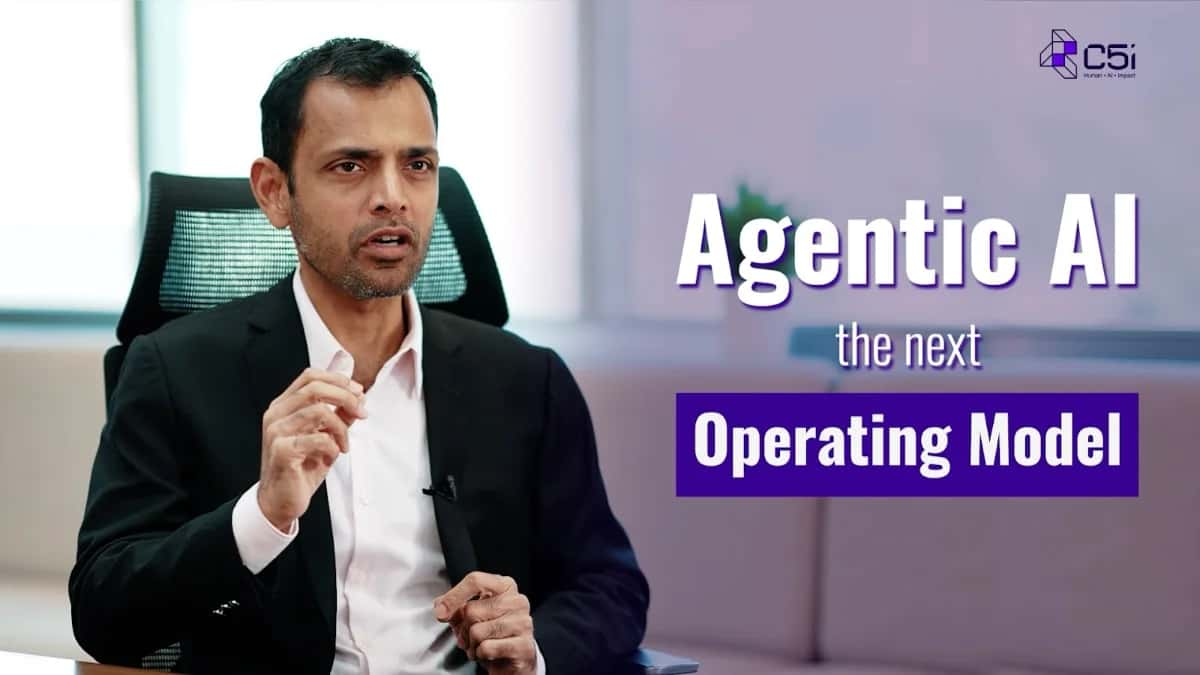
As Executive Chairman Ashwin Mittal explains, “We’ve always been providers of decision intelligence to corporations, using data analytics and AI. In some way, we’ve even prided ourselves that we are only the higher order intelligence providers, not doing the operations.”
That distinction enabled C5i to focus on high-value intelligence. And yet, as Mittal explains, often its claim to ROI was not as strong since it didn’t handle execution.
Once a decision left the insights layer and entered operational workflows, execution depended on fragmented processes, multiple systems, and numerous human handoffs. Value creation slowed not because the intelligence was wrong, but because the path to action was complex.
The ‘Aha’ Moment: Agentic AI as an Operating Model Shift
Over the past year, as agentic AI evolved from experimental prototypes to production-ready systems, that boundary became increasingly untenable. “When we started understanding agentic AI technology, we realised things are going to completely change. This is not just a technology trend. The operating model of business is what’s going to change over time. One doesn't need to stop at a decision, because the same decision can then be orchestrated into action using AI.”
For the first time, decisions no longer had to remain endpoints.
What changed was not merely the tooling, but the architecture of work itself. Agentic AI made it possible to move from static outputs to dynamic execution systems that coordinate tasks, communicate across workflows and operate within defined constraints.
This is what marked the origin of Agent5i.
Reimagining Execution: Human–Agent Teams
Rather than building yet another orchestration layer, C5i began by examining the nature of enterprise execution. Large organisations do not fail to execute because they lack effort. They struggle because processes are layered, evolving and often undocumented.
“Execution has got many different people and complicated processes involved, sometimes they are documented, sometimes not documented, and sometimes what is written is not what is followed.” Simply inserting autonomous agents into such environments does not solve the problem. The process itself needs to be understood and, in many cases, redesigned.
This insight shaped one of Agent5i’s most distinctive architectural components: its Planner module. Instead of assuming a clean workflow exists, the Planner analyses how work is currently performed, breaks it into tasks, maps interdependencies and presents a structured representation for validation.
While other agentic AI platforms assume the user already knows what they want to build, the Planner is a conversational process elicitation system. The user can describe their business intent, goals, rules, and constraints. It transforms the request into an AI-ready workflow, mapped to the user’s domain, such as marketing, supply chain, omni-commerce, or risk.
“You need to first break it into tasks and then reimagine it as the ideal combination of humans and agents. What can be done by agents and what needs to be done by humans,” Mittal notes. Only after this reimagination does orchestration begin. The goal is not automation for its own sake, but optimal human–agent collaboration.
That collaboration represents a deeper shift in enterprise dynamics. Agentic systems introduce new organisational models in which humans and AI agents operate as coordinated teams.
“Teams could have humans and agents working together, humans supervising agents and agents supervising humans.” In such environments, repetitive, data-intensive, and time-sensitive tasks can be handled by agents operating continuously and at scale. Humans focus on judgement, creativity, exception handling, and strategic direction. The result is not replacement, but redistribution of cognitive effort.
Enterprises that adapt to this blended model gain structural agility, not merely incremental efficiency.
Governance by Design, Not as an Afterthought
Yet, execution at scale demands trust. One of the defining characteristics of agents is memory and the ability to retain and use contextual information across tasks. That capability is powerful, but in enterprise settings it can also introduce risk.
“Agents can remember, but it can be a hazard.” Auto-delete history and restriction of very sensitive data are only necessary for the agents that really need it. These considerations shaped Agent5i’s design from inception.
Controlled memory management, data provenance tracking, role-based access, human-in-the-loop validation and governance frameworks are embedded into the architecture rather than layered on later. Agentic execution, in this context, operates within real business constraints rather than outside them.
Before formally launching Agent5i, C5i deployed its agentic framework internally and across select client environments, particularly in healthcare and life sciences.
In life sciences analytics workflows, manual data collection had consumed significant analyst time and limited the breadth of coverage. By implementing a multi-agent architecture that integrated crawling, classification, validation and expert review, C5i achieved measurable gains.
These included a 25-35% reduction in manual effort, a 2-3x expansion in coverage breadth, and more than 90% precision supported by human-in-the-loop validation. Insight delivery cycles accelerated from weekly to multiple times per week, while the system scaled to process thousands of sources across therapy areas.
Similar outcomes emerged in marketing environments. A global technology brand implemented an agentic content lifecycle framework in which specialised agents supported planning, drafting, quality inspection, compliance, translation, publishing and performance analysis.
The result was a 150% increase in content output, 10 hours saved per week by the team, a 20% reduction in turnaround production time, and a 7% increase in click-through rates, leading to personalised content experiences.
These AI-powered quality checks and editing also resulted in a 20% reduction in grammatical errors and a 15% increase in content clarity and readability scores. These were not isolated pilots. They were governed deployments in complex enterprise contexts.
The success of Agent5i was evident soon after external implementation. A senior executive of a global food and beverage company observed that C5i’s implementation of agentic AI automation for complex logistics operations had earned trust. The programme is now in production for the company, and the stakeholders seem to have gained confidence in agentic AI capabilities. The company is also seeing increased interest in developing additional exception-handling applications.
The emphasis on trust reflects a broader lesson: agentic AI delivers value only when it integrates seamlessly into operational realities and earns stakeholder confidence.
Purpose-Built for Domains That Matter
Agent5i was never intended to be a universal, horizontal automation platform.
C5i deliberately focused on domains where it already had deep expertise and established intelligence frameworks, including marketing, customer analytics, risk, product, and supply chain.
“We have Agent5i purpose-built for these domains, and we’re not looking to do anything and everything.” By embedding domain knowledge directly into orchestrated workflows, the platform extends trusted decision systems into execution layers where measurable impact occurs. It is built for enterprise scalability and designed to integrate into broader technology ecosystems, with extensibility that allows organisations to embed agentic execution into their existing environments.
Agent5i reflects a shift in C5i’s approach of enterprise value creation. The competitive edge of the coming decade will not belong to organisations that merely generate better dashboards. It will belong to those who can continuously translate intelligence into coordinated action across teams, systems, and geographies. Agentic AI, in this context, is not a trend but an operating-model transformation. As the company puts it, Agent5i was built to close that loop from data to decisions to action, with the ideal combination of humans and AI agents.
- The AI-First Employee is Not What You Think
- Top Test Management Solutions for End-to-End Testing
- Genpact Certified as a Best Firm for Data Scientists
- The Economics of Continuous Inference
- [Webinar Alert] Building Secure and Scalable Enterprise Applications in the Age of AI With Aurigo
- Hexaware Certified as Best Firm for Forward-Deployed Engineers by AIM