
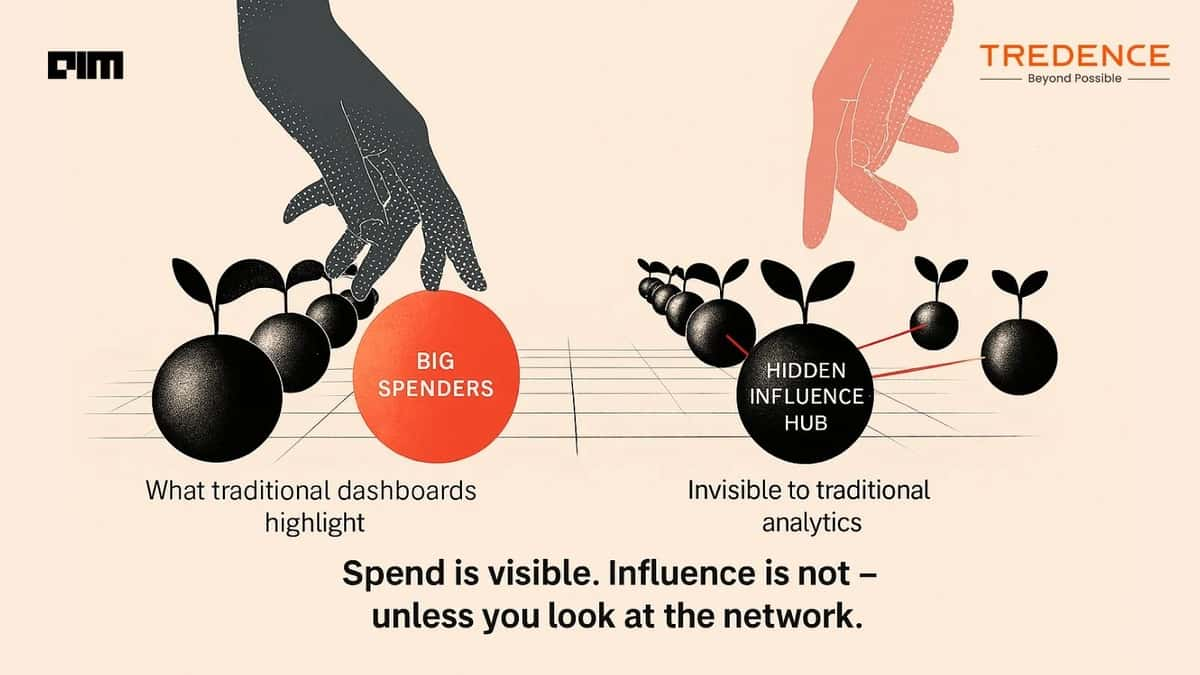
Companies are drowning in customer data, but may still be misreading value. The real drivers of revenue are often invisible, buried in relationships that traditional analytics cannot capture. As businesses double down on dashboards and spend metrics, they risk overlooking the customers who quietly hold entire revenue networks together.
Enterprises are not short of data. They are short of the right questions. That is the central argument from Arvind Ramachandran, Director of Data Engineering at Tredence, who has spent over 15 years working across enterprise data systems, cloud platforms, and large-scale modernisation projects.
Across industries, he sees the same pattern repeat. Companies invest heavily in analytics, build sophisticated dashboards, and yet fail to understand their customers in any meaningful way.
“The gap is not in terms of the volume of data because most enterprises have more than enough,” Ramachandran says. “It is, however, in how the data is structured and what questions it is capable of answering.”
At the core of that gap is a flawed assumption that has shaped enterprise analytics for decades: that customers behave as isolated units.
They don’t.
The Blind Spot: Customers are Networks, Not Rows
Traditional analytics systems are built to answer transactional questions, like who bought what, how often, and at what value. They do that well. But the moment the question shifts to relationships, the system breaks.
“Customers do not behave as independent units,” Ramachandran explains. “Their decisions are shaped by the people around them. And their loyalty rarely stays contained to just one relationship.”
This is where he says the “hidden influencer problem” emerges. It is a theme he expands on in his recent work on ontology-driven knowledge graphs.
Companies tend to equate value with spend. The highest spender is treated as the most important customer.
But that logic collapses in a networked world. Ramachandran offers a simple analogy. A customer who spends $100,000 will always rank higher than one who spends $20,000. But if the latter brings in 10 or 15 other customers, their actual impact on revenue is significantly larger.
“It’s not just about how much a particular person spends,” he says. “It’s rather about how much that person has an influence over the network.”
That influence rarely shows up in dashboards. It sits buried in relationships that traditional data models cannot represent.
Why Enterprises Keep Missing it
The failure is structural. Relational databases are designed to store and query records. They are not designed to capture influence, community behaviour, or network effects.
As Ramachandran puts it, “The moment the question becomes relational—for instance, who influences who, or how does the disengagement spread—those systems will not have any answer.”
The cost of this blind spot is not immediate. It builds quietly. When a high-spending customer churns, the loss is visible. When a network anchor leaves, the impact spreads gradually across connected customers.
“It shows up as a slow, diffuse erosion that takes quarters to fully materialise,” he says. By the time it becomes visible in revenue trends, the opportunity to act has already passed.
To fix this, Ramachandran argues for a different way of modelling customer data.
Instead of treating customers as isolated records, enterprises need to represent them as interconnected entities. This is where knowledge graphs and ontology come in.
A knowledge graph models data as a network. An ontology defines the meaning of relationships within that network. A knowledge graph represents data as a network of connected entities rather than isolated records. Ontology defines what those entities mean, how they relate to each other and what rules govern these relationships.
Together, they allow enterprises to move from descriptive analytics to relational intelligence. In a network-driven model, a customer’s worth is not limited to their own transactions. It includes the revenue they influence across their ecosystem.
That includes indirect revenue, group behaviour, and what Ramachandran calls “ecosystem value”.
A Case from Travel and Hospitality
The impact becomes clearer in practice. Ramachandran points to work in the travel and hospitality sector, where customer behaviour is inherently social.
A typical case involved a mid-tier customer. Moderate spending, average visit frequency, and nothing that would trigger attention in a traditional report. But when modelled within a knowledge graph, the picture changed.
This customer turned out to be one of the most connected nodes in the network. Their travel decisions consistently brought others along. Their satisfaction influenced an entire cluster of customers.
“The total network value associated with their ecosystem was a completely different order of magnitude from their individual spend,” Ramachandran says. More importantly, their engagement signals were declining. If that had gone unnoticed, the risk was not one customer churning. It was an entire revenue cluster.
One of the hardest parts of this shift is the mindset. Revenue teams are conditioned to prioritise top spenders. Changing that requires more than theory.
“The conversation rarely succeeds if you lead with methodology,” Ramachandran says. “They need to see the numbers.” The approach that works is to reconstruct a customer’s full economic footprint. Not just their transactions, but the downstream value linked to their network.
When that number is presented to decision-makers, the prioritisation logic begins to change. Customers who never appeared on priority lists suddenly emerge as critical assets.
Technology is Not the Bottleneck Anymore
What’s surprising is that infrastructure is no longer the main challenge.
Modern platforms like Snowflake and Databricks have evolved to support relationship modelling, graph computation, and semantic layers within a single environment.
“The technology is rarely the hardest part,” Ramachandran says.
The real challenge is upstream. Clean, unified, and identity-resolved data. Without that, any network model will fail.
The second critical layer is ontology design. Defining what constitutes a meaningful relationship requires domain expertise and iteration.
“It is not a one-time exercise,” he says. “But it is what determines whether the graph produces intelligence… or just a visually impressive network diagram.”
For enterprises considering this shift, the transition is less disruptive than expected. Customer-facing systems do not need to be redesigned. Loyalty programmes, tiers, and engagement models can remain intact.
What changes is the intelligence layer underneath.
“The same retention budget directed more precisely using network-driven value signals produces materially better outcomes,” Ramachandran says.
In practice, that means reallocating attention. Mid-tier customers with high network influence receive more focus. High spenders with low influence are still valued, but in proportion to their influence.
The broader shift here is about how enterprises think about data itself. For years, data platforms have been optimised for reporting. What Ramachandran is describing is closer to an intelligence layer.
“It’s going to be more of an intelligence layer we are building on top of the existing data, which could potentially help all the data scientists and data analysts to operate with enriched metrics,” he says.
- Hexaware Certified as Best Firm for Forward-Deployed Engineers by AIM
- Meet the Winners of AIM Chess League 2026
- Cypher 2026: AIM’s Best Firm Awards Spotlight 22 Companies Shaping India’s AI Workforce
- 2026 Minsky Awards for Excellence in AI Winners
- What Enterprise Vendors Need to Rethink About AI Agents
- The Industrialisation of Enterprise Intelligence