
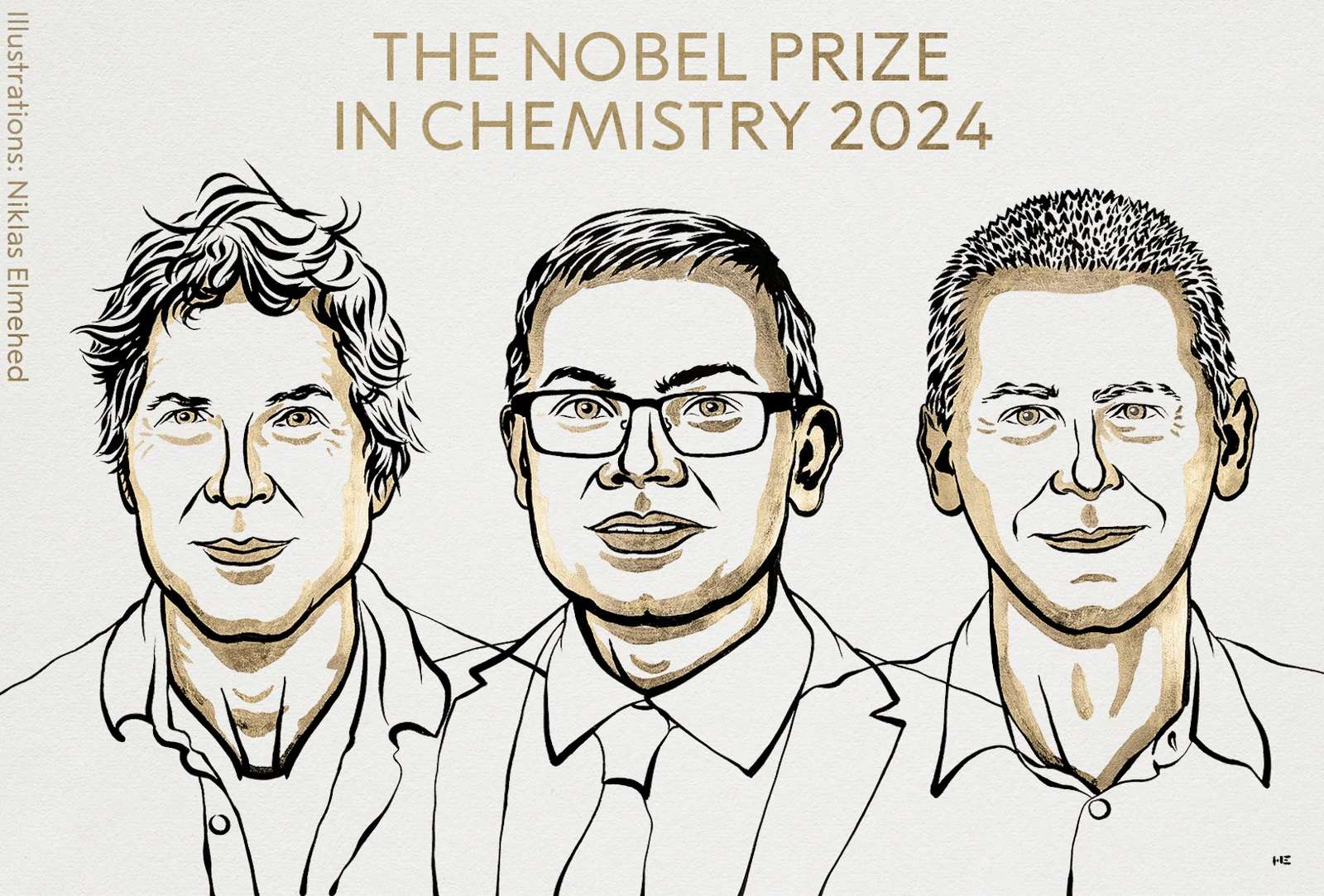
David Baker, an American biochemist and computational biologist, and Demis Hassabis and John M Jumper, two Google DeepMind scientists, have been awarded the Nobel Prize in Chemistry 2024 by The Royal Swedish Academy of Sciences.
Baker received the award for ‘computational protein design’ and the other two shared jointly by Hassabis and Jumper for ‘protein structure prediction.’ The latter two have successfully utilised AI to predict the structure of almost all known proteins. In 2020, Hassabis and Jumper presented an AI model called AlphaFold2.
With its help, researchers have predicted the structure of virtually all the 200 million proteins identified. Since their breakthrough, AlphaFold2 has been used by more than two million people from 190 countries. Researchers can now better understand antibiotic resistance among many scientific applications and create images of enzymes that can decompose plastic.
AlphaFold2 successfully predicts the three-dimensional structures of nearly all known proteins, approximately 200 million, overcoming a challenge that has perplexed scientists for over 50 years. Their work allows researchers to quickly access protein structures, significantly enhancing studies in areas such as antibiotic resistance and environmental sustainability.
Baker’s contribution lies in creating entirely new proteins through computational methods, enabling innovative applications in pharmaceuticals and green chemistry. His work allows researchers to design proteins from scratch, pushing the boundaries of biotechnology.
The synergy between AI advancements and computational design has opened unprecedented possibilities in the understanding of life’s building blocks, heralding a new era of biochemical research.
Recently, Geoffrey E. Hinton and John J. Hopfield were also awarded the Nobel Physics Prize 2024 in Physics by the Royal Swedish Academy of Sciences for pioneering advancements that form the basis of today’s ML world. Their work used principles of physics to develop neural networks.
- Coforge Revenue Rises 54% as AI Engineering and Deal Bookings Gain Momentum
- Tech Mahindra Partners With SpaceXSI to Bring AI Into Software Engineering
- Infosys AI Revenue Rises 29% in Q2, FY27 Growth Guidance Cut
- LTM Launches BlueVerse Industrial AI Lab in Chennai
- Chariot Launches Speech Recognition Model for 10 Indian Languages
- Meta Expects Up To $145 Billion In Capex As AI Investments Expand