Key takeaways
- Indus International School has introduced AI-powered robots to assist teachers and engage students in classrooms.
- The robots do not replace human teachers, but rather support them by answering questions and providing additional information.
- The collaborative learning model aims to integrate real-world applications of knowledge alongside traditional teaching methods.
- Students receive immediate evaluation of their tests through the robots, enhancing the learning experience.
- Development of the robots took two years, focusing on research and practical implementation for classroom use.
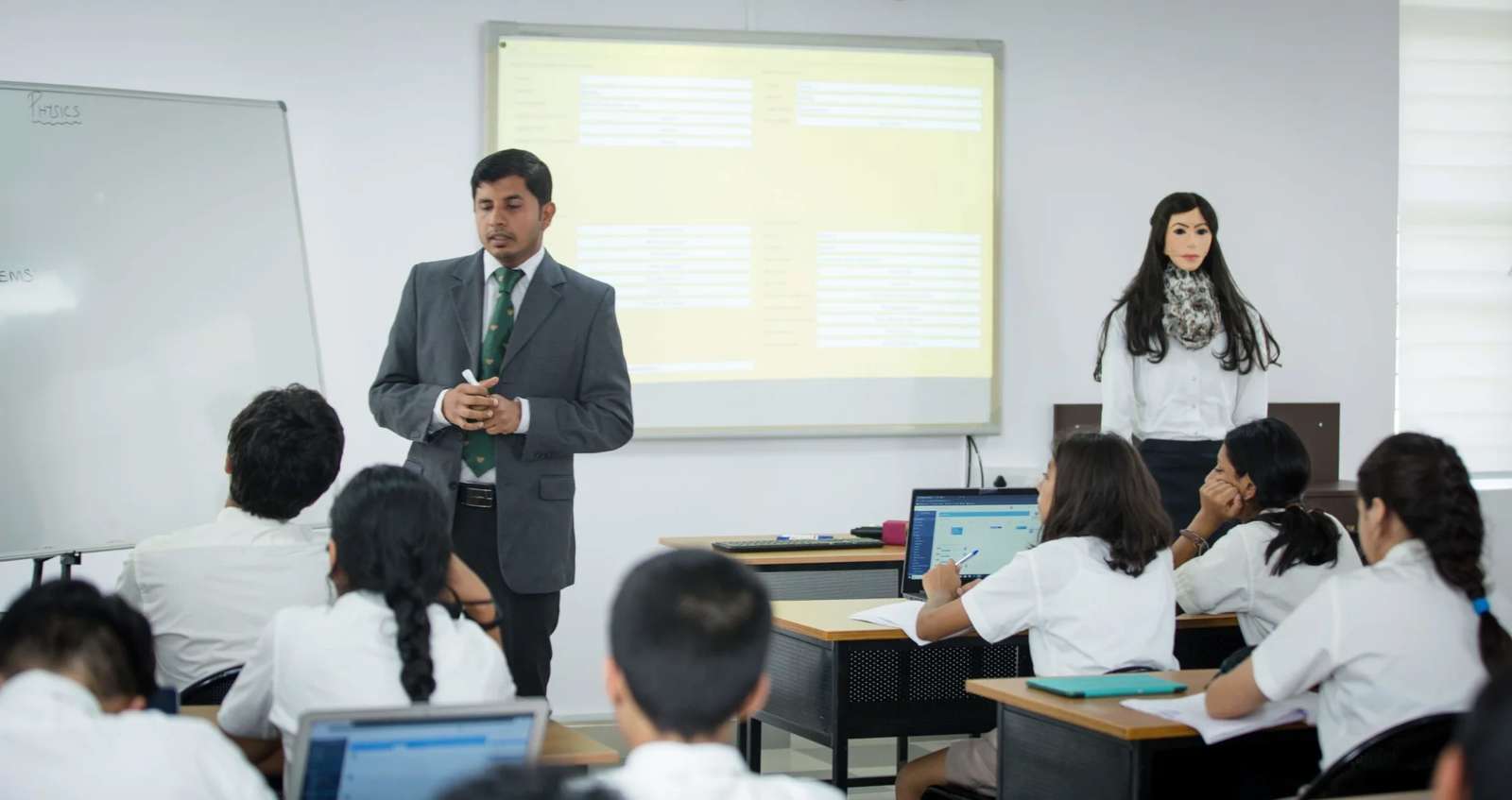
In an unprecedented event, Indus Internation School has deployed AI-powered robots -- Eagle, Eagle 1.0, Eagle 2.0 -- to teach in classrooms. However, they are not supposed to replace human-teachers. Rather, they will clear doubts of students and also assist teachers in providing extra information. “We have a collaborated learning model, where teachers, students, and robots indulge in classrooms to learn,” says Vignesh Rao, chief design officer at Indus International School.
Vignesh believes, teachers, delivering lessons straight from the textbook or that are already available on the internet. However, the leaning things are of no use until they are put to use. Thus, there is a need for implementing those learning into real-world use cases. Owing to this, robots can take the role of traditional teachers by delivering the lessons and human-teachers can assist students in implementing those learning to solve problems. A robot cannot motivate people to do something. This requires a human touch, thereby, teachers will always be a part of the classrooms.
In addition, robots will be answering students questions and vice-versa, thereby creating an engaging session in classes. Further, at the end of every lesson, students will receive a link on their laptops to take the test. This then gets evaluated immediately by robots, and the students know their marks.
Build by Vignesh and his team it took two years for them to develop robots with such dexterity. The first year was spent on the research and the next year to build it from scratch. However, these robots have started taking classes for students in VII, VIII, and IX. The school is further planning to expand the offerings and introduce the robots in primary classes. Currently, the robots can teach students in Physics, Chemistry, Biology, History, and Geography. And in the future, the development team will empower the robots to teach other subjects such as English and Mathematics.
Spotted an error? Tell our editors. Read our editorial standards and corrections.