Key takeaways
- Anthropic's AI model Claude significantly accelerated programming tasks for a robot dog during internal trials.
- Teams utilizing Claude completed tasks in half the time compared to those without AI assistance.
- Claude-enabled researchers made notable advancements towards achieving full autonomy for the robot dog.
- Access to Claude facilitated better navigation of conflicting information while connecting to robot sensors.
- The experiment highlighted AI's potential in bridging digital and physical task execution.
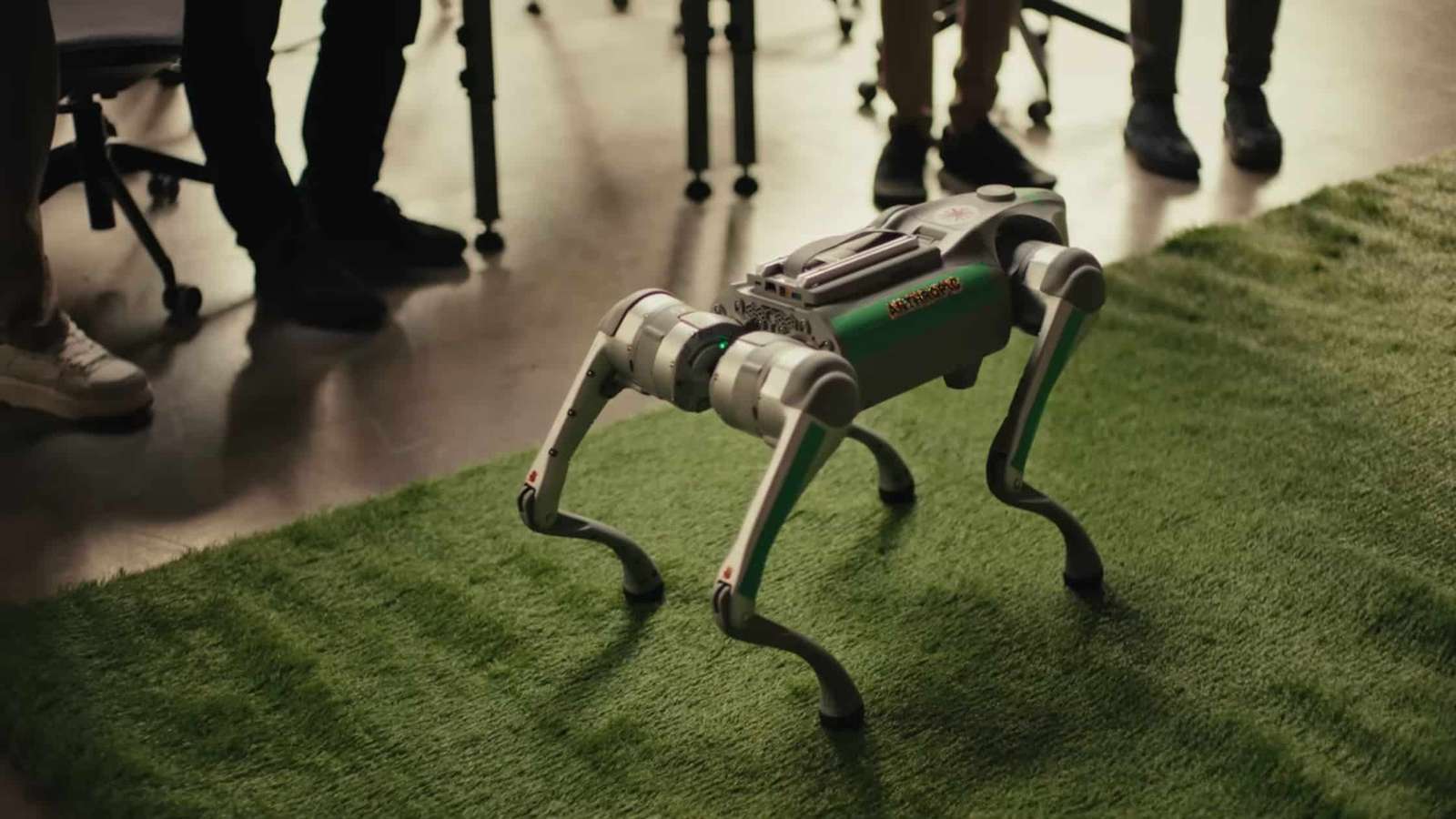
Anthropic tested how its AI model Claude could help non-experts operate a robot dog during an internal trial called Project Fetch. The company split eight researchers with no robotics background into two groups on a single day.
One team used Claude, while the other worked without it. Both groups were asked to program quadruped robots to fetch beach balls. Anthropic said the goal was to assess how AI could support tasks that bridge the digital and physical worlds.
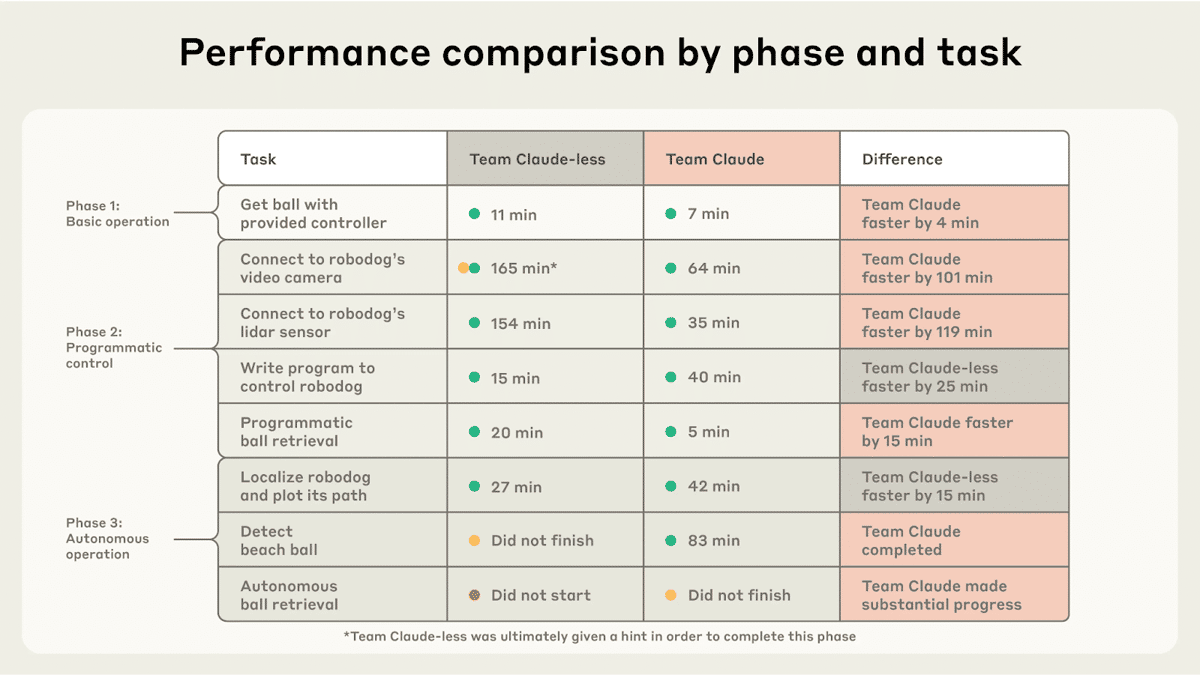
The team using Claude completed more tasks and worked faster. According to the company, “Team Claude succeeded in about half the time it took Team Claude-less.” Only the Claude-assisted team made significant progress towards full autonomy, where the robot detected and retrieved the ball without human steering.
The experiment involved three phases. First, both teams used the manufacturer’s controller to guide the robot. In the next phase, they had to connect their laptops to the robot, retrieve sensor data, and write software to control its movement. Anthropic noted that access to Claude “was most advantageous” in connecting to the robot and its onboard sensors, where the AI helped navigate conflicting online information.
The Claude-assisted team also wrote more code and explored several approaches in parallel. The company observed that this sometimes led to diversions, but it also widened experimentation.
During the final phase, the Claude-assisted team almost achieved autonomous ball retrieval. Their robot “could autonomously locate the beach ball, navigate towards it, and move it around,” but it fell short of grasping and returning the ball.
Anthropic analysed audio transcripts from the workspace. It reported that the Claude-less team showed more confusion and negative emotion. The group also asked more questions among themselves compared with the Claude team, whose members often partnered mainly with their AI assistants.
Researchers without Claude commented that working without the tool felt unusual, since they used it daily. Despite occasional frustrations, both teams managed to get the robots running. The experiment also surfaced real-world issues for AI systems, including a moment when a robot dog miscalculated its path and nearly collided with a table after being programmed to walk forward at speed.