

Anthropic, the company behind the Claude family of models, unveiled a report on Monday to showcase the impact of AI on how people work.
The report revealed that roughly 36% of all occupations use AI for at least a quarter of their associated tasks. Moreover, 57% of use cases involved leveraging AI to augment human capabilities, while 43% suggested automation. However, only 4% of occupations showcased AI usage for at least 75% of their tasks.
The study found that AI is used primarily for software development and technical writing tasks. Conversely, tasks involving physical manipulation of the environment use AI minimally.
“Computer and mathematical occupations show the highest associated AI usage rate, comprising 37.2% of all queries,” Anthropic said. Meanwhile, arts, design, entertainment, sports, and media comprise 10.3% of all the queries.
It was also found that AI usage peaked in the upper quartile of wages of jobs such as computer programmers and web developers. However, AI usage was quite low at both extreme ends of the spectrum. The report cited an example of lower AI usage among waiters and anesthesiologists – jobs which earn low and high wages, respectively.
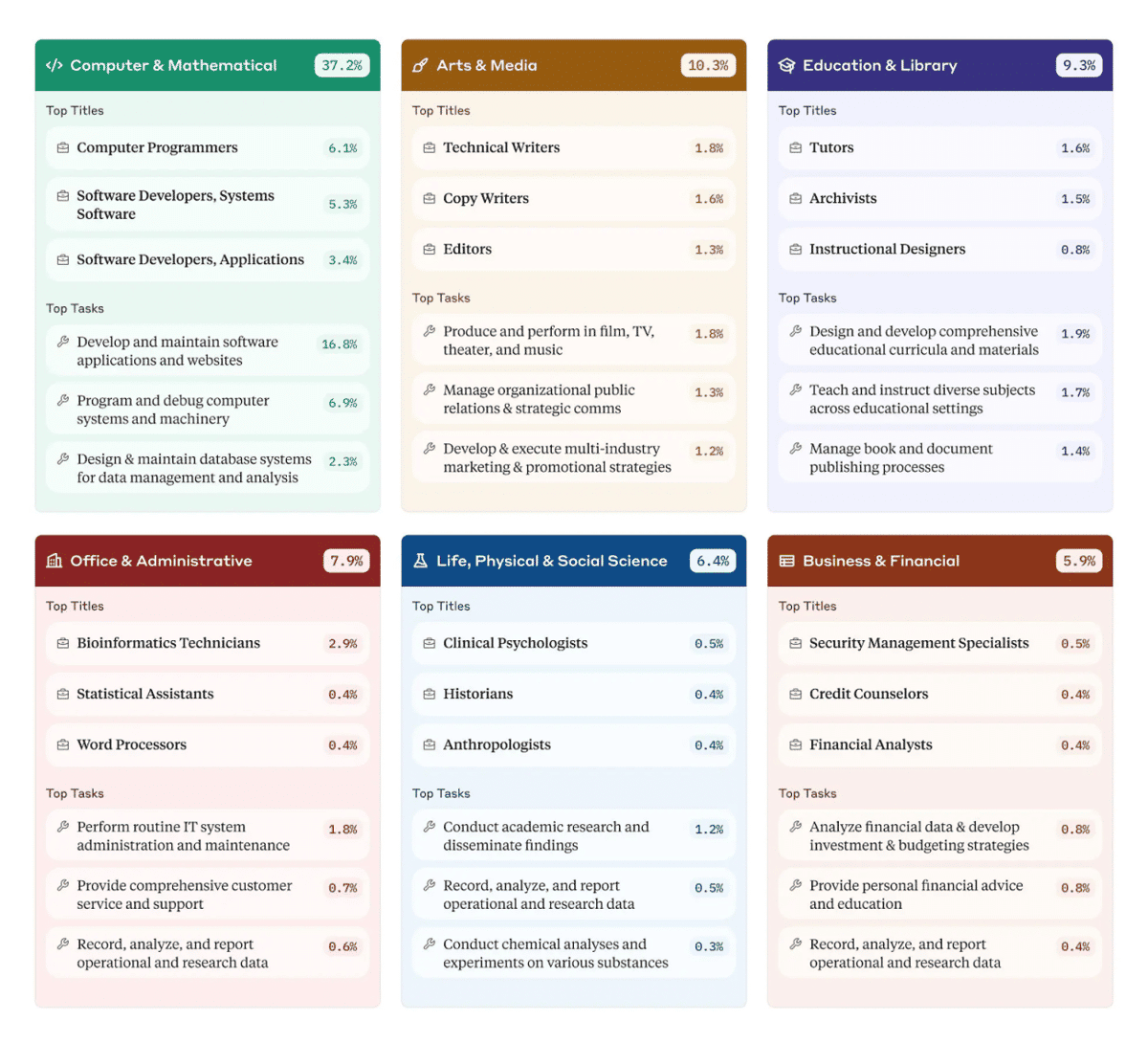
Source: Anthropic
The detailed report from Anthropic, which is packed with infographics, and a deep dive into their research methodology can be accessed from the following link.
The report analysed over four million Claude.ai conversations based on the tasks in the United States labour department’s O*NET database. Anthropic said mapping conversations to the database helped “identify not just current usage patterns but also early indicators of which parts of the economy may be most affected”.
The research methodology may seem advantageous because the company isn’t surveying people about how they use AI but is preparing a study based on direct data about how it is used.
That said, the study only focuses on a US-centric database, which, of course, does not account for the impact in other countries. Moreover, the study focuses on text-based AI interactions, excluding the usage of multi-modal AI, and demands an expansion of work given the advent of AI agents.
Overall, there have been plenty of developments in the last year or two regarding the intersection of AI and computer science or programming. Last year, Google revealed that over 25% of the code it writes is AI-generated.
AI-enabled coding products like Cursor, Windsurf, GitHub Copilot, and more such tools have observed tremendous growth. Recently, Cursor announced a $105 million Series B funding and also revealed that the startup exceeded $100 million in recurring revenue. Writing code with the help of AI also offers unprecedented ease in building products.
“LLMs [and] Cursor have made me more ambitious with programming. I now implement many more features. Things that I wouldn't have bothered to do because they would take too long, I now go ahead and do [them] because they take much less time,” said Navin Kabra, a visiting professor at IIT Bombay.
“Weeks reduces to days. Days reduce to hours,” he added.
- Coforge Introduces Autonomous Software Factory to Coordinate AI Agents
- SAP India Targets 2 Million People for AI Skilling by 2030
- Google Announces Gemini 4 Carbon With Focus on Cybersecurity and Coding
- Sarvam, Krutrim Account for 68% of Indic AI Funding as Sector Raises $687 Million: Tracxn
- Alphabet Revenue Jumps 25% as Google Cloud Doubles & Search Growth Slows
- ‘You’re Not Doing This AI Stuff,’ Databricks CEO Tells Snowflake