
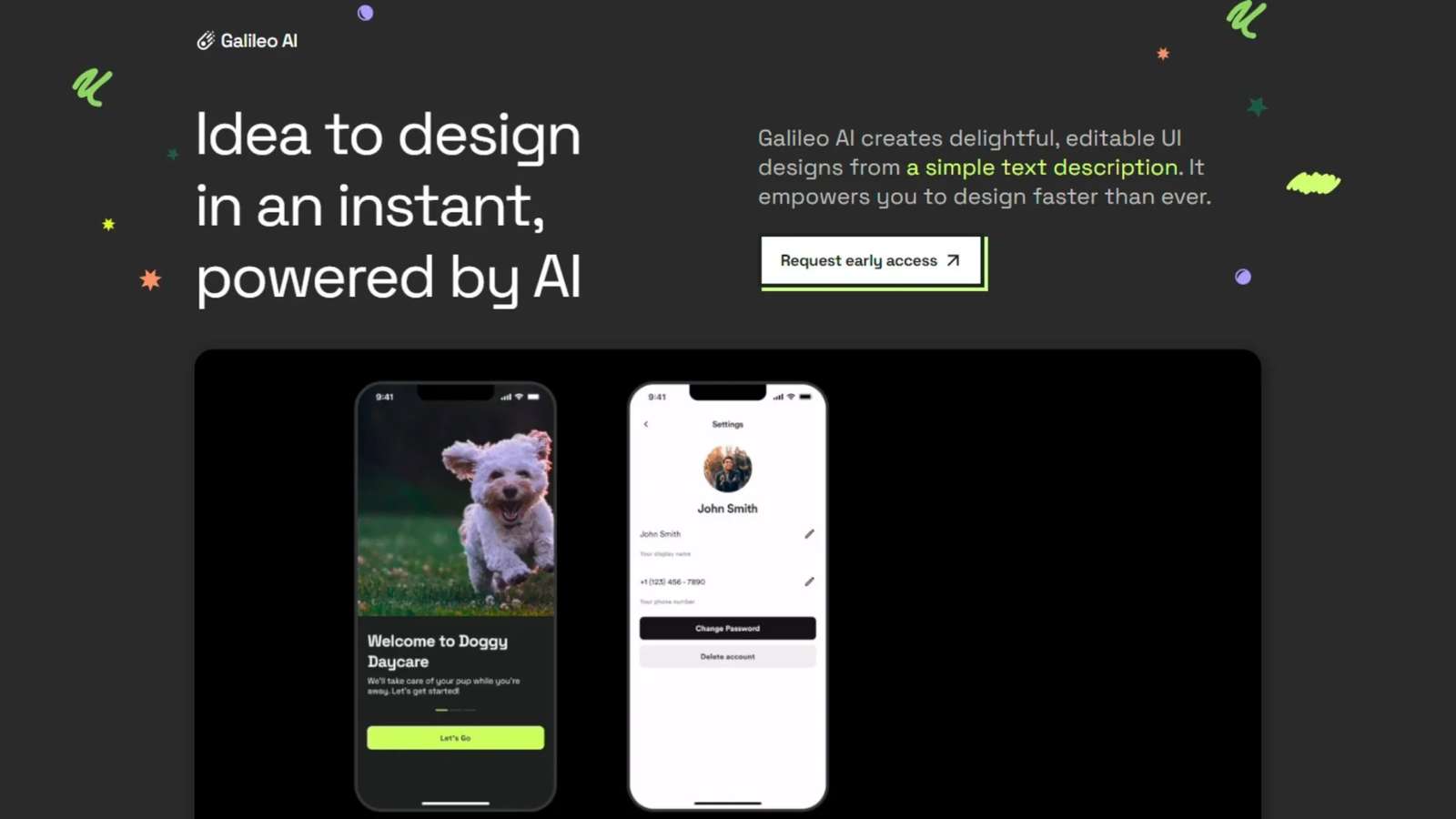
Former Google engineer Arnaud Benard and former Facebook product designer Helen Zhou have brought Generative AI to user interface design with Galileo AI, which employs natural language to generate UI designs.
Galileo AI aims to generate unique, completely editable UI designs from text input at a very high speed. It also has a host of curated AI-generated illustrations and images that you can add to your product.
“We had conversations with many designers, while they enjoy the challenge of problem-solving and storytelling, it comes with the tedious hours spent on repetitive UI patterns and mundane pixel-pushing,” said Bernard in his tweet.

Galileo AI is currently looking to add full-stack, frontend, and AI research engineering talents to join the team.
Register for the waitlist here.
Surge of Investments in Generative AI
In lieu of the success of LLM-based 'ChatGPT', several startups have also started experimenting with generative AI to build their own text-generation models. Due to this, venture capitalists have increased their investment in teams and firms that employ LLMs. However, there is a grey area between investors who may be making investments solely for profits or might be genuinely interested in the development of AI. The majority of VCs are following the footsteps of industry titans such as Khosla Ventures, which was the first to invest in OpenAI and is now receiving ongoing funding from Microsoft. Owing to the significant investments made by companies such as Sequoia Capital and Y Combinator in generative AI firms, every company today aspires to be recognised as them.
- Hexaware to Drive EBRD’s Banking Tech Ops for 5 Years
- LTM, ServiceNow to Expand Partnership to Scale AI Agent Deployments
- AI Productivity to Add $28 Billion to $84 Billion to India's GDP: Cognizant Study
- OpenAI's Codex Helps in Aerodynamic Engineering for Mazda
- Bengaluru Accounts for 34% of India's FDE Talent: Report
- 84% See AI Productivity Gains, but Only 10% Allow Agent Autonomy: TCS Study